
Paying AUD 2,500 twice hurts. The visa application charge is generally not refunded if you are refused. If you have already had a refusal, read our guide to Australia student visa refusal before you lodge again.
Why Australia’s International Education Success Should Be Protected, Not Priced Out — A Detailed Briefing for Universities, Colleges, and Industry Partners
By Vinay Hari
Founder & CEO, Angels Immigration & Education Consultant
Who Should Read This
This article is written for three audiences at once: the university and college international offices who plan intake around Australia’s changing fee and enrolment settings; the industry partners who counsel students through the application journey; and the students and families trying to make sense of what a AUD 2,500 visa fee actually means for their plans. Wherever confusion exists between these groups, I have tried to close it with verified numbers rather than assumptions.
For nearly two decades, I have counselled thousands of Indian students and families who dream of pursuing higher education overseas. Throughout that time, Australia has consistently been one of the most respected and trusted destinations for international education — and it remains one today. This piece is written in that spirit: as a constructive, evidence-based perspective, not a criticism of Australia’s sovereign right to set its own immigration policy.
Key Facts at a Glance
- The Student visa (Subclass 500) base application charge rose from AUD 2,000 to AUD 2,500 on 1 July 2026 — a 25 percent increase.
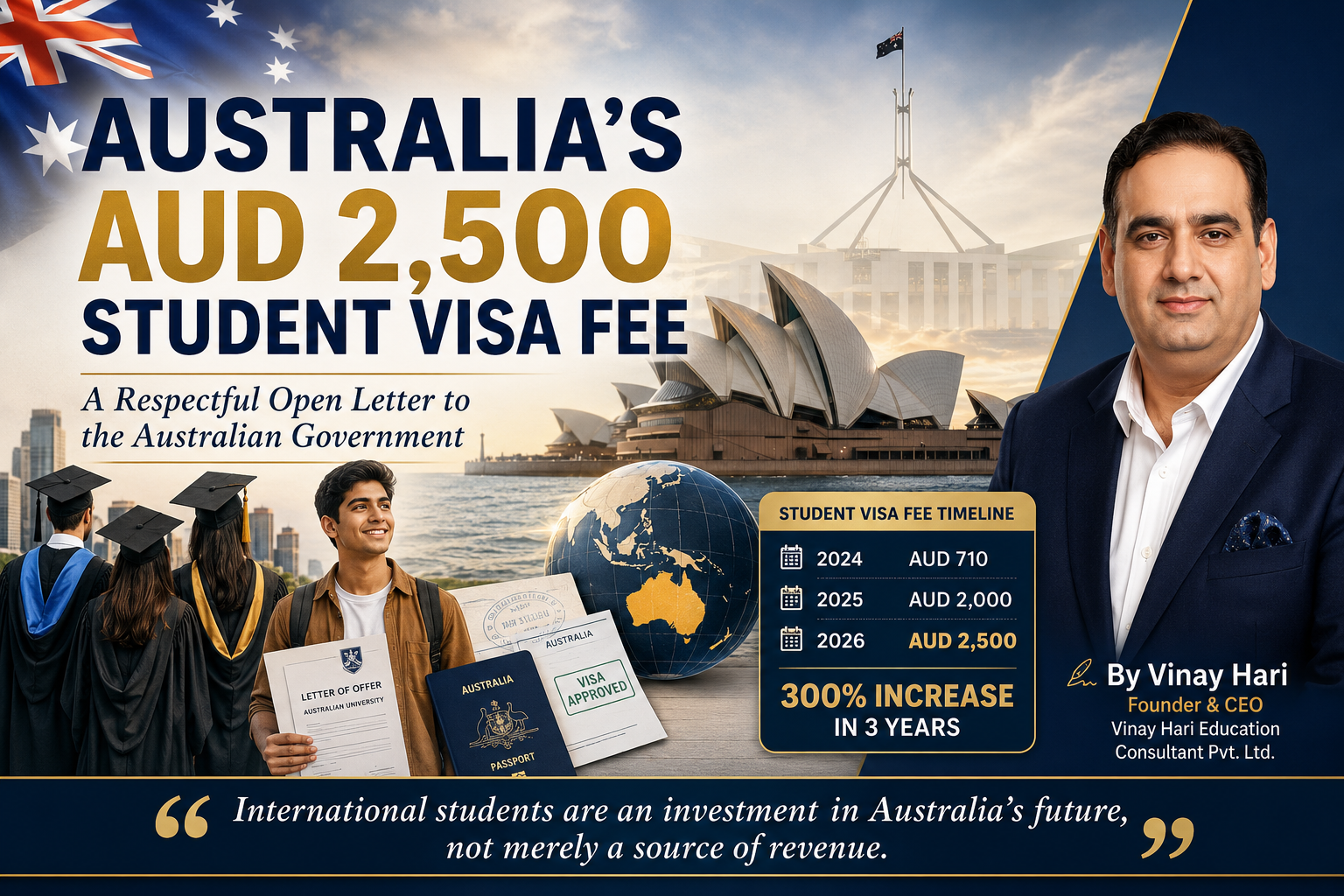
- Over three years, the same visa fee has moved from AUD 710 (to June 2024) → AUD 1,600 (July 2024) → AUD 2,000 (July 2025) → AUD 2,500 (July 2026) — more than tripling.
- The increase was enacted through the Home Affairs Legislation Amendment (2026 Measures No. 1) Regulations 2026, part of an economy-wide ~25 percent rise applied to the first instalment of most visa application charges — not a measure aimed at international education alone.
- The visa fee remains non-refundable if a visa application is unsuccessful.
- Australia’s 2026 National Planning Level allows for 295,000 international enrolments, up from 270,000 in 2025, though still below the post-pandemic peak.
- From 2026, students progressing into a public university from an Australian secondary school, pathway program, or TAFE are exempt from the national enrolment cap.
- International education contributed close to AUD 55 billion to the Australian economy in 2025.
- At AUD 2,500, Australia’s visa fee is now the highest of any major study destination — well above Canada, the United Kingdom, Ireland, and New Zealand.
The rest of this article unpacks each of these points, and what they mean in practice for institutions, industry partners, and the students both groups serve.
Australia Has Built One of the World’s Greatest Education Success Stories
International education is much more than an export industry. It is one of Australia’s greatest national achievements.
Each year, hundreds of thousands of international students choose Australia because of its world-class universities, high graduate employability, safe and multicultural society, strong research ecosystem, excellent quality of life, attractive post-study work opportunities, and a transparent immigration framework.
Indian students have proudly contributed to this success story for decades. Many have become doctors, nurses, engineers, researchers, entrepreneurs, educators, and business leaders who continue contributing to Australia’s economy and society long after graduation.
Australia’s education system has never competed solely on cost. It has competed on quality, opportunity, trust, and reputation. Nothing in this article questions that foundation. What it does question is whether the pace and presentation of recent fee increases are protecting that foundation as well as they could.
The Visa Fee Timeline: Three Years, Four Numbers
| Effective Date | Visa Fee (AUD) | Change from Previous |
|---|---|---|
| Until 30 June 2024 | $710 | — |
| From 1 July 2024 | $1,600 | +125% |
| From 1 July 2025 | $2,000 | +25% |
| From 1 July 2026 | $2,500 | +25% |
In three years, the Student visa fee has more than tripled — an increase of approximately 252 percent. Australia now charges the highest student visa fee among all major international education destinations.
It is worth noting, for accuracy, that the July 2026 increase was not an isolated decision about international students. It arrived as part of the Home Affairs Legislation Amendment (2026 Measures No. 1) Regulations 2026, which applied an approximate 25 percent increase to the first instalment of most visa application charges across the migration system — tourist visas, partner visas, skilled visas, and graduate visas included. The Student Guardian (Subclass 590) visa rose by the same amount, to $2,500, while the lower-cost English-language (ELICOS) and non-award student streams were held closer to flat, rising only to $2,050.
This context matters. It does not make the increase easier for a family to absorb, but it does mean international education was not singled out — it was swept up in a much broader, economy-wide recalibration of visa pricing. Institutions and industry partners fielding questions from concerned students are on solid ground explaining that this is a system-wide charge, not an education-specific penalty.
While governments are entitled to revise visa charges, this level of increase inevitably influences how students evaluate Australia compared with other countries — a point explored in more detail below.
Students Pay Much More Than a Visa Fee
The visa application charge represents only one component of studying abroad. Before receiving their visa, students and families already invest substantial amounts in:
- University tuition deposits
- Overseas Student Health Cover (OSHC) — typically AUD 500 to 650 per year for a single student
- IELTS or PTE examinations — typically AUD 300 to 400
- Medical examinations — typically AUD 300 to 500
- Biometrics collection — currently around AUD 45
- Police clearance certificates
- Airfare
- Accommodation deposits
- Living expenses
On top of these, applicants must now demonstrate access to at least AUD 29,710 to meet the 12-month living-cost financial capacity requirement that applies from January 2026 — a figure institutions should be quoting to prospective students alongside tuition, since it directly affects how affordable a course looks on paper once the full picture is visible.
For many middle-class Indian families, studying abroad represents years of financial planning and personal sacrifice. Every additional upfront cost increases the financial pressure before a student even begins their academic journey — and every cost that is not clearly communicated in advance becomes a source of confusion, frustration, or a withdrawn application later in the cycle.
The Financial Risk of a Non-Refundable Visa Fee
Another important issue is the non-refundable nature of Australia’s student visa fee. If a genuine student’s visa is refused, the entire visa application fee is generally lost. This means applicants may lose AUD 2,500 in addition to the other expenses already incurred during the application process — a materially larger loss than it would have been even two years ago, when the same mistake cost AUD 1,600, or three years ago, when it cost AUD 710.
Governments understandably incur costs in processing applications. However, from a student’s perspective, the financial consequence of an unsuccessful application has become considerably greater than it was only a few years ago. This raises the stakes for everyone involved in preparing an application: the student, the institution issuing the offer and Confirmation of Enrolment, and the counsellor assembling the supporting evidence. A weak or rushed application is now a far more expensive mistake than it used to be, for every party in the chain. For a closer look at how refusals actually happen and how they can be prevented, see our detailed guide on student visa refusals for Punjabi students.
A Balanced Alternative Could Benefit Everyone
Rather than requiring the full visa fee at lodgement, Australia could consider a staged payment model. For example:
- AUD 1,000 payable when lodging the application
- The remaining AUD 1,500 payable after visa approval, or immediately before visa grant
To be clear, this is not current policy — it is a recommendation, and institutions and industry partners should not represent it to students as an existing option. But such a model could recover government processing costs, reduce financial losses for unsuccessful applicants, increase confidence among genuine students, and demonstrate fairness while maintaining immigration integrity. Many industries already use milestone-based payment structures that balance administrative costs with consumer protection. A similar approach could strengthen confidence in Australia’s student visa system without costing the government meaningful revenue, since genuine applicants who are eventually granted a visa would still pay the full charge in the end.
Clearing the Confusion: A Direct Briefing for Universities and Colleges
Institutions are not just watching a fee change — they are managing it alongside a separate but related policy: Australia’s enrolment planning system. The two are frequently conflated in conversation, so it is worth separating them clearly.
The fee change and the enrolment cap are two different levers. The AUD 2,500 visa fee affects what a student pays. The National Planning Level affects how many students an institution may enrol. For 2026, the National Planning Level is 295,000 international enrolments, an increase of 25,000 places on the 2025 level of 270,000 — though still roughly 8 percent below the post-pandemic peak. Institutions should plan intake against the National Planning Level and communicate cost against the fee schedule; treating them as a single combined constraint tends to create unnecessary internal confusion during intake planning.
Growth allocations are conditional, not automatic. Public universities seeking to increase their individual 2026 allocation above their base level need to demonstrate progress against two specific government priorities: increased engagement with Southeast Asia, and the provision of student accommodation for domestic and international students. For institutions whose growth strategy is concentrated on the Indian market specifically, it is worth flagging that “Southeast Asia” and “South Asia” are distinct categories in this framework — a strong India pipeline does not, on its own, satisfy the Southeast Asia engagement criterion. Institutions should confirm directly with their own regulatory-affairs teams how their specific enrolment mix is assessed rather than assuming a strong India pipeline covers both categories.
A meaningful exemption now exists. From 2026, students who progress into a public university from an Australian secondary school, an approved pathway program, or TAFE (Technical and Further Education) are exempt from the national enrolment cap. This is a significant, practical detail for colleges and pathway providers with transition arrangements into university partners, and it deserves to be built into intake modelling and marketing conversations with prospective families, many of whom are currently unaware this exemption exists.
The fee increase is not retrospective. It applies to applications lodged from 1 July 2026 onward. Institutions fielding questions from students who lodged earlier can confirm the earlier fee stands for that application.
Non-refundability changes the cost of a weak application on your side of the desk too. A visa refusal after a Confirmation of Enrolment has been issued creates cost and disruption for the institution as well as the student — deferred intake, revised commencement dates, and, at scale, volatility in semester-by-semester revenue forecasting. Institutions have a direct interest in working only with counselling partners who prepare complete, evidence-backed, genuine applications the first time, precisely because the financial and administrative cost of a refusal has risen for everyone in the chain, not just the applicant.
Communicate full cost, not headline cost. Prospective students frequently anchor on tuition fees and are genuinely unaware of the compounding cost of the visa fee, OSHC, examinations, medical checks, and the AUD 29,710 living-cost requirement until late in the process. Institutions that proactively itemise this full cost of attendance — rather than leaving students to discover it fee by fee — will see fewer late withdrawals and a more realistic, better-prepared applicant pool.
Clearing the Confusion: A Direct Briefing for Industry Partners
Counsellors and consultants sit closest to the student, and the rising financial stakes of this fee trajectory raise the bar for how that role should be carried out.
Be precise about what is policy and what is a recommendation. The staged-payment model discussed above is not current policy. Presenting proposals as though they are already in effect — even with good intentions — creates confusion that reflects poorly on the entire industry when a student discovers otherwise partway through an application.
Treat the non-refundable visa fee as the headline risk-management issue it now is. At AUD 2,500 per application, a preventable refusal is a serious financial loss, not a minor inconvenience. Every application should be built to the strongest possible evidentiary standard before lodgement, not repaired after a refusal has already occurred.
Quote the full cost of compliance, every time. A responsible counselling conversation now includes the visa fee, OSHC, examination fees, medical costs, biometrics, and the AUD 29,710 living-cost threshold — not the tuition fee alone. Students and parents who hear the full number early make better-informed decisions and are far less likely to withdraw applications midway through the cycle.
Avoid any framing that implies a guaranteed outcome. No visa outcome, job outcome, or migration outcome can ever be promised. As fees rise, the temptation to oversell certainty in order to justify the cost to a family only grows — and it should be resisted more firmly, not less.
Raising the professional bar protects institutional relationships, not just individual students. Universities and colleges are, understandably, becoming more selective about which counselling partners they work with as the cost of a bad application rises for everyone. Ethical, transparent, evidence-first counselling is no longer just good practice — it is what keeps an industry partner trusted by institutions in the first place.
Australia and India Share a Strategic Partnership
Australia and India are no longer connected only through education. Today the partnership includes trade, technology, healthcare, defence, research, innovation, and skills development. India has become one of Australia’s largest and most important international student markets, and thousands of Indian graduates contribute to Australia’s workforce every year.
Recognising this close partnership, Australia could explore additional initiatives that support genuine students while maintaining strong immigration standards, including faster processing for low-risk applicants, trusted institution pathways, better communication before major policy changes, and flexible payment options for the visa fee. Such reforms would strengthen Australia’s relationship with one of its most important strategic partners, and give institutions and industry partners on both sides more predictability to plan around.
International Students Are an Investment, Not Simply Revenue
International education contributed close to AUD 55 billion to the Australian economy in 2025, and remains one of the country’s largest service exports. Yet its real contribution extends far beyond economics.
International students become future nurses, engineers, scientists, researchers, technology specialists, entrepreneurs, business leaders, and skilled workers addressing labour shortages. They strengthen Australia’s economy, research capability, workforce, innovation, and international relationships.
Every major education destination understands that attracting talented students is an investment in future national capability. The long-term value of an international student extends well beyond the initial visa fee — a point that gets lost when fee policy is discussed purely in terms of in-year revenue.
Australia Risks Losing Its Competitive Advantage
The latest visa fee increase comes at a time when global competition for talented students is becoming increasingly intense. The comparison is stark when placed side by side:
| Destination | Approximate Student Visa Cost |
|---|---|
| Australia | AUD 2,500 |
| New Zealand | NZD 850 (≈ AUD 780) |
| United Kingdom | £524 (≈ AUD 1,050) |
| Canada | CAD 235 total, including biometrics (≈ AUD 260) |
| Ireland | €60–100 (≈ AUD 100–170) |
(Approximate AUD equivalents; exchange rates fluctuate and these conversions are indicative only.)
Australia’s greatest competitive advantage has always been the quality of its education. However, Australia is increasingly becoming the most expensive destination simply to submit a student visa application — several multiples above its closest competitors.
The pressure is not limited to the study visa itself. The Temporary Graduate (Subclass 485) visa — the post-study work visa that is one of Australia’s strongest selling points for Indian students — rose from AUD 2,300 to AUD 4,600 in March 2026, then to AUD 5,750 from 1 July 2026: a rise of exactly 150 percent within a matter of months. For a market where post-study work rights are consistently one of the top factors in a student’s decision-making, this compounds the effect of the study visa fee increase rather than offsetting it. For more on eligibility and how this pathway works in practice, see our guide to the Australia Graduate Program.
Cost may not be the only factor influencing students. But it is certainly one of them, and at present it is moving in one direction only.
Was the Fee Increase Communicated With Enough Notice?
Another issue deserving discussion is the transparency surrounding the recent increase. The Home Affairs Legislation Amendment (2026 Measures No. 1) Regulations 2026 introduced the 25 percent increase across most visa application charges, with the regulations registered only shortly before they commenced on 1 July 2026.
For students who plan their education one or two years in advance, and for institutions building intake forecasts on similarly long horizons, such short notice creates avoidable uncertainty. Clear communication well ahead of a major charge increase allows families and institutions to prepare responsibly. Policy certainty has always been one of Australia’s strengths, and maintaining that certainty — even around measures the government is fully entitled to make — benefits everyone downstream of the decision.
A Short-Term Revenue Gain Could Become a Long-Term Strategic Cost
From a fiscal perspective, increasing visa application charges is an efficient way of generating additional government revenue: charges collected from students and their dependants brought in approximately AUD 735 million in 2025, up from around AUD 244 million in 2018, and the current round of Student visa fee increases alone is estimated to add a further AUD 740 million in government receipts over the four years to 2028–29.
Many applicants who have already committed to studying in Australia are unlikely to abandon their plans because of one additional fee increase. In the short term, higher charges may therefore produce higher revenue with only limited immediate impact on application numbers.
However, long-term public policy should be assessed not only by immediate revenue but by its impact on Australia’s future competitiveness. Tomorrow’s applicants have choices. Before deciding where to study, students compare total education cost, visa fees, immigration policies, processing times, graduate employment opportunities, pathways to permanent residence, and policy stability. If Australia becomes consistently more expensive while competing destinations improve affordability and predictability, future students may simply choose another country before beginning their application journey at all.
Competitiveness Is Built on Trust
Australia’s international education success has been built over decades. Its reputation rests upon quality education, stable institutions, transparent governance, predictable immigration policies, and strong graduate outcomes.
Policy stability is itself a competitive advantage. Students making one of the biggest financial decisions of their lives seek confidence that immigration settings will remain consistent throughout their education journey. Frequent policy changes and a rapidly increasing visa fee create uncertainty that may influence future decision-making, even when each individual change is defensible on its own terms.
Students Compare Entire Countries, Not Just Universities
Today’s international students evaluate much more than university rankings. They compare entire destinations. A student considering Australia is often simultaneously comparing opportunities in Canada, the United Kingdom, Ireland, and New Zealand, weighing tuition fees, living expenses, the visa fee, graduate work rights, immigration pathways, career opportunities, and overall return on investment.
Every additional financial barrier, including the visa fee itself, becomes another consideration during that decision. Institutions marketing Australia as a destination are, whether they intend to or not, now competing on cost as well as quality, and should plan their messaging accordingly rather than relying solely on reputation to carry the comparison.
Protecting Australia’s Reputation
Australia’s reputation has taken decades to build. It should never be taken for granted — reputation is difficult to establish but much easier to lose.
If highly talented students increasingly perceive Australia as becoming more expensive and less predictable than competing destinations, they may redirect their ambitions elsewhere. The consequence is not simply fewer student enrolments. Australia risks losing future doctors, nurses, engineers, researchers, entrepreneurs, technology specialists, and skilled workers — precisely the people Australia will continue needing in the decades ahead.
Supporting Genuine Students Strengthens Australia’s Future
Australia must continue protecting the integrity of its migration system. Preventing fraud and ensuring genuine student applications remain essential objectives. However, policies should also encourage genuine students rather than unintentionally discourage them through rising financial barriers.
Balanced reforms could include a staged visa payment model, earlier consultation with universities, colleges, and industry stakeholders before major changes are finalised, clearer communication timelines, streamlined visa fee arrangements for low-risk applicants, and continued collaboration with strategic education partners such as India. These reforms would strengthen both immigration integrity and Australia’s international competitiveness at the same time — they are not competing objectives.
An Invitation to Dialogue
Over nearly two decades of placing genuine students with Australian institutions, I have watched policy shifts of this scale ripple through admissions offices, industry networks, and family living rooms in Punjab and Haryana simultaneously, often within the same week. What looks like a single line item in a federal budget becomes, on the ground, hundreds of individual conversations about whether a family’s plans are still realistic.
I welcome the opportunity to share that ground-level perspective with any university, college, or industry stakeholder seeking to understand how policy changes like this one are actually being received by prospective students and their families in India. Constructive dialogue between origin-country counsellors and destination-country institutions has rarely been more necessary than it is right now, and I would rather be part of that conversation than simply comment on it from a distance.
Final Thoughts
Australia has earned its place as one of the world’s leading education destinations through excellence, innovation, openness, and global engagement. The increase of the Student visa (Subclass 500) visa fee to AUD 2,500 is more than a financial adjustment. It sends a message to prospective students, and to the institutions and partners who serve them, about the accessibility and affordability of one of the world’s finest education systems.
As someone who has spent nearly twenty years advising students, I respectfully believe there is an opportunity to reconsider how future policy changes are introduced and communicated. The objective should not simply be to increase revenue. The objective should be to ensure Australia remains one of the world’s most attractive destinations for talented international students.
The brightest minds do not simply contribute tuition fees. They become Australia’s future nurses, engineers, scientists, entrepreneurs, researchers, innovators, taxpayers, and global ambassadors. Investing in genuine international students is ultimately an investment in Australia’s own future prosperity.
About the Author
Vinay Hari is the Founder & CEO of Angels Immigration & Education Consultant, India. With more than 18 years of experience in international education and immigration consulting, he has guided thousands of students towards higher education opportunities in Australia, Canada, New Zealand, the United Kingdom, Europe, and other leading destinations. He advocates ethical counselling, transparent immigration practices, and evidence-based policy discussion that strengthens international education for students, institutions, and governments alike.
Universities, colleges, and industry stakeholders are welcome to reach out directly to discuss any of the points raised in this article.
Email: me@vinayhari.com
Phone: 9513165527 / 7307530886
Offices: 505, Sector 82, Mohali, Punjab | BMC Chowk, Jalandhar, Punjab