
A note before you read: this is an analysis piece, not investigative journalism. Every statistic below is sourced to a government, regulator, or news report — links are at the end. Where a claim is opinion rather than documented fact, it’s marked as such. Read it, check the sources yourself, and tell me where you disagree in the comments.
Australia student visa policy has changed more in the last three years than in the previous twenty. To understand today’s crisis, we have to go back almost 25 years — and this time, with the numbers on the table.

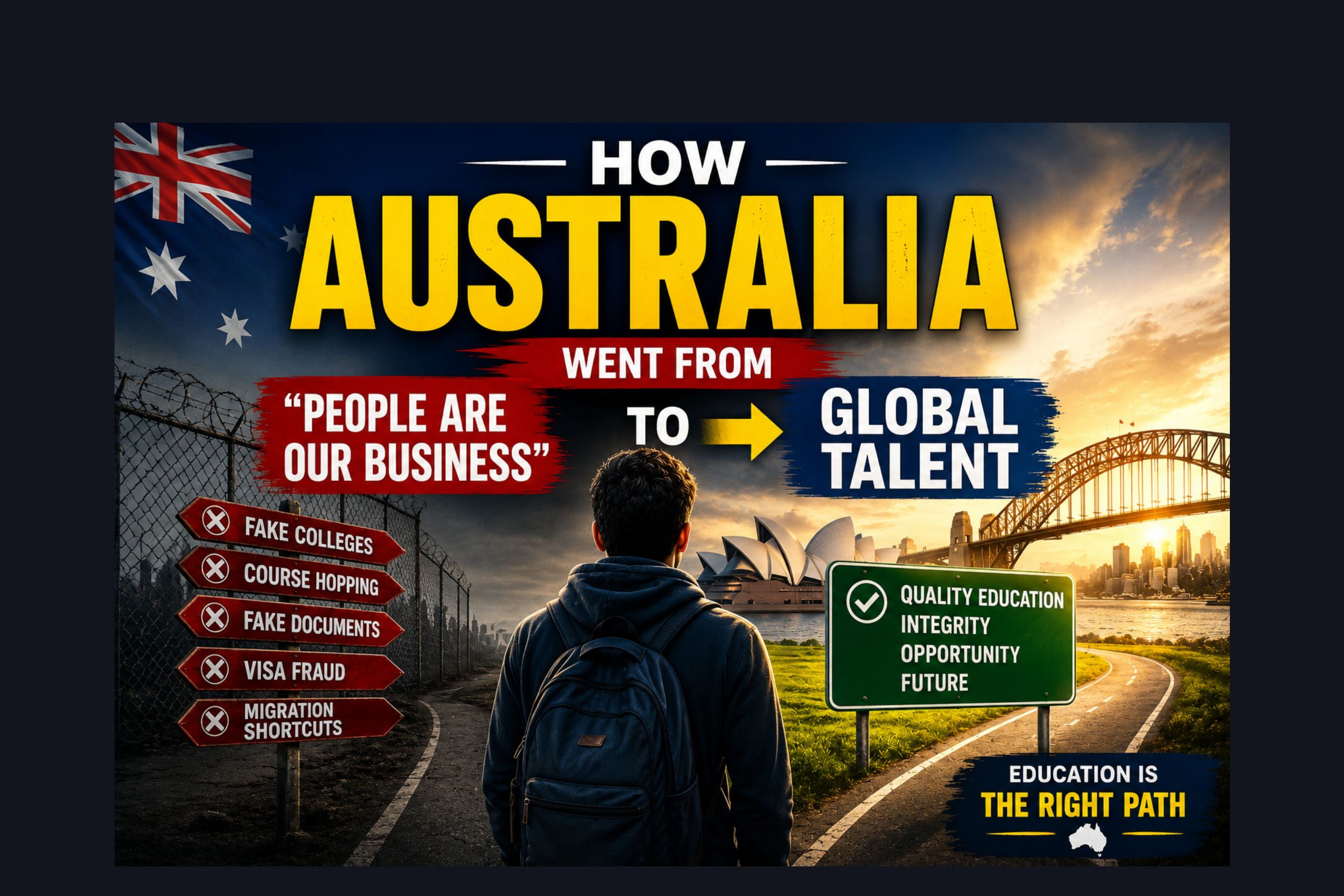
Correcting the Record on “People Our Business”
Anyone researching the Australia student visa system may have heard that Australia’s immigration department once ran on a slogan called “People Our Business.” That part is true. What isn’t quite accurate is why it existed.
The phrase became the Department of Immigration’s slogan in 2005, following an agency-wide culture and systems overhaul. That overhaul wasn’t triggered by a desire to grow migrant numbers — it followed two of the most damaging scandals in the department’s history: the wrongful detention of Australian citizen Cornelia Rau and the wrongful deportation of Vivian Alvarez Solon. The department spent roughly $26,797 putting the slogan on mugs, banners, screensavers and even a jigsaw puzzle, as a reminder to staff that immigration decisions affect real people.
The slogan stayed in use until 2013, when the department merged with Australian Customs and Border Protection and the phrase was retired.
So “People Our Business” was really about accountability and fair casework after a human-rights failure — not a marketing line for attracting migrants. It’s a good symbol for how immigration policy tries to balance system integrity with human dignity, but it wasn’t born from an “Australia wants migrants” mindset. Worth knowing before it gets repeated as a talking point.
What is true is that the early-to-mid 2000s were a period of rapid growth for Australia’s international education sector, driven by genuine labour shortages and an ageing workforce — and that growth is where today’s story really starts.
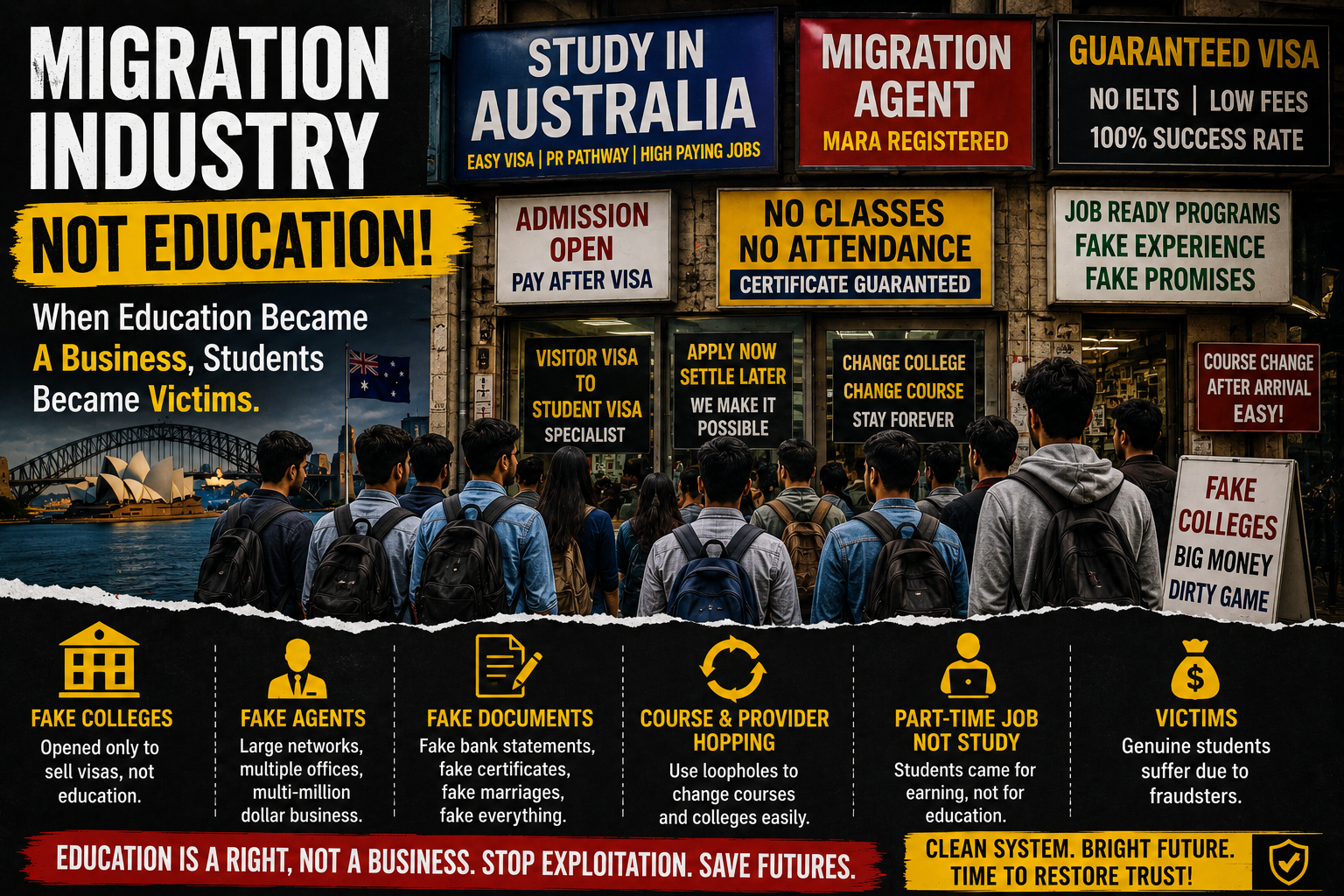
When Education Became a Migration Industry
Australia’s international education sector didn’t just grow — it became one of the country’s biggest export industries. In the 2024–25 financial year, it generated $53.6 billion in export income, according to the Department of Education. That’s up from $51.5 billion in the 2024 calendar year and $46.9 billion in 2023 — a 43% increase over the pre-pandemic 2018–19 peak. Education is now Australia’s fourth-largest export category, behind only iron ore, coal and natural gas.
More than 833,000 international students were in Australia between January and October 2025 alone — a 70% jump from the post-pandemic low in 2022.
Growth at that scale, across thousands of providers, inevitably attracted more than just genuine students. The Nixon Review — a government-commissioned investigation completed in March 2023 by Christine Nixon AO APM, former Chief Commissioner of Victoria Police — found that some education providers and their agents were exploiting the visa system, with a particular concentration of “non-genuine student” cases in the private Vocational Education and Training (VET) sector, where low fees and short course durations created a direct financial incentive to enrol people who had no real intention of studying.
This is a documented government finding, not speculation — you can read the review yourself (linked below).
The Business of Migration
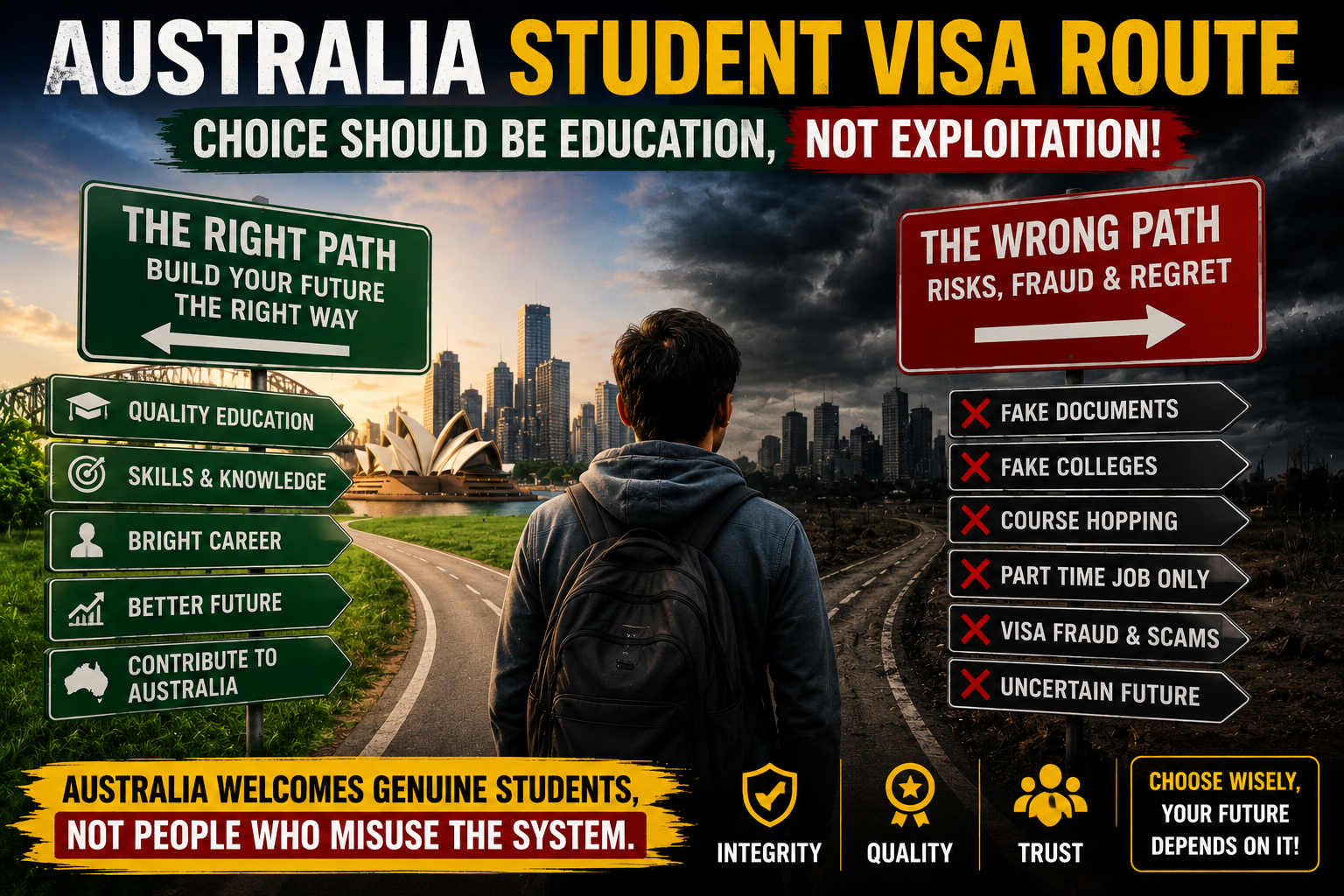
Migration itself isn’t the problem. The problem is what happens when the Australia student visa system becomes a business built around exploiting loopholes — and on that front, the data backs up what a lot of people in this industry have said privately for years.
Education agent regulation has a real gap. Registered migration agents in Australia are regulated by OMARA (the Office of the Migration Agents Registration Authority), which sanctioned 14 agents in the 2024 financial year alone — bringing the total sanctioned since 2021–22 to 61. Five were permanently barred for dishonesty or submitting false information; two had registrations cancelled for false declarations; five were suspended for negligence or breach of client trust. But here’s the gap: education agents are not required to register with OMARA at all, unless they’re also giving formal immigration advice. The onus of policing them falls on the education provider they represent — a system the Nixon Review specifically flagged as needing reform.
The government has since moved to close some of this gap: amendments to the Education Services for Overseas Students Act 2000 now ban cross-ownership between education providers and the agents who recruit for them, precisely to remove the incentive structure the Review identified.
By the Numbers: What the Data Actually Shows
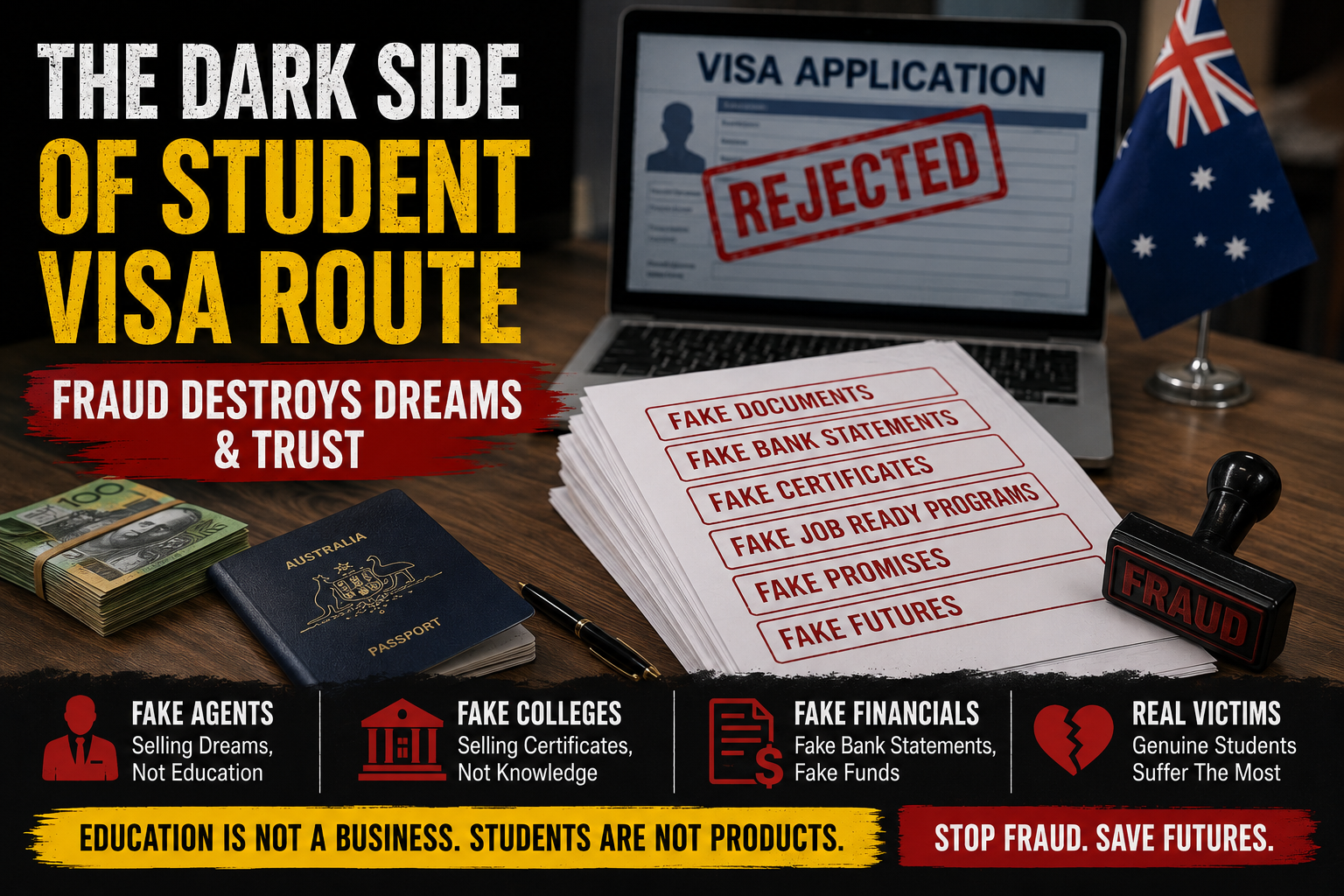
Australia student visa data is where this stops being anecdotal. Here’s what’s actually documented:
Visa refusal rates spiked sharply for Indian applicants. Offshore higher education visa approval rates for Indian applicants fell from 74.2% in 2022–23 to 60.8% in the second half of 2023 — the lowest level since 2005–06, according to Department of Home Affairs data reported by SBS News. Different visa subclasses and reporting periods show different numbers (some reports cite refusal rates near 50% for certain categories in 2023), which is itself a sign of how volatile and provider-dependent this period was.
The “ghost college” crackdown is real, large, and ongoing. Starting in August 2024, the Australian Skills Quality Authority (ASQA) shut down 150 dormant CRICOS-registered providers and issued warning notices to another 140. As of the latest reporting, ASQA has made 63 sanction decisions against providers (52 registration cancellations or renewal rejections, 11 suspensions) and is actively investigating 210 “serious matters” across 145 providers, some involving allegations of fraud and visa/migration risk. The scale of the cleanup has escalated fast: roughly 21,000 qualifications were voided by April 2025, over 25,000 by September 2025, and more than 30,000 by mid-November 2025 — affecting an estimated 26,000 people.
Important caveat, in the interest of fairness: this crackdown has not been clean. Independent reporting found the “ghost college” list mistakenly swept up legitimate organisations, including Ausgrid, the Alzheimer’s Association of Queensland, the Australian Medical Association, the Australian College of Nursing, a dozen schools, and the University of the South Pacific. That’s a real regulatory failure in its own right, and it’s a fair reason for students and agents to be frustrated with how the crackdown has been executed — even while agreeing that a crackdown was needed.
International student caps are now hard policy, not just rhetoric. The government capped new international student places at 270,000 for 2025, rising to 295,000 for 2026. Universities where international students make up more than 37% of enrolment can keep only half of any further growth — a rule that hits Australia’s most prestigious institutions hardest, forcing Group of Eight universities like Sydney, Melbourne, Queensland and ANU to cut commencing intakes below 2023–24 levels.
One genuinely under-reported nuance: in March 2024, Australia replaced the old “Genuine Temporary Entrant” (GTE) test with a new “Genuine Student” (GS) requirement. This wasn’t purely a tightening — the GS test explicitly states that wanting to eventually apply for permanent residency does not count against an applicant, as long as study is the primary purpose. In some ways, it’s more honest about the reality that most students hope to build a life where they study, rather than pretending otherwise. The crackdown and this liberalisation happened almost simultaneously, which tells you the government’s real target was never “students who want to stay” — it was fraud and non-attendance.
Australia Knew the Risks in the Australia Student Visa System
Australia’s immigration system is highly digital — visa applications, provider enrolments, attendance records, provider transfers, and immigration histories are all monitored through connected government systems. The patterns behind the Nixon Review and the ghost college crackdown didn’t emerge overnight; they were visible in the data for years before enforcement caught up. Critics of the government’s timeline have a fair point: the mechanisms to detect this existed well before the 2023–2025 crackdown began.
The Shift Toward “Global Talent”
Today’s Australia student visa messaging from officials is markedly different from the “let’s grow the numbers” era. The current framing — genuine students, global talent, research capacity, sustainable migration — reflects a policy goal that has shifted from maximising enrolments to maximising quality and system integrity. The caps, the GS test, the ESOS Act amendments and the ghost college crackdown are all pieces of that same shift, even if they don’t always look coordinated from the outside.
Who Should Be Held Responsible? (This Section Is Opinion)
This is where fact ends and analysis begins on the Australia student visa story — and it’s worth being upfront about that, because it’s easy to blur the two on a topic this emotional.
Based on the documented enforcement actions above, responsibility appears to sit across several groups, not one:
Some students who knowingly submitted false information or never intended to complete their studies — this is what the “non-genuine student” finding in the Nixon Review describes, though the Review does not put a number on how common this was, and neither should this article.
Some education consultants and migration advisers who prioritised commission and visa outcomes over genuine educational counselling — the 61 OMARA sanctions since 2021–22 are real, documented cases of this, though 61 sanctioned agents out of the thousands operating is not evidence that misconduct is industry-wide.
Some education providers, particularly in the low-fee, short-course VET segment, where the financial incentive structure the Nixon Review identified made non-genuine enrolments profitable — the 150+ shuttered “ghost colleges” are the clearest evidence of this.
Regulators, who by the government’s own actions clearly moved too slowly relative to how fast the industry scaled — though the same regulators also mistakenly caught out legitimate organisations in their catch-up crackdown, which cuts both ways.
The overwhelming majority of students, consultants, and providers in this industry are not part of any of this. But a system this large, moving this much money, was always going to attract people who saw a loophole. The documented enforcement numbers above are a floor, not a ceiling, on how big that problem actually is — we don’t have (and this article won’t pretend to have) a reliable estimate of the true scale.
How Australia Can Rebuild Trust
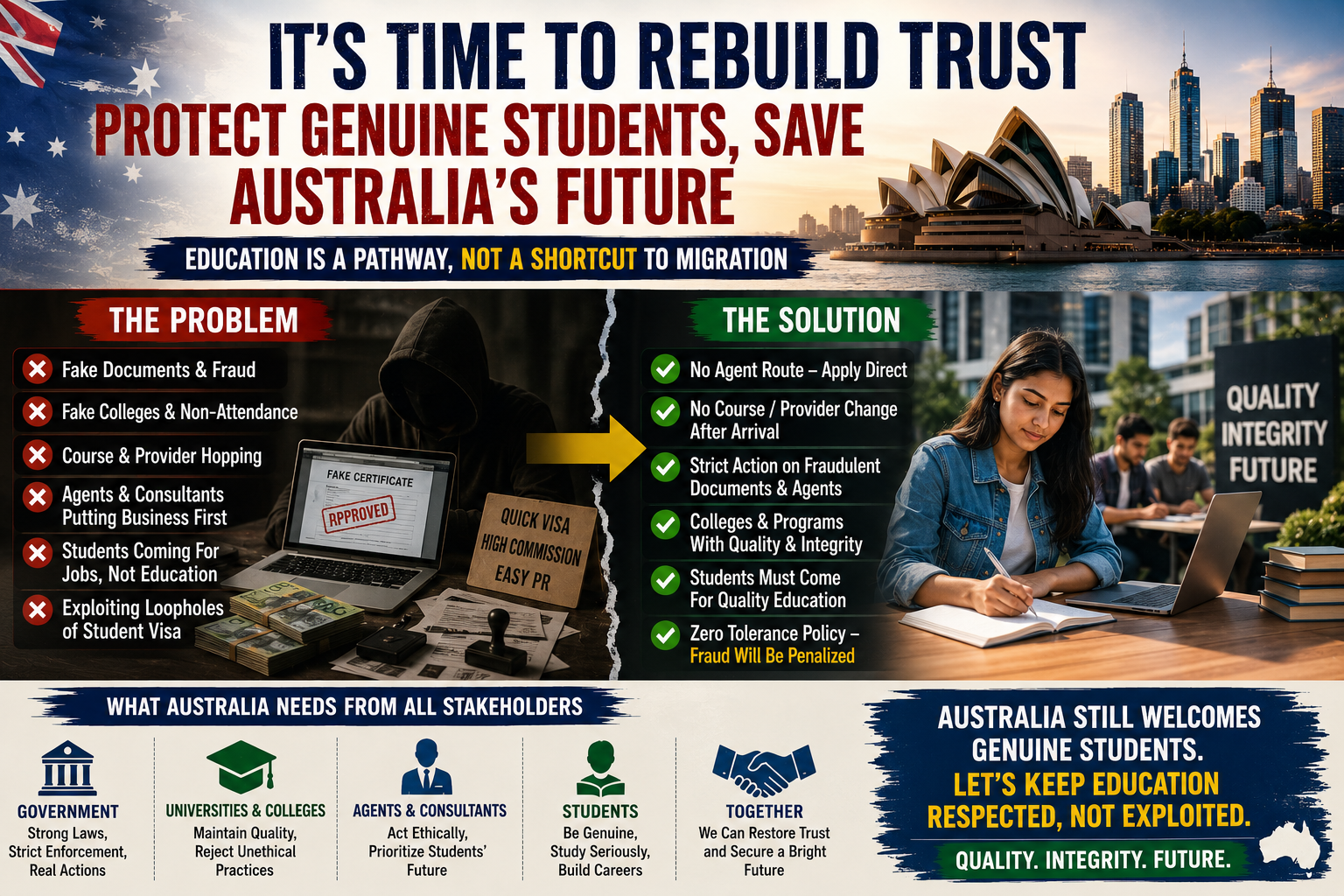
Fixing the Australia student visa system for good means a few reforms already underway — and a few worth pushing further:
- Restrict early-stage provider transfers unless there’s a genuine, documented reason, to close the “enrol, transfer, work” pattern regulators have flagged.
- Track agent-level compliance data — visa cancellation rates, attendance rates, and provider-transfer rates by referring agent — and make consistently poor performers publicly identifiable, the way OMARA sanctions already are for migration agents.
- Extend OMARA-style registration to education agents, closing the gap the Nixon Review flagged, rather than leaving oversight entirely to the providers agents represent.
- Continue the ESOS Act cross-ownership ban and monitor for workarounds, since financial incentive structures are the common thread across almost every documented failure above.
- Fix the false-positive problem in provider crackdowns — a regulatory system that mistakenly flags the Australian Medical Association as a “ghost college” damages its own credibility and gives bad-faith actors an easy talking point.
My Conclusion
Australia didn’t lose confidence in Indian students. It lost confidence in parts of the Australia student visa system that let migration outcomes quietly become more important than education outcomes — and the data above shows that erosion happening in measurable, documented ways, not just in headlines.
The honest version of this story has no single villain. It has a regulator that moved slowly, an incentive structure that rewarded the wrong behaviour, a minority of bad actors across every part of the chain, and a majority of genuine students and ethical advisers who are now paying the reputational cost of other people’s shortcuts.
Where I’d push back on my own argument, and where I’d like to hear yours: is a 270,000-student cap actually the right tool to fix a fraud problem that, by ASQA’s own numbers, is concentrated in maybe a few hundred providers out of thousands? Or is that punishing genuine students for a regulatory failure that should have been caught agent-by-agent and provider-by-provider years ago? I don’t think the answer is obvious — tell me where you land in the comments.
Sources for This Australia Student Visa Analysis
- Government Response to the Nixon Review Recommendations
- Rapid Review into the Exploitation of Australia’s Visa System (Nixon Review, full report)
- Department of Education: Education export income data
- “We’ve never refused so many” — SBS News on visa approval rates
- Ghost colleges in Australia — background and timeline
- Over 23,000 student qualifications cancelled — Riverwood Migration
- New legislation strengthens regulation of registered migration agents — Minister for Home Affairs
- The Genuine Student requirement — Study Australia (official)
- Australia’s student caps will ease up in 2026 — The Conversation
Have a Different Read on This?
I’d genuinely like to hear it — drop your view in the comments. And if you want to talk through your own Australia student visa plan with someone who’ll give you the straight, documented picture (not just the sales pitch), reach out:
📞 9513165527 / 7307530886
📧 me@vinayhari.com
📍 505, Sector 82, Mohali | BMC Chowk, Jalandhar