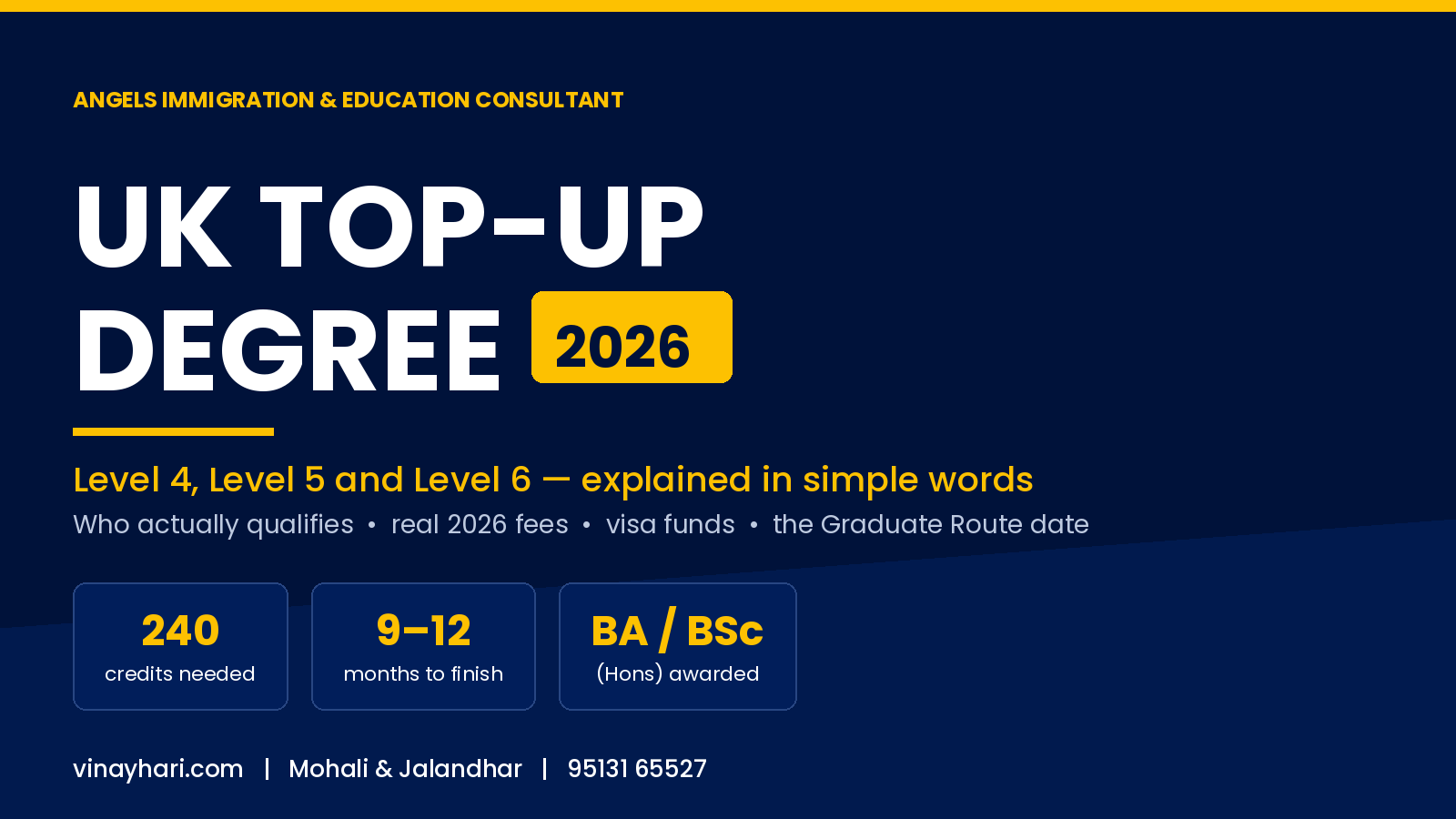

Most students who ask me about a UK top-up degree have already been told they are “eligible”. Very few of them can tell me how many credits they hold.
That gap is where the money gets lost. A top-up degree is a genuine, useful route for the right profile. For the wrong profile it becomes a rejected application, a wasted university fee, or worse, a UK degree that adds nothing to a career the student had already built.
So before fees and universities, let us fix the vocabulary. Once you understand Level 4, Level 5 and Level 6, the rest of the decision becomes much easier.
The short answer
In England, Wales and Northern Ireland, education is mapped onto nine qualification levels. A UK honours degree is built from three of them.
| Level | What it equals | Credits earned | Typical qualification |
|---|---|---|---|
| Level 4 | 1st year of a UK degree | 120 | HNC, Certificate of Higher Education |
| Level 5 | 2nd year of a UK degree | 120 more (240 total) | HND, DipHE, Foundation Degree |
| Level 6 | Final year of a UK degree | 120 more (360 total) | BA (Hons), BSc (Hons) |
A top-up degree is the Level 6 year on its own. You are not doing a new three-year degree. You are joining the final year directly, because you already finished the equivalent of the first two years somewhere else.
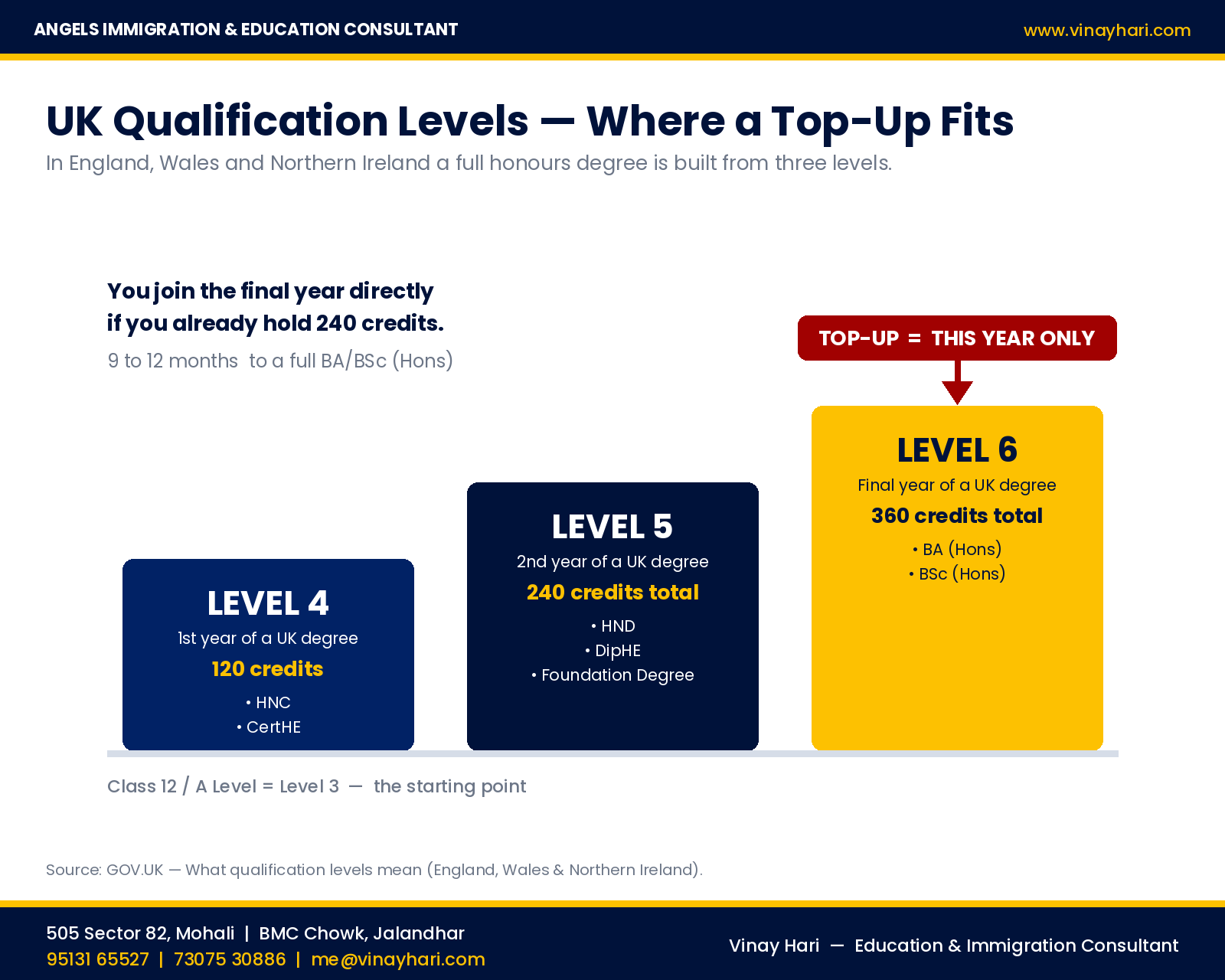
That is why a top-up takes 9 to 12 months, not three years. And the certificate you receive at the end is a full BA (Hons) or BSc (Hons) from that university, with no mention of the word “top-up” on it.
An example that makes it click
Think of a three-storey building.
Simran is a hypothetical student. She finishes her 12th class in Ludhiana. That is Level 3 in the UK system — the ground floor.
She then does a two-year business qualification that a UK university recognises as 240 credits. She has now built the first floor (Level 4) and the second floor (Level 5). Her building is real, people can live in it, but there is no roof.
The Level 6 top-up year is the roof. One year, 120 credits, and she walks away with a completed BA (Hons) Business Management.
Arjun, another hypothetical student, has a 3-year B.Com from a Punjab university. He does not have a building with two floors and no roof. He has a completed building. If he does a top-up, he is essentially rebuilding a roof he already owns.
That does not mean a top-up is useless for Arjun. Sometimes it makes sense — he may want UK study experience, a UK-awarded degree on his CV, or a route into the UK job market. But he should go into it knowing he is paying for a second bachelor’s degree, not an upgrade. In many cases a UK master’s would give him more career lift for a similar spend. That is a conversation worth having before the deposit, not after.
So who is a top-up degree actually for?
There are four common profiles, and they are not equal.
Strong fit — you hold a UK-style HND, HNC or Foundation Degree. This is exactly what the route was designed for. A Pearson BTEC HND in Business, a Foundation Degree from a UK college, or an HND completed at an approved international centre maps cleanly onto 240 credits. Universities process these applications routinely.
Possible fit — you hold a 3-year Indian polytechnic or vocational diploma. Some UK universities will assess a 3-year diploma against Level 5 and consider you for direct entry to Level 6. Others will not. It depends on the institution that awarded your diploma, your subject, your marks, and how the university reads the syllabus. Universities often refer to UK ENIC, the UK’s national agency for recognising international qualifications, when judging comparability. This is a case-by-case decision, never an automatic yes.
Needs a serious rethink — you already hold a completed Indian bachelor’s degree. BBA, B.Com, BA, BCA. You are not missing a final year. Ask yourself honestly what the top-up adds. Sometimes the answer is genuine: a specialisation you do not have, a UK qualification for a UK employer, a stronger fit than a master’s if your academic record is weak. Sometimes the honest answer is that a master’s is the better use of the same 30 lakh.
Weakest fit — you dropped out of an Indian degree after two years. Two years of an Indian bachelor’s is not automatically 240 UK credits. Incomplete degrees are assessed differently from completed diplomas, and many universities will decline. Get this checked properly before you build a plan around it.
Subject match matters more than students expect
A top-up year is the final year of a specific degree. You are not starting fresh — you are joining a class that has already covered two years of that subject.
So a business diploma leads to a business top-up. A computing HND leads to a computing top-up. An engineering diploma holder cannot walk into the final year of a business degree simply because both are “Level 5”.
Some universities ask for a personal statement precisely so they can see whether your previous modules gave you the knowledge to survive Level 6 study in that field. The University of Chester’s Level 6 route asks for exactly this. It is not a formality.
What a UK top-up degree costs in 2026
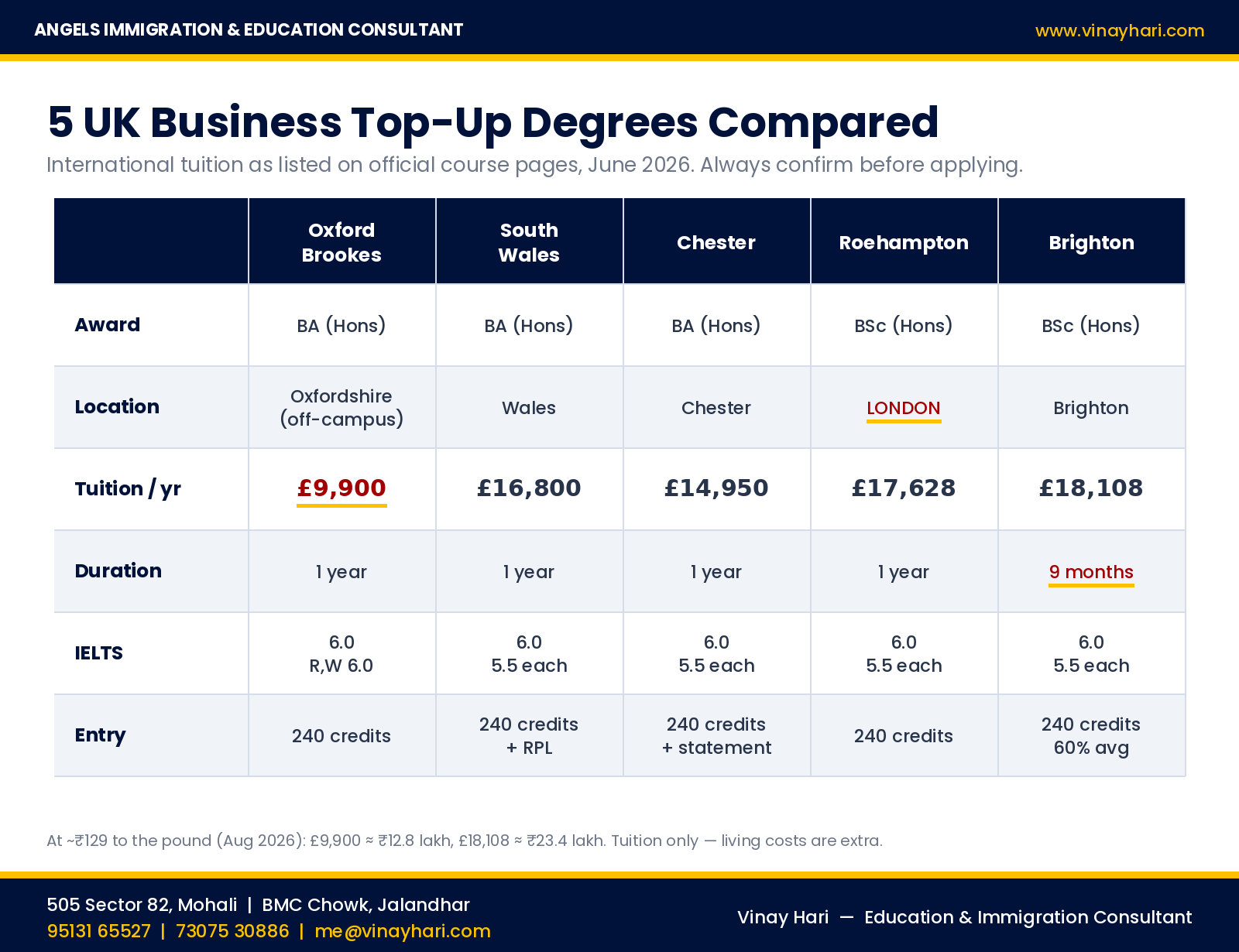
Here are five universities offering business top-up degrees, with tuition as listed on their official course pages in June 2026. Fees change, so treat these as a planning range and confirm on the university website before you apply.
| Oxford Brookes | South Wales | Chester | Roehampton | Brighton | |
|---|---|---|---|---|---|
| Award | BA (Hons) | BA (Hons) | BA (Hons) | BSc (Hons) | BSc (Hons) |
| Location | Oxfordshire (taught off-campus) | Wales | Chester | London | Brighton |
| Tuition / yr | £9,900 | £16,800 | £14,950 | £17,628 | £18,108 |
| Duration | 1 year | 1 year | 1 year | 1 year | 9 months |
| IELTS (Academic) | 6.0, R & W 6.0 | 6.0, 5.5 each | 6.0, 5.5 each | 6.0, 5.5 each | 6.0, 5.5 each |
| Entry | 240 credits | 240 credits, RPL considered | 240 credits + personal statement | 240 credits | 240 credits, around 60% average |
At roughly ₹129 to the pound in August 2026, £9,900 is about ₹12.8 lakh and £18,108 is about ₹23.4 lakh. Check the live rate when you plan — a five-rupee move on £18,000 is nearly ₹90,000.
Two things in that table are easy to misread.
Oxford Brookes is taught off-campus. The degree is awarded by Oxford Brookes University, but classes run at Abingdon & Witney College in Oxfordshire, one intensive day per week. That is a real advantage if you want flexibility, and a real disappointment if you were picturing daily life on the main Oxford Brookes campus. Know which one you are buying.
Brighton’s 60% requirement is stricter than the others. It also carries AACSB accreditation, which matters in corporate recruitment. Higher bar, stronger signal.
The number parents actually need
Tuition is not the budget. The budget is tuition plus living costs plus visa costs.
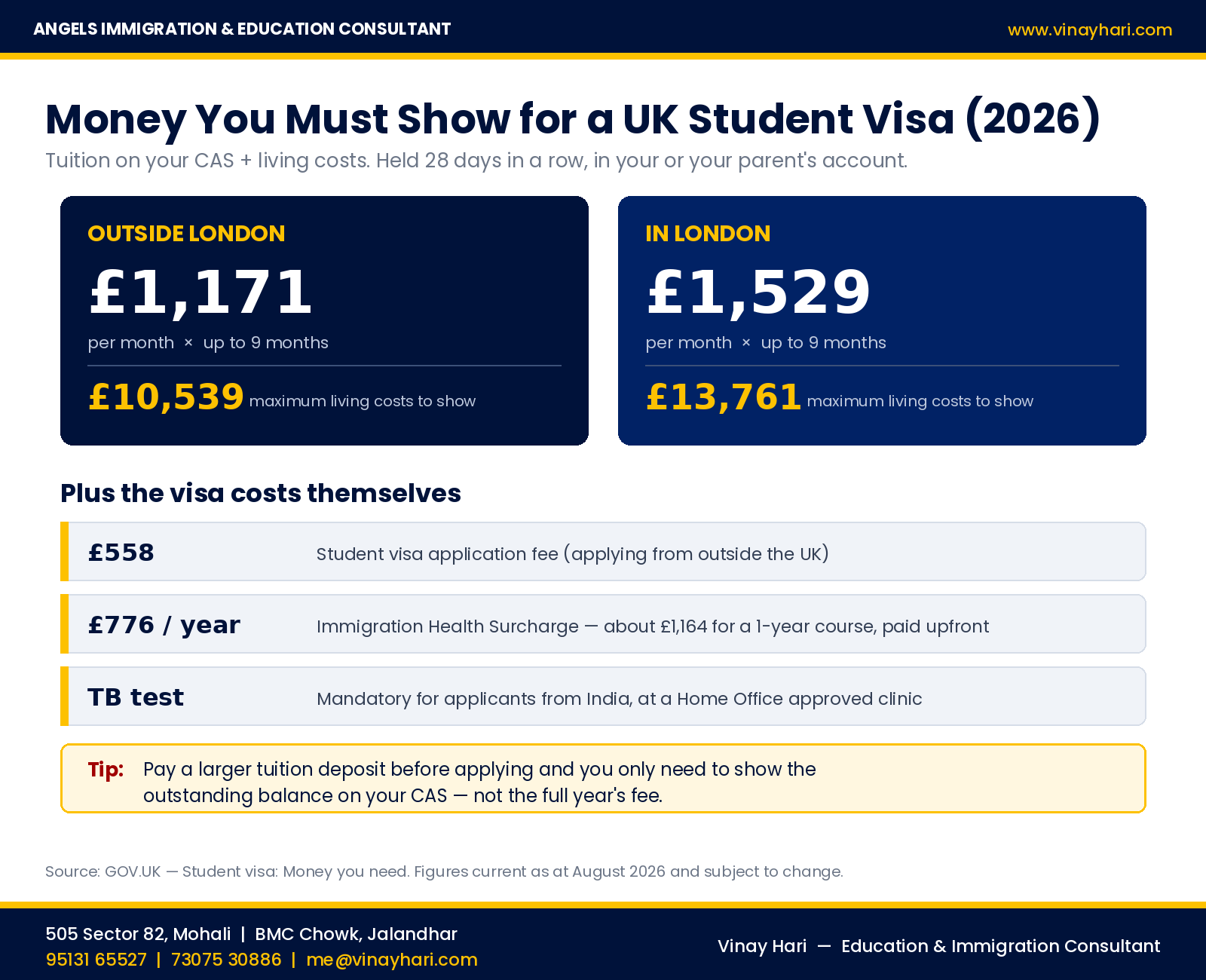
For the UK Student visa, the Home Office sets exactly how much money you must show. As of August 2026, GOV.UK requires:
- £1,529 per month for courses in London, for up to 9 months — £13,761 maximum
- £1,171 per month for courses outside London, for up to 9 months — £10,539 maximum
That is on top of the tuition fee outstanding on your CAS. The money must sit in your account, or a parent’s account, for 28 consecutive days in a row, and the closing balance date must be within 31 days of your visa application.
Then the visa costs themselves:
- Student visa application fee: £558 when applying from outside the UK
- Immigration Health Surcharge: £776 per year of visa length, paid upfront. A one-year course usually gets around 16 months of leave, which works out to roughly £1,164
- TB test certificate — mandatory for applicants from India, from a clinic approved by the Home Office
Worked example — Oxford Brookes, outside London. Tuition £9,900 plus maintenance £10,539 = £20,439 to show in the bank, roughly ₹26.4 lakh at current rates. Add about £1,722 for the visa fee and IHS. Then flights, deposit for accommodation, and the fact that real living costs in most UK cities exceed the Home Office minimum.
Worked example — Roehampton, London. Tuition £17,628 plus maintenance £13,761 = £31,389 to show, roughly ₹40.6 lakh. London costs more to prove and more to live in.
One useful detail: if you pay part of your tuition as a deposit before applying, you only need to show the outstanding balance from your CAS, not the full fee. For families where funds are tight, paying a larger deposit can meaningfully reduce the bank figure you need to demonstrate.
The Graduate Route date most students are getting wrong
This is the part I would most like Indian families to read carefully, because a lot of marketing material has not caught up.
The Graduate Route lets you stay in the UK and work after finishing an eligible course. A top-up degree qualifies, because what you complete is a UK bachelor’s degree.
But the duration changed. According to GOV.UK, a Graduate visa now lasts:
- 2 years if you apply on or before 31 December 2026
- 18 months if you apply on or after 1 January 2027
- 3 years if you hold a PhD or other doctoral qualification
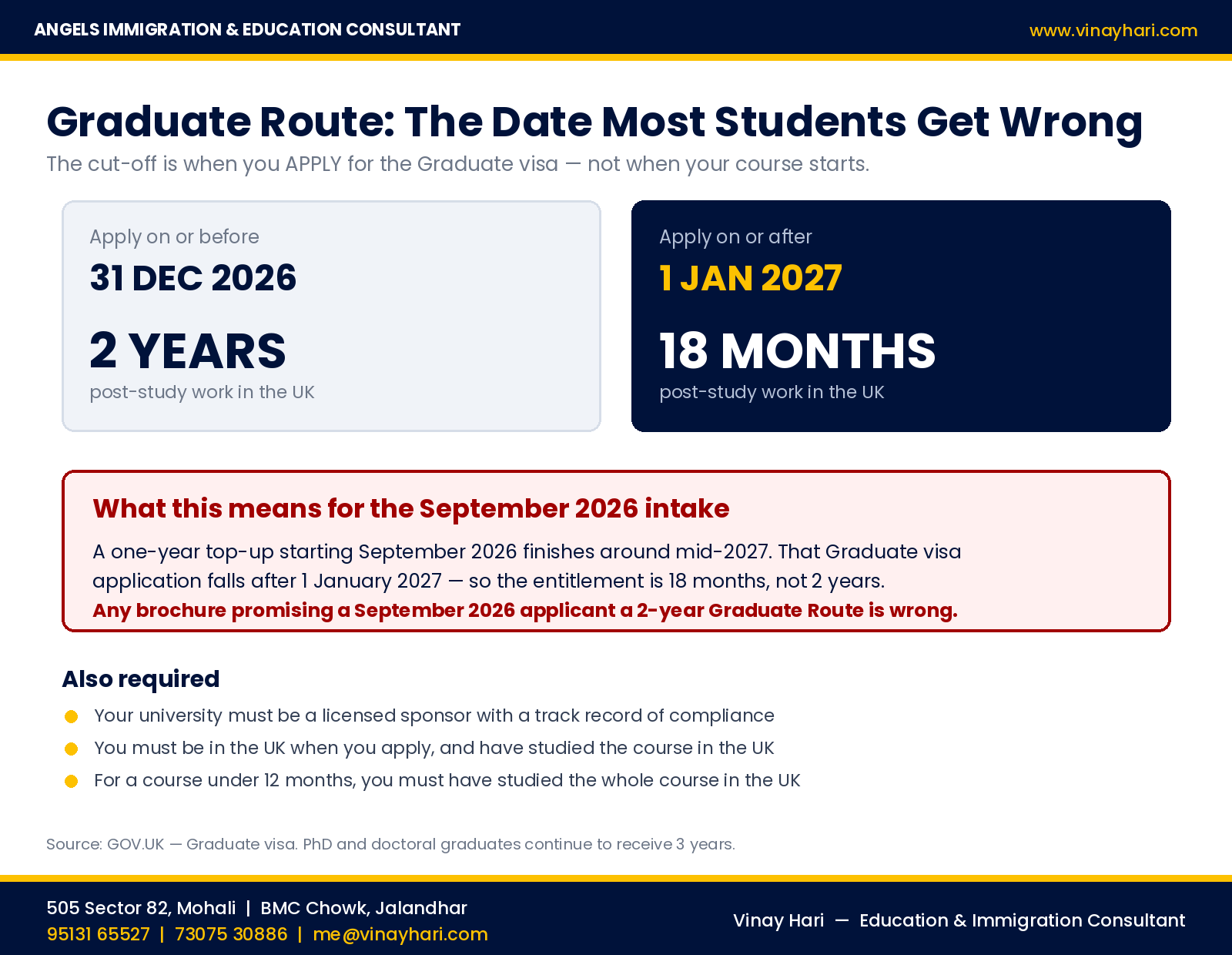
Read that again, because the date refers to when you apply for the Graduate visa, not when you start your course.
A student joining a September 2026 top-up intake will finish somewhere around mid-2027. Their Graduate visa application will therefore fall after 1 January 2027, which means 18 months, not 2 years. Any brochure telling a September 2026 applicant they will “lock in” a two-year Graduate Route is describing something that will not happen for them.
Eighteen months is still a meaningful window. It is simply a shorter one, and your plan for converting it into a Skilled Worker visa or a longer-term route needs to be tighter than it would have been last year. If you are already thinking about that stage, our guide to working abroad from India covers how the employment side usually plays out.
Two more conditions worth knowing. Your university must be a licensed sponsor with a track record of compliance. And you must have studied the course in the UK — for a course shorter than 12 months, such as Brighton’s 9-month route, that means the whole course. Distance-learning shortcuts do not count.
Mistakes I see repeatedly
Assuming a diploma automatically equals Level 5. It does not. Get a written assessment from the university before paying anyone anything.
Choosing on tuition fee alone. Oxford Brookes at £9,900 looks unbeatable next to Brighton at £18,108. But add nine months of living costs, compare the accreditation, compare the campus experience, and the gap narrows. Cheapest tuition is not cheapest outcome.
Treating a top-up as an immigration product. It is an academic year. Immigration is a separate decision made by UK Visas and Immigration, on its own evidence, and no consultant controls that outcome. If you have had an application go wrong before, our guide to study visa refusal reasons and how to reapply explains what officers actually look at.
Not checking who awards the degree. Some top-ups are taught at a private college and awarded by a partner university. That can be perfectly legitimate, but you should know the awarding body’s name before you apply, because that is the name on your certificate.
Doing a top-up when you already hold a full bachelor’s, without asking why. If you cannot explain to an interviewer what the top-up added to your existing degree, a visa officer may have the same question.
Ignoring the syllabus document. Universities want your detailed module list, not just your marksheet. Students who cannot produce it lose weeks.
Is a UK top-up degree recognised in India?
You finish with a BA (Hons) or BSc (Hons) awarded by a UK university. That is a standard UK undergraduate degree.
For Indian employers, recognition generally follows the awarding university’s standing, and the Association of Indian Universities handles equivalence certification where an employer or a further-study institution requires it. If your plan involves an Indian government job or a specific Indian postgraduate course, check that institution’s own equivalence requirement before you apply. Do not assume.
What to do before you spend anything
Get your qualification assessed in writing. Send your diploma, all marksheets and the detailed syllabus to the university’s international admissions team, or have them reviewed properly, and get a documented view on whether you meet the 240-credit requirement.
Then answer four questions honestly. Does the top-up subject connect to what you have already studied? Does it connect to the career you want? Can your family fund the full budget, not just the tuition? And do you understand that an 18-month Graduate Route now needs a job plan, not just hope?
If all four answers hold up, a top-up degree is one of the most efficient routes into a UK qualification available to Indian students. One year, one fee cycle, a full honours degree.
If any of the four wobble, the answer is not “no”. It is “let us look at a different pathway first”.
Frequently asked questions
What does Level 6 mean in the UK?
Level 6 is the final year of a bachelor’s degree with honours. Complete it and you hold a BA (Hons) or BSc (Hons). Level 4 is first year, Level 5 is second year.
Is a top-up degree a real degree?
Yes. You graduate with the same BA (Hons) or BSc (Hons) as a student who studied all three years at that university. The certificate does not say “top-up”.
How many credits do I need for a top-up degree?
Normally 240 credits, meaning Level 4 and Level 5 completed. An HND, a Foundation Degree or a DipHE typically carries this.
Can I do a top-up degree after an Indian 3-year diploma?
Sometimes. Universities assess Indian diplomas individually against Level 5. Your awarding institution, subject and marks all matter. Ask for a written eligibility decision rather than relying on a verbal assurance.
Can I do a top-up degree after a completed B.Com or BBA?
Often technically yes, but ask whether it is the right choice. You already hold a bachelor’s degree. A UK master’s may deliver more career value for a similar cost. Compare both before deciding.
What IELTS score do I need for a UK top-up degree?
For the five universities listed here, IELTS Academic 6.0 overall with 5.5 in each component is the common requirement, though Oxford Brookes asks for 6.0 in Reading and Writing specifically. Some universities accept PTE, TOEFL or an MOI certificate. Always check the current requirement on the course page.
How much money do I need to show for the visa?
Tuition outstanding on your CAS, plus £1,171 per month outside London or £1,529 per month in London, for up to 9 months. Held for 28 consecutive days.
Is a top-up degree eligible for the Graduate Route?
Yes, since you complete a UK bachelor’s degree, provided your university is a licensed sponsor with a track record of compliance and you studied the course in the UK. Duration is 2 years for applications on or before 31 December 2026 and 18 months for applications from 1 January 2027.
Can I work while studying in the UK?
Student visa work rights depend on your course level and are stated in your visa conditions. Check the conditions attached to your own grant rather than relying on what a friend was allowed to do.
Will an agent guarantee my visa?
No one can. The decision belongs to UK Visas and Immigration. Anyone promising a guaranteed visa, guaranteed PR or a guaranteed job is telling you something they cannot deliver.
Official sources
- GOV.UK — What qualification levels mean (England, Wales and Northern Ireland)
- GOV.UK — Student visa: money you need
- GOV.UK — Graduate visa: overview
- GOV.UK — Graduate visa: the course you studied
- GOV.UK — Register of licensed student sponsors
- GOV.UK — TB test for a UK visa
- Oxford Brookes University — BA (Hons) Business and Management Practice (Top-Up)
- University of South Wales — BA (Hons) Business Management (Top-Up)
- University of Chester — BA (Hons) Business Management and Administration (Level 6 only)
- University of Roehampton — BSc (Hons) International Business and Finance (Top-Up)
- University of Brighton — BSc (Hons) Business Management (Top-Up)
Before you commit
A top-up degree is a one-year decision with a 30-lakh price tag and a long shadow. It is worth an hour of proper assessment first.
If you want your diploma, marksheets and syllabus reviewed against the 240-credit requirement, and an honest view on whether a top-up or a master’s fits your profile better, that assessment is free at either of our offices.
Vinay Hari — Angels Immigration & Education Consultant
505, Sector 82, Mohali | BMC Chowk, Jalandhar
95131 65527 | 73075 30886
me@vinayhari.com
Fees, entry requirements and immigration rules change. Always verify on the official university and GOV.UK pages before applying. We do not guarantee admission or visa outcomes — immigration decisions are made solely by UK Visas and Immigration.