
If you are reading this the same day your Canada study visa refusal arrived, take a breath first. A refusal letter is written in cold administrative language, and it feels like a verdict on you. It is not. It is a decision about one application, made by one officer, on the evidence in front of them on that day.
That distinction matters more than anything else in this article.
You have not been banned. You have not been blacklisted. In most cases there is no waiting period, no limit on how many times you may apply, and nothing on your record that stops a future officer from approving you. What you have is a document telling you which part of your case did not convince someone — and, since July 2025, that document now comes with the officer’s own working notes.
The mistake I see most often is what happens in the next 48 hours. Panic, then a rushed second application with the same file and a slightly longer SOP. That is the one move almost guaranteed to produce a second refusal.
Visa refusal is not the end of your Canada dream. It is a signal that you need to understand what went wrong before you try again.
— Vinay Hari
First, some perspective from IRCC’s own numbers
Students often assume a refusal means Canada has shut the door. The published targets say otherwise.
For 2026, IRCC expects to issue up to 408,000 study permits — 155,000 to newly arriving international students and 253,000 to students already in Canada. Under the international student cap, 309,670 study permit application spaces are available for applicants who need a PAL or TAL.
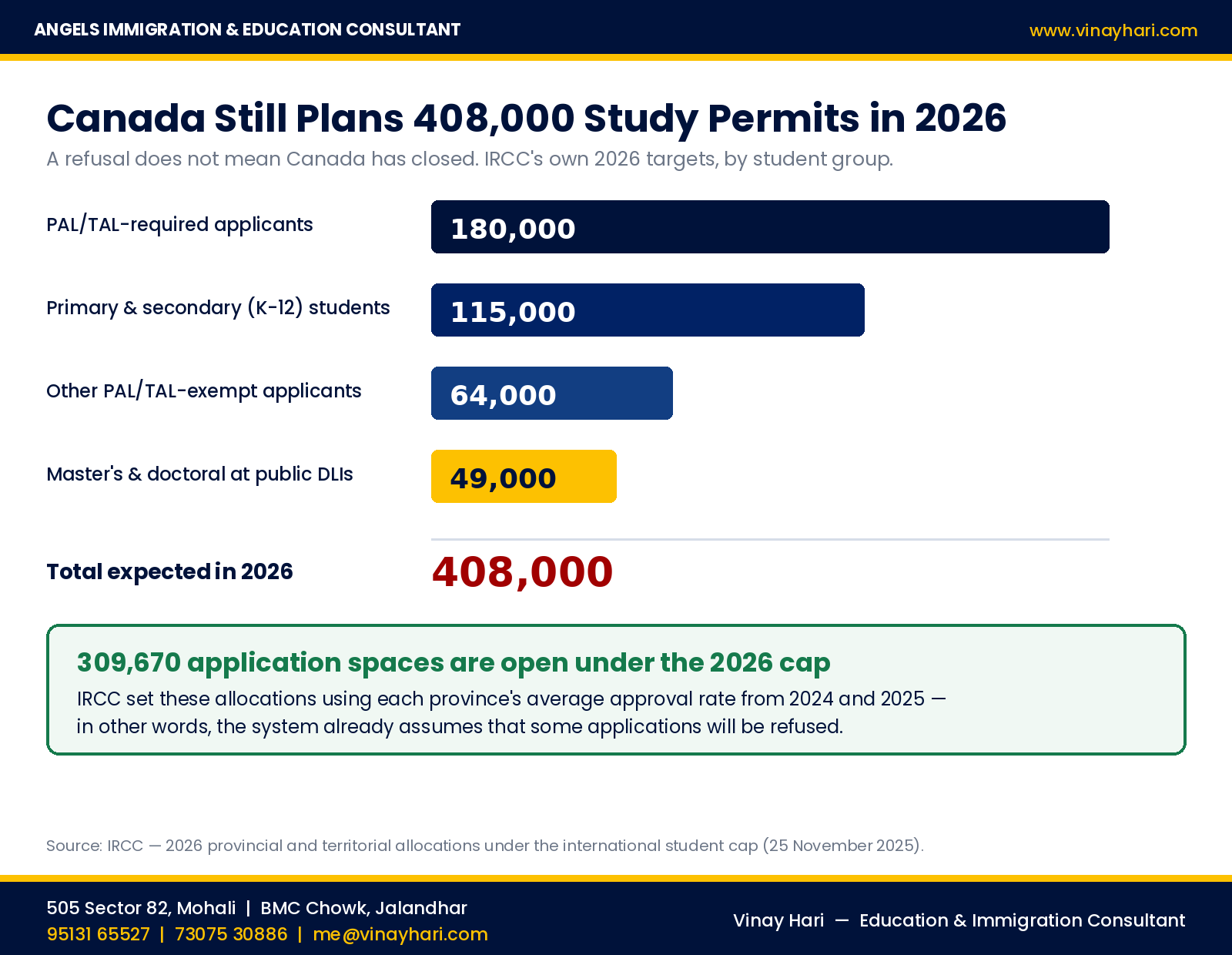
Read the last line of that chart carefully, because it is the part nobody quotes. IRCC allocated those spaces to provinces based on each province’s average approval rate from 2024 and 2025 — that is, the department calculated how many applications would need to be received in order to issue the permits it wants, knowing that a portion would be refused.
Refusals are built into the system’s arithmetic. Being refused once puts you in a very large group of people, many of whom go on to be approved.
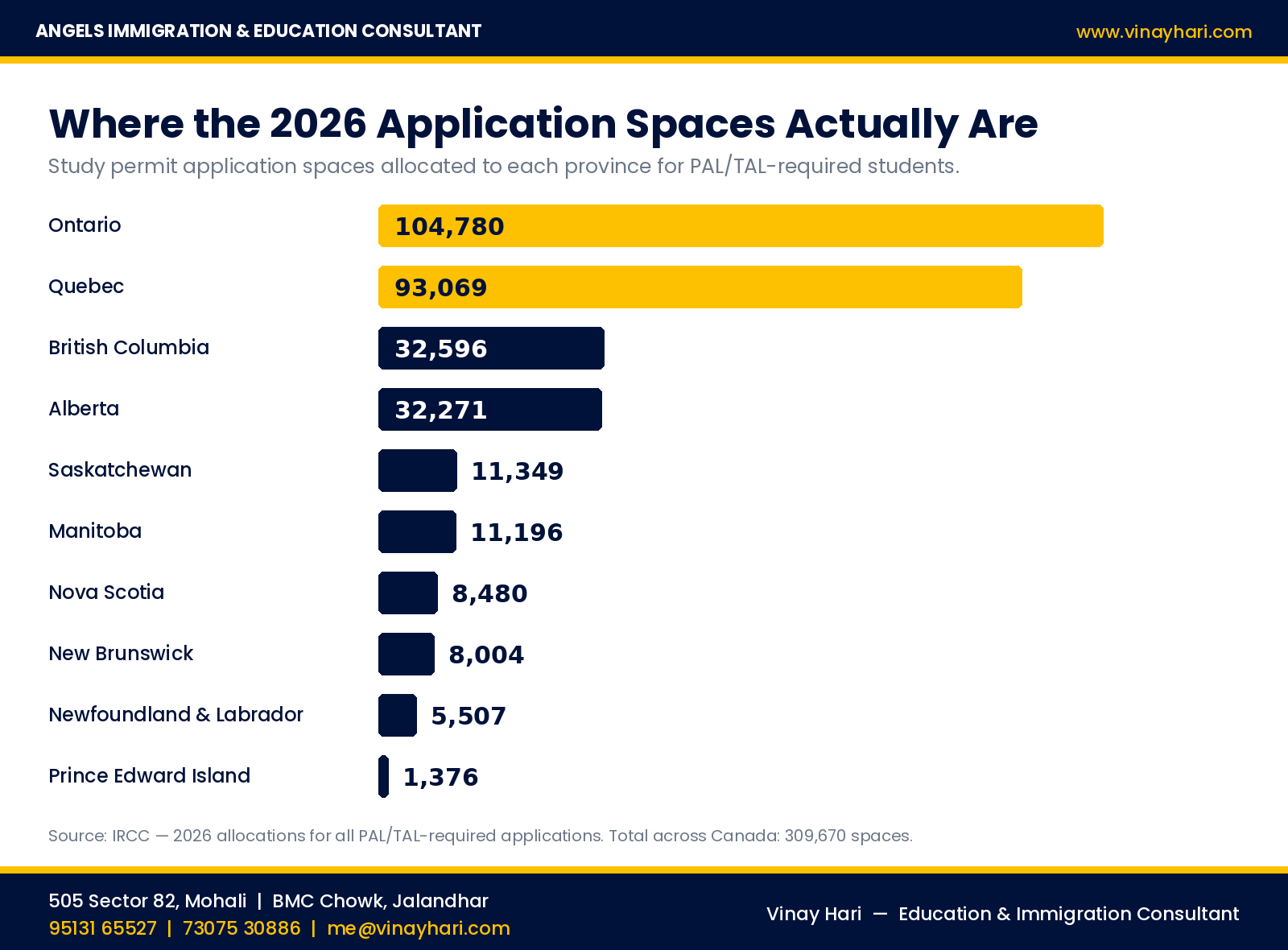
Ontario alone holds 104,780 application spaces for 2026. Quebec holds 93,069. The room exists. The question is whether your file is strong enough to occupy it.
Step 1: Read the refusal letter properly
Most students skim the checkboxes and stop. Do the opposite — read every line, twice, and note the exact wording.
A study permit can be refused because the officer was not satisfied about any of the following.
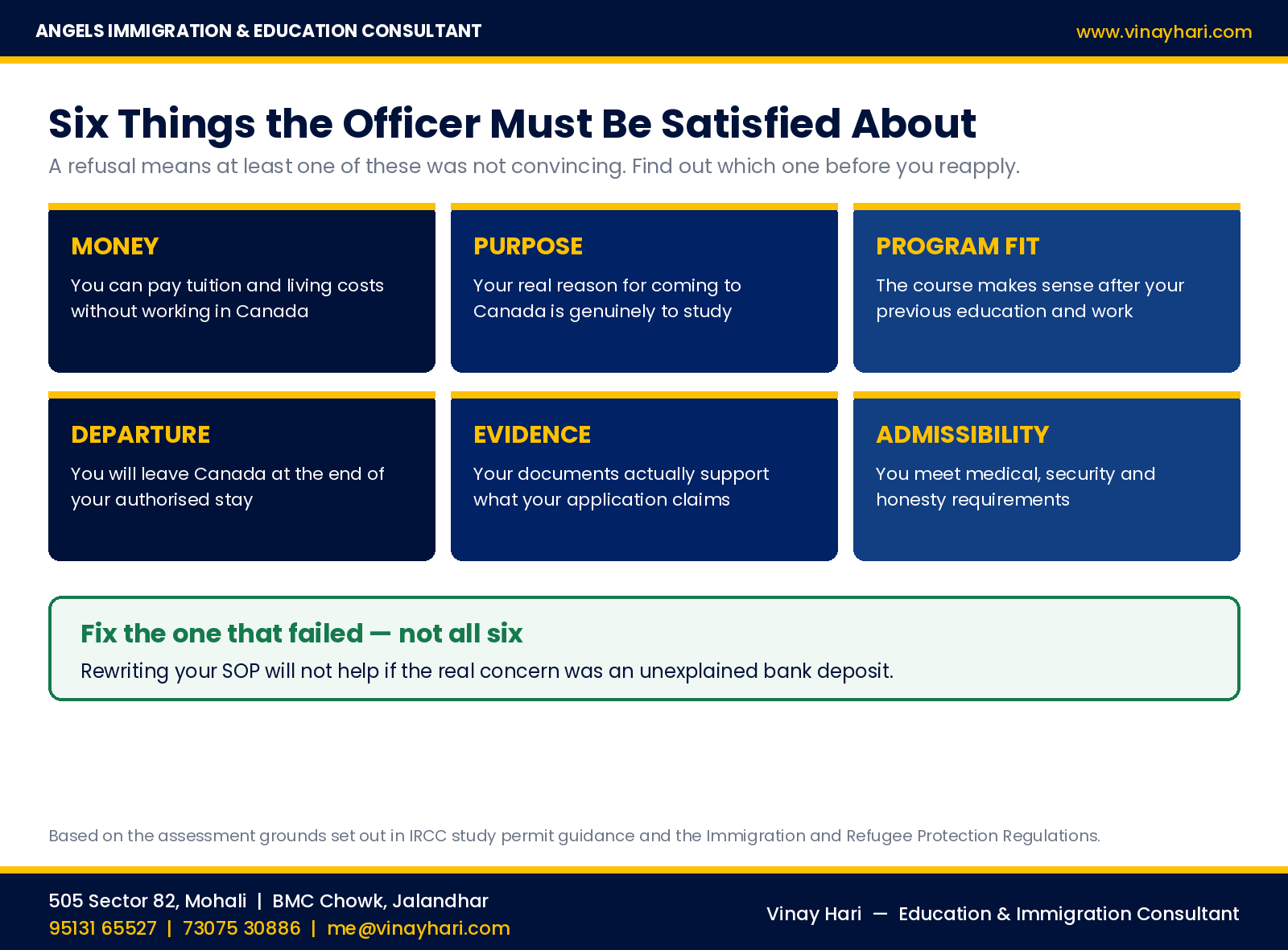
Here is the part that changes how you should approach step two: you only have to fix the one that failed. A student whose refusal was about an unexplained bank deposit does not need a new college, a new course, or a longer statement of purpose. They need a paper trail for that deposit.
Rewriting everything is not thoroughness. It is guessing.
That said, do not read the checkboxes in isolation either. Your application is read as a single story:
Education → Previous studies → Work experience → Chosen program → Institution → Career plan → Future employment
If those pieces do not connect, an officer may tick “purpose of study” even though the underlying problem is that the course does not follow from anything you have done before. A longer SOP will not repair a broken chain. A better-chosen program might.
Your Canadian education should tell a logical story: what you studied, what you are studying next, and where you want your career to go.
— Vinay Hari
Step 2: Read the officer’s decision notes
This is the single most useful change for refused applicants in years, and a lot of students still do not know it exists.
Since 29 July 2025, IRCC provides the officer’s decision notes along with the refusal letter for most temporary resident applications — including study permits and study permit extensions. Since 26 May 2026, the same applies to most permanent residence applications.
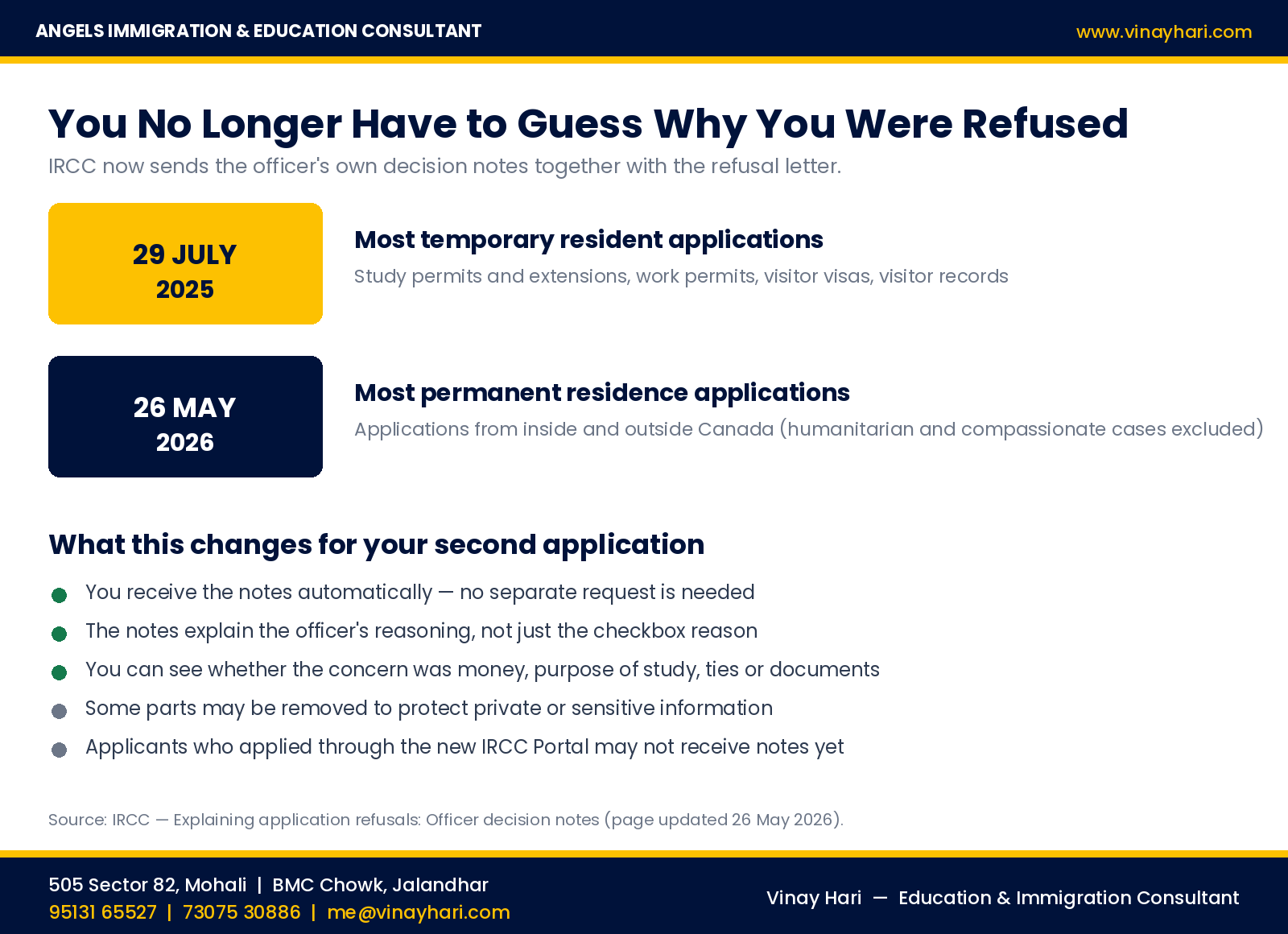
You do not have to file anything to get them. They arrive with the refusal.
The difference is enormous. The refusal letter tells you the category. The notes tell you the reasoning — what the officer looked at, what they doubted, and what evidence they felt was missing.
So stop asking “why was my visa refused?” Ask instead: “what exactly did this officer believe was missing, weak, or unconvincing?”
Two caveats worth knowing. Parts of the notes may be removed to protect private or sensitive information. And applicants who applied through the newer IRCC Portal may not receive notes yet — if yours did not arrive, that may be why.
Step 3: Identify the real problem, not every problem
A refusal may list several concerns. They are rarely equal in weight. Work through these five areas honestly.
Purpose of study. Does the program follow logically from what you have already studied and done? A commerce graduate moving into an unrelated field is not automatically refused — but they need to explain the career logic, and the explanation has to be believable.
Financial capacity. The question is not how much is in the account. It is where the money came from and whether the story holds together.
Career plan. An officer should be able to read your application and answer four questions without effort: what have you studied, what are you doing now, why this specific program, and how does it improve your career.
Home-country ties. The officer must be satisfied you will leave at the end of your authorised stay. Family, employment, property, financial circumstances and career plans all form part of that assessment.
Academic progression. Your next qualification should be a step forward. Choosing a program because it was available, cheap or easy to enter is not progression, and it is visible from the outside.
The money question, in actual numbers
Financial concerns sit behind a very large share of study permit refusals, and the requirement changed recently enough that some families are still working from old figures.
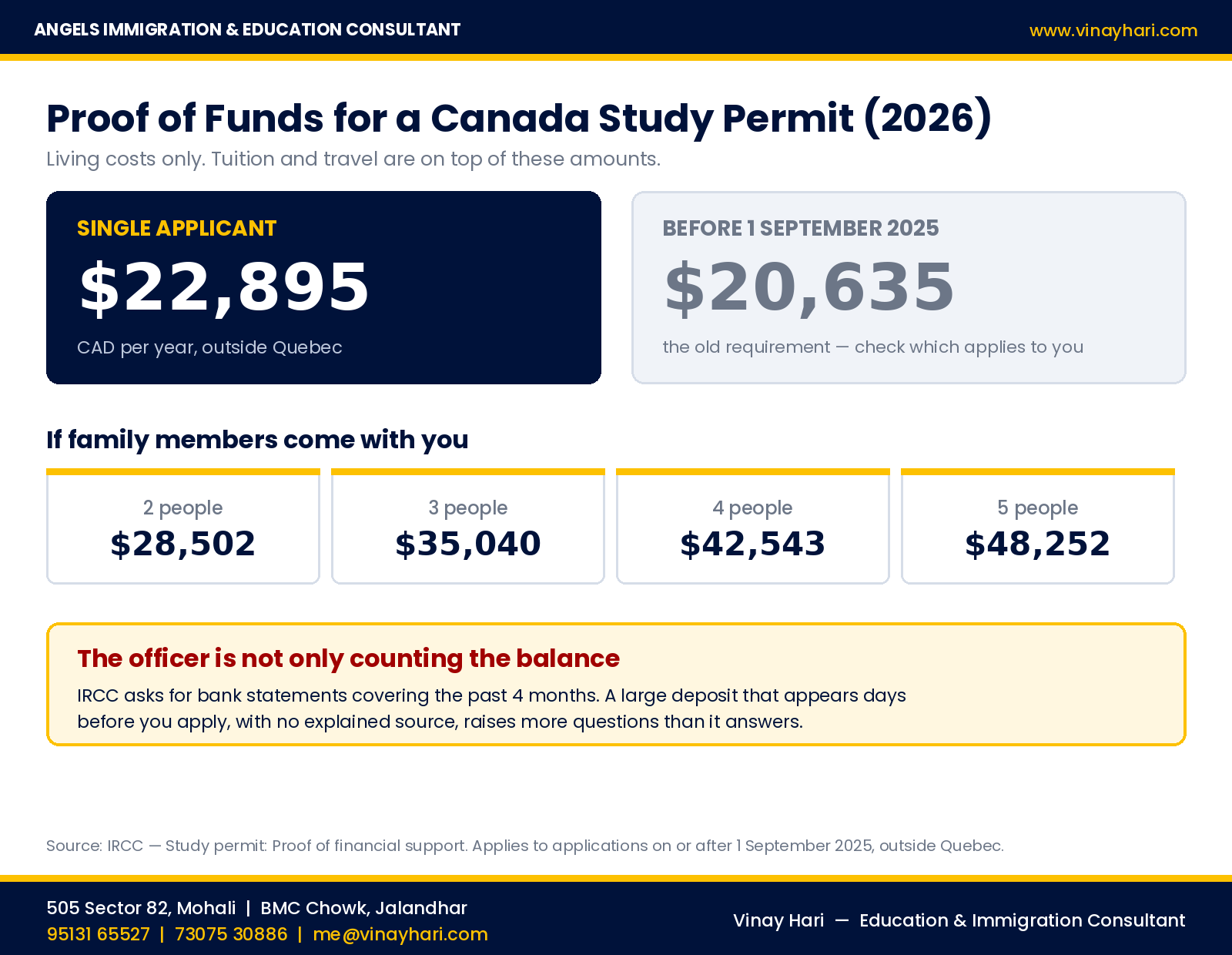
For applications submitted on or after 1 September 2025, outside Quebec, a single applicant must show CAD $22,895 for living expenses for the first year — on top of tuition and travel costs. Before that date the figure was $20,635. If a family member comes with you, it rises to $28,502 for two people and $35,040 for three.
But the amount is only half of it. IRCC asks for bank statements covering the past four months. That window exists precisely so officers can see how the money behaved before it became a visa document.
A balance that appeared eleven days before you applied, from a source you cannot document, is weaker evidence than a smaller balance that has been sitting there for a year. This is where a lot of otherwise genuine students lose their application.
A bank balance is only a number. What matters is whether you can explain the genuine source of your funds.
— Vinay Hari
Step 4: Do not submit the same application again
If your first application was refused, resubmitting the same documents with reworded paragraphs is not a strategy. It is a repeat.
That does not mean everything must change. Sometimes your circumstances were always strong and the first application simply failed to explain them. The task is to find the weakness and answer it with evidence, not to redecorate.
Don’t reapply just because you have been refused. Reapply when you have a stronger case to present.
— Vinay Hari
Step 5: Reconsider the university and the program
This is where many second applications are quietly won or lost, and where diploma holders in particular need to slow down.
Most students choose their first program on a short list of factors: low tuition, easy admission, a quick offer letter, low English requirements, seats available, a friend’s or agent’s recommendation. None of these are dishonest. They are simply not the factors an officer is weighing.
Admission is not the destination. Choosing the right university and the right degree program is part of building a credible study plan.
— Vinay Hari
After a refusal, resist the instinct to find an even easier college. Instead, hold your options against your own profile: the institution’s standing, the program structure, the level of the qualification, your previous education, your work experience, your career objective, and whether the whole thing reads as progression.
A stronger application should be able to answer, without hesitation: why this university, why this degree, why Canada, and why this is the right next step.
Diploma students especially
Many diploma holders are refused not because they are weak students, but because nobody explained how academic progression is read in an immigration file.
A student with a diploma who applies for another unrelated or lower-level diploma has a hard question to answer: why is this necessary for your career? Sometimes there is a genuine answer. Often there is not, and the student did not realise the question would be asked.
This does not mean every diploma student gets refused. It means the applicant has to demonstrate that the Canadian program is a logical and genuine step forward from what they already hold. For some profiles, a relevant bachelor’s degree or another appropriate higher-level qualification tells a cleaner story than a second diploma — a UK top-up degree is one route diploma holders sometimes overlook. For others it does not fit at all. It depends on the full profile, and that is exactly the kind of thing worth having assessed properly rather than guessed at.
Many diploma students are refused not because they are weak students, but because they are unaware of how their academic progression needs to be presented.
— Vinay Hari
One more note on the 2026 rules that is worth knowing if a higher qualification is realistic for you: from 1 January 2026, master’s and doctoral students enrolled at a public designated learning institution no longer need a PAL or TAL. IRCC also set aside 49,000 permits for that group. It is not a shortcut, and it is not right for everyone — but if a postgraduate program genuinely fits your background, it now sits outside the cap.
Step 6: Rebuild the financial file
Depending on your circumstances, a stronger financial file might include bank statements, education loan documents, income and tax documents, employment or business evidence, sponsor documents, an explanation of any large deposit, proof of tuition paid, and documents establishing the source of funds.
The goal is a credible history, not an impressive number.
Step 7: Rewrite the study plan around the actual concern
A second study plan should not be the first one with new adjectives. It should answer, directly and specifically:
Why Canada? Not “world-class education” — the actual reason this country fits your goal.
Why this program? The specific skills and knowledge you expect to gain.
Why this university? Why it suits your academic objective in particular.
Why not study this in India? If a comparable program exists at home, say plainly what the Canadian one offers that it does not.
What is your career plan? What you intend to do afterwards, concretely enough that someone could check it.
Why does your background matter? The line connecting what you have done to what you propose to do.
A longer SOP does not make a stronger application. A logical story supported by genuine evidence does.
— Vinay Hari
Step 8: You need a new PAL or TAL
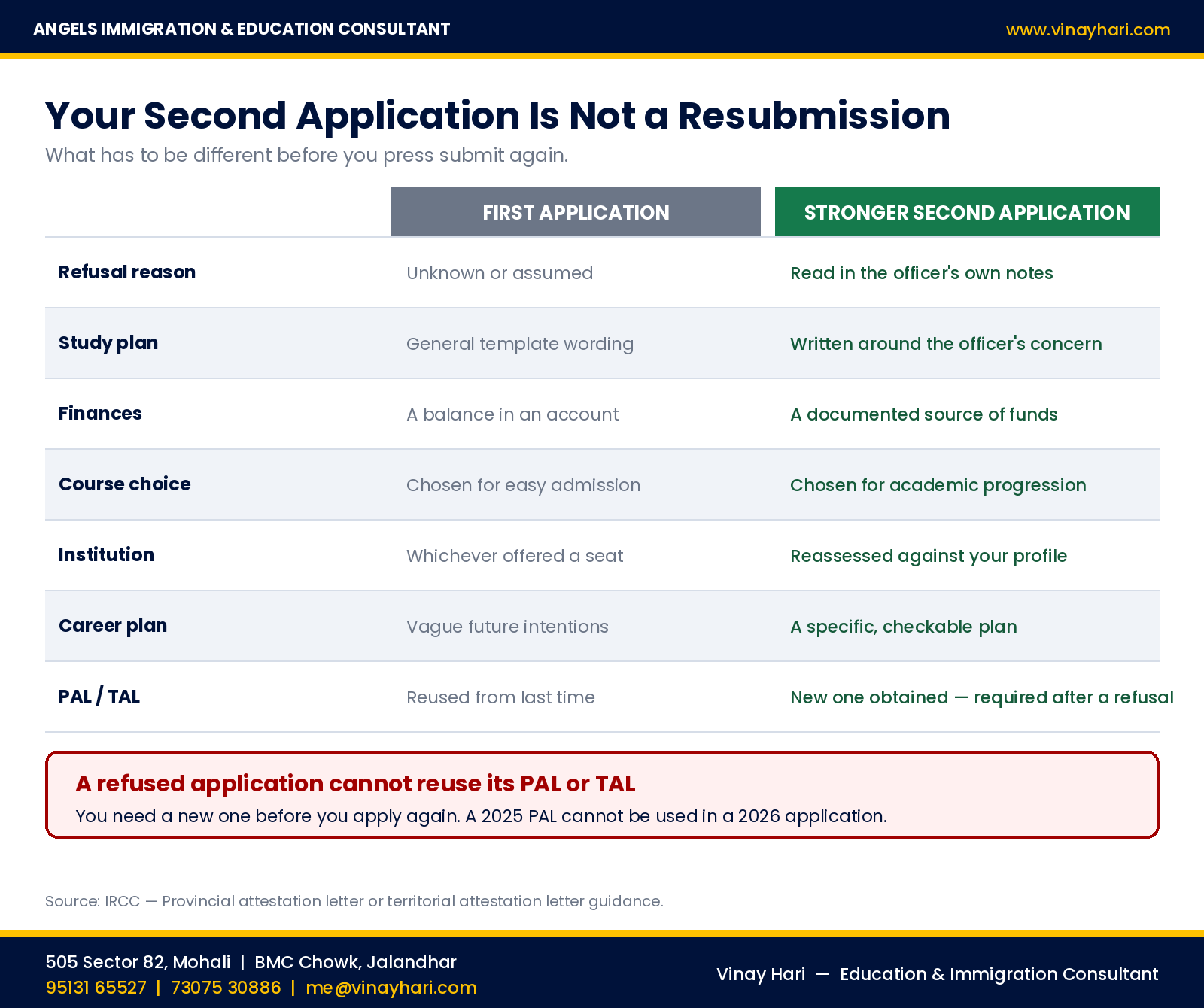
A procedural point that catches people out. If your study permit application was refused, you generally need a new PAL or TAL before submitting another application, where one is required. You cannot reuse the one from the refused file.
There is a related trap: a PAL issued for the 2025 cap year can no longer be used in an application from 1 January 2026.
Note the distinction. If IRCC did not accept your application into processing and refunded your fee, that is a return, not a refusal, and the original PAL may still be usable if still valid. Check which one actually happened in your case.
Step 9: Check for admissibility or misrepresentation issues
Not every refusal is a documentation problem. If your refusal involves false information, misrepresentation, fraudulent documents, medical or criminal inadmissibility, or a previous immigration violation, treat it as a different category of problem entirely. Submitting a fresh study permit application without addressing the underlying issue can make things considerably worse.
And to be direct about it: never use fake documents or false information to get around a refusal. It converts a recoverable setback into a long-term bar.
Step 10: Decide whether to reapply at all
There is no rule that every refused applicant should reapply immediately. The better question is: what can I now demonstrate that I could not demonstrate last time?
If the honest answer is “nothing has changed”, another application is unlikely to change the outcome.
Your second application should not be a copy of your first application. It should be a response to everything you learned from the first refusal.
— Vinay Hari
Should you change your college?
Not automatically.
If your academic progression was reasonable and the refusal was about financial documentation, changing colleges solves nothing and costs you a fresh admission cycle. If the institution or program genuinely did not fit your background, changing it may be central.
Let the reason for refusal decide. Not the assumption that a new name on the offer letter looks better.
Should you change your course?
Same principle. A change makes sense when the original course did not demonstrate logical progression. Changing course purely to make the application “look” better is not a strategy, and an officer reading two applications from the same person will notice the switch and wonder why.
Your application should describe your real educational plan.
How long should you wait before reapplying?
There is generally no mandatory waiting period after a refused study permit unless your decision letter says otherwise.
So the question is not “how many days?” It is “have I actually fixed the problem?” Waiting ninety days changes nothing by itself. Fixing the financial trail, or securing a program that makes sense, changes a great deal — and that might take two weeks or three months depending on what went wrong.
What about judicial review?
If you believe the refusal involved a reviewable error or an unfair process, it may be possible to seek judicial review at the Federal Court. This is a legal proceeding, not a second application, with strict deadlines and procedures. Anyone considering it should get proper legal advice first.
The mistakes that produce a second refusal
Reapplying within days. Speed is not strength.
Recycling the SOP. New wording around the same weak explanation does not address the concern.
Showing unexplained funds. A large unexplained balance invites more scrutiny, not less.
Changing college for no reason. A different institution does not repair a financial or credibility issue.
Choosing the easiest admission. The easiest offer letter is not the strongest application.
Ignoring academic progression. Particularly costly for diploma holders. If you have had an earlier refusal elsewhere too, our guide to study visa refusal reasons and how to reapply covers the pattern across countries.
Ignoring the officer’s own words. The decision notes are the map. Use them.
Using fake documents. This is the one mistake with no route back.
A better sequence for your second application
Refusal → officer decision notes → identify the real concern → review your profile → review the university and program → fix the weakness → update the evidence → rebuild the study plan → get a new PAL/TAL → check current requirements → reapply
Rather than:
Refusal → change SOP → change college → reapply
The second application has to give the officer better reasons and better evidence — not more words.
Frequently asked questions
Can I reapply after a Canada study visa refusal?
Yes. In most cases there is no mandatory waiting period and no limit on the number of applications. But a new application should address the concerns raised in the refusal, otherwise the outcome is likely to be the same.
Will I get the officer’s notes with my refusal?
For most study permit refusals since 29 July 2025, yes, and automatically. Some sections may be removed to protect sensitive information, and applicants using the newer IRCC Portal may not receive them yet.
Do I need a new PAL after a refusal?
Generally yes, where a PAL or TAL is required. A PAL from a refused application cannot be reused, and 2025 PALs cannot be used in 2026 applications.
How much money do I need to show in 2026?
For applications on or after 1 September 2025, outside Quebec, CAD $22,895 for a single applicant for living expenses in the first year, plus tuition and travel. More for accompanying family members.
Does a refusal affect my future applications to other countries?
You will normally have to declare previous visa refusals on applications to other countries. Declaring it honestly is essential; hiding it is misrepresentation. A single refusal is not usually fatal to a later application elsewhere.
Should I change my college after a refusal?
Only if the college or program was part of the problem. If the refusal was financial, a new college does not address it.
How long should I wait before reapplying?
There is generally no fixed waiting period. Reapply when the weakness is genuinely fixed, not when a certain number of days has passed.
Can an agent guarantee approval on my second application?
No. The decision belongs to IRCC. Anyone promising a guaranteed study permit is promising something they do not control.
Is a refusal recorded permanently?
Your immigration history is retained, and future officers can see previous applications and decisions. This is another reason your second application should be consistent with the first, not contradict it.
Where this leaves you
A refusal is a setback and it is allowed to feel like one. But treat it as feedback, because that is what it functionally is: a document telling you which part of your case did not hold.
Read the letter. Read the notes. Find the one thing that failed. Fix that thing with evidence. Then decide, calmly, whether the second application is genuinely stronger — and only then submit it.
Don’t ask, ‘Which college will give me admission?’ Ask, ‘Which university and degree will make sense for my education, career and future?’
— Vinay Hari
Official sources
- IRCC — Explaining application refusals: Officer decision notes
- IRCC — 2026 provincial and territorial allocations under the international student cap
- IRCC — Study permit: Proof of financial support
- IRCC — Study permit: Get the right documents
- IRCC — Provincial attestation letter or territorial attestation letter
- IRCC — 2026–2028 Immigration Levels Plan
If you want the file reviewed
If you have a refusal letter and officer decision notes in front of you and you are not sure what they are actually saying, bring them in. We will read the notes with you, tell you honestly which concern is the real one, and tell you plainly if we think a second application is not yet ready.
Vinay Hari — Angels Immigration & Education Consultant
505, Sector 82, Mohali | BMC Chowk, Jalandhar
95131 65527 | 73075 30886
me@vinayhari.com
Immigration decisions are made solely by IRCC. We do not guarantee visa outcomes. Rules, fees and financial requirements change — always verify on canada.ca before applying.