
By Vinay Hari, Angels Immigration & Education Consultant. Updated 14 October 2026.

Check your Australia student visa eligibility before you pay a deposit. This guide is for the February 2027 intake.
Australia is still open to Indian students. But the Student visa (subclass 500) is no longer a form you fill in and hope for the best. Home Affairs data reported by the ABC shows that more than 40 per cent of Indian student visa applications were refused in 2025 to 2026. The visa fee is now AUD 2,500, and it is not returned if you are refused.
So this guide begins with a plain message. If your profile is not ready, do not apply yet. A refusal costs you the fee, months of time, and a mark on your immigration history that the next officer will read.
We are putting this first because the families who walk into our Mohali and Jalandhar offices deserve the full picture before they move money.
Here is what this guide covers:
-
What Australia is really testing: genuine study, not work and not PR
-
A quick 10 question check you can do tonight
-
Who is eligible, who is borderline, and who should wait
-
The money: how much you must show, in AUD and in rupees
-
Which parent profiles find the paperwork easier, and which find it very hard
-
The top refusal reasons and how to avoid each one
-
A timeline for the February 2027 intake
Quick facts (as of 14 October 2026)
| Point | Current position |
|---|---|
| Visa application charge | AUD 2,500 for most applicants from 1 July 2026 (it was AUD 2,000) |
| Living cost to show (single student) | AUD 29,710 for 12 months |
| Also to show | Tuition for your first year (less what you have already paid) and return travel |
| Parents' income option | Parents' or partner's personal income of at least AUD 87,856 in the last 12 months, shown by official tax documents |
| India's evidence level | Level 3, the highest scrutiny tier, since 8 January 2026 |
| Genuine Student statement | Four online questions, 150 words each, in English |
| English | IELTS 6.0 overall, or the equal in another approved test (5.5 for some packaged pathways) |
| Work while studying | Up to 48 hours per fortnight during term |
| Planning level for 2027 | 295,000 new overseas student commencements, unchanged from 2026 |
| Spouse and children | Usually cannot be included for new students from 2 October 2026 |
Officers read the whole file together. The course, the funds, the papers and your four answers have to agree.
What Australia is really testing
Every Student visa applicant must pass the Genuine Student (GS) requirement. It replaced the old Genuine Temporary Entrant test for applications lodged on or after 23 March 2024. Home Affairs says you must be a genuine applicant for entry and stay as a student, and you must understand that studying is the primary reason you are applying (Home Affairs: Genuine Student requirement).
In simple words, Australia wants integrity. It wants students whose goal is the course. It does not want a student visa used as a back door to work or to settle.
One fact surprises many parents, so read it carefully. Home Affairs says that a genuine student may later choose to apply for permanent residence, and that future intentions of that kind do not count against you under GS. The test is not "do you want to stay one day". The test is whether your file honestly shows that study is the main reason you are going now.
That is why a file fails when:
-
the course has no link to your past study or your career,
-
you cannot explain why Australia, and why this college, instead of studying in India,
-
the money looks arranged and not real,
-
the story in your statement does not match your documents.
Officers look at five areas: your circumstances at home, your likely circumstances in Australia, the value of the course to your future, your immigration history, and anything else relevant.
Why this matters more for Indian students in 2026
-
Evidence Level 3. On 8 January 2026 Home Affairs moved India, Nepal, Bangladesh and Bhutan from Evidence Level 2 to Level 3, the tier with the most scrutiny, after concerns about fake academic and financial documents (Gulf News). In practice, expect to attach full financial and English evidence at lodgement.
-
Refusal numbers. The monthly refusal rate for all student visas was 24.2 per cent in June 2026, up from 7.9 per cent in June 2016. For India, more than 40 per cent of applications were refused in 2025 to 2026, against 5.8 per cent for China (ABC News, 9 September 2026).
-
Seats are not the problem. The 2027 National Planning Level stays at 295,000. The government says it is not a cap, and, as PIE News reports, that commencements are on track to stay below it (Study Australia). So the real hurdle for you is the visa assessment, not a shortage of places.
-
Your provider affects processing speed. For offshore applications lodged on or after 14 November 2025, Ministerial Direction 115 sets the processing priority, which depends on how your chosen provider is tracking against its allocation (Home Affairs: processing priorities). That changes how soon your file is looked at. It does not change the test.
-
A refusal for an offshore applicant cannot be appealed. Migration lawyers quoted by the ABC say applicants who apply from overseas have no appeal right. Your first file has to be your best file.
The overall refusal rate has tripled in ten years, and the rate for India is far above the rate for China. That is why every part of the file has to hold up.
Your 10 question check
Be honest with yourself. Nobody else is reading this.
-
Does my course build on what I studied before, or lead to a clear job I can name?
-
Can I explain in plain words why this course, why this college and why Australia, not India?
-
Can my family show the full money with papers, and explain where every part of it came from?
-
Is the money already in a proper account with a history, not moved in last week?
-
Can I explain every gap in my studies or work, with documents?
-
Have I ever been refused a visa by any country? If yes, do I understand exactly why?
-
Do I already meet the English score, or do I have a test date that fits the timeline?
-
Do I know the real monthly cost of living in the city I chose?
-
Is study the main reason I want to go?
-
Am I being asked to sign a statement I did not write, or documents I do not understand?
How to read your result. A "no" to any of questions 1 to 9, or a "yes" to question 10, means pause. Fix it first. Applying with a known gap is the fastest way to lose AUD 2,500 and a clean record.
Basic eligibility in one place
Before finance, check that these are in order. A college offer alone is not a visa.
| Requirement | What it means for you |
|---|---|
| Confirmation of Enrolment (CoE) | You need a valid eCoE from a registered provider for a CRICOS course before you can apply |
| Genuine Student | Four online questions, 150 words each, backed by documents. Home Affairs gives more weight to statements supported by evidence |
| Financial capacity | Living costs, tuition and travel, shown with acceptable evidence (see below) |
| English | IELTS 6.0 overall or the equal in an approved test. Home Affairs does not accept fully online or at home test versions. Your college may ask for more than the visa minimum (Home Affairs: English language) |
| Overseas Student Health Cover (OSHC) | Compulsory for your whole stay. It is not counted inside the living cost figure |
| Health and character | Medicals and police clearance as asked |
| Academic documents | Certificates and transcripts that match your story. Evidence Level 3 means these are looked at closely |
Australia student visa eligibility: who is eligible, who is borderline, and who should wait
No table can promise an outcome. Every file is judged on its own facts. But the official rules and the published refusal patterns point the same way.
| Profile | What we see |
|---|---|
| Strong fit | Recent study, and the course is a clear next step. No unexplained gaps. English already met. Funds or parents' income documented, with a source you can explain. No earlier refusals. You can describe the college, the city and your plan in your own words |
| Borderline: fix before you apply | A gap year with weak papers. A change of field with no story behind it. An earlier refusal not yet addressed. Funds that depend on a loan not yet sanctioned. A statement that is generic or copied |
| Please wait or choose another path | Course has no link to your background and you cannot explain it. Money cannot be traced, or is borrowed only for the file. Main goal is work abroad or settling. Financial position cannot support the course plus living costs. A recent refusal you cannot explain. Any plan that depends on documents that are not true |
Our message to students
Please do not apply if you cannot explain your money, you cannot explain your course, or your real plan is to go and work. You will lose AUD 2,500 and a refusal will sit in your history. We would rather tell you "not now" today than see you refused in six weeks. If that is you, talk to us about fixing the gap, choosing a different course, or looking at a different country.

The money: what you must show
Financial capacity is where many Punjab and Haryana files struggle, so we will take it slowly.
The formula
You generally have to show you can pay for the first 12 months (or the whole course if it is shorter):
Tuition for 12 months (less what you have already paid) + living costs + return travel
The living cost amounts currently listed by Home Affairs are:
| Item | Amount (AUD) |
|---|---|
| You, the student, for 12 months | 29,710 |
| Partner, for 12 months | 10,394 |
| Each child, for 12 months | 4,449 |
| Each child of school age, schooling per year | 13,502 |
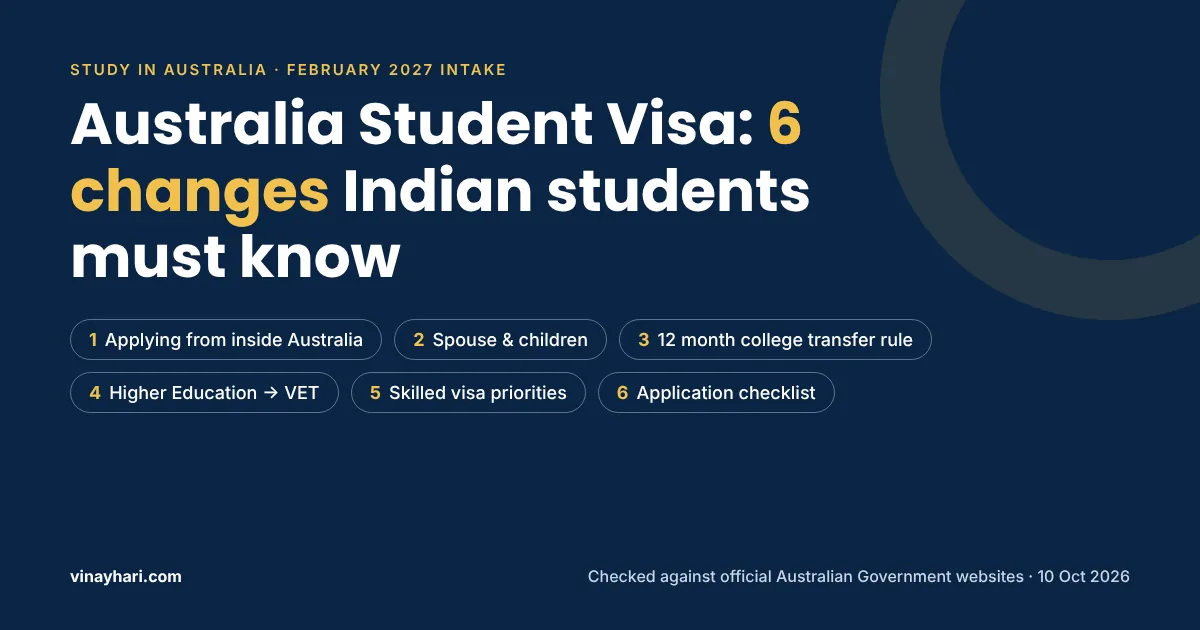
Return travel is also counted. Plan about AUD 2,000 to 2,500 for an Indian applicant. Spouse and children usually cannot be included for new students from 2 October 2026, so most readers only need the first row. We explain those changes here: Australia Student Visa February 2027: 6 Changes Indian Students Must Know.
A worked example, in rupees
The tuition numbers below are illustrations only. Use the fee on your own offer letter.
| Tuition, first year (AUD) | Living costs (AUD) | Travel, planning (AUD) | Total to show (AUD) | Approx. in rupees |
|---|---|---|---|---|
| 30,000 | 29,710 | 2,500 | 62,210 | about ₹42 lakh |
| 35,000 | 29,710 | 2,500 | 67,210 | about ₹45 lakh |
| 45,000 | 29,710 | 2,500 | 77,210 | about ₹52 lakh |
Rupee figures use about ₹67.6 per Australian dollar (10 October 2026). The rate moves, so check it on the day.
Two more points on this table:
-
OSHC is extra. The cost depends on the cover and the length of stay, from roughly AUD 580 upward.
-
AUD 29,710 is the visa benchmark, not your real budget. Rent and food in Sydney or Melbourne can cost more than the benchmark. Make your own budget for your city before you commit.
Two ways to show the money
Option 1: Show the funds. Acceptable evidence includes money deposited with a financial institution, a loan from a bank or government, and scholarship or sponsorship. For a loan, the best evidence of genuine access is that the money has been disbursed.
Option 2: Show your parents' income. Instead of funds, you can show that your parents (or a spouse who is not travelling with you) had a personal annual income of at least AUD 87,856 in the 12 months before you apply. With family travelling, the figure is AUD 102,500. Parents' incomes can be added together. The evidence must be official government documents, such as a tax assessment (Study Adelaide, Visa Envoy summary of the Home Affairs rules).
Put that income test in rupees and the reality is clear. AUD 87,856 is about ₹59 lakh a year of documented personal income. For most Indian families that is out of reach, so Option 2 suits only a small group. Most families use Option 1.
Genuine access: the part people forget
Having money is not enough. Officers must believe the money is genuinely available to you. That means:
-
A clear source. Salary savings, business profit, sale of a property with a registered deed and bank credit, maturing fixed deposits. Each should match the family's tax and income history.
-
A visible history. Large amounts that appear in the account just before lodging are a classic refusal trigger.
-
A clear relationship. If someone else is funding you, show the relationship, their ID, and any earlier support they gave you or another student.
-
Loans that are real. Bank sanction letter, loan terms and disbursement. If property or land is used as collateral, show it.
-
Land on paper is not funds. A land record shows wealth, but the visa asks for money you can use. Land helps as proof of source if it is sold and the money reaches the bank.
Never borrow money from friends or relatives for a few weeks only to show it. This is called "show money". It creates a false picture, and false or misleading information can lead to refusal under Public Interest Criterion 4020 and trouble with future applications. With India at Evidence Level 3, officers can check what you submit against other records.
Loans and the Student visa: what is allowed and what is not
Many families ask whether a loan can be shown as funds. The short answer: a loan can count, but only if it comes from a recognised lender, the money is genuinely available to the student, and it is real and not arranged for the file.
The key rule comes from the Australian High Commission in New Delhi. A loan must be from an acceptable "financial institution", and Home Affairs only recognises banks regulated by the Reserve Bank of India: SBI and associates, nationalised banks, other public sector banks, Indian private sector banks (not payment banks or local area banks), foreign banks and regional rural banks. Evidence that the loan has been disbursed is the best proof of genuine access. If it has not been disbursed, officers may doubt that you can really use the money (Australian High Commission: country specific financial guidance).
Loan by loan
| Loan type | Can it be used? | What is needed | Main risk |
|---|---|---|---|
| Education loan from a public or private bank (SBI, PNB, Canara, HDFC, ICICI, Axis, Kotak and similar) | Yes. The strongest loan evidence | Sanction letter for the full loan, with collateral details if any. Disbursement of tuition for the first year or first semester, travel and first 12 months of living costs, as the loan agreement and your college require | Sanction letter alone, with nothing disbursed. Loan much larger than needed |
| Education loan from an NBFC (finance companies that focus on education) | In our experience, NBFC loans need extra care. NBFCs are not on the High Commission's list of recognised lenders, so check before relying on them | If you still choose it, ask your college and Home Affairs in writing whether they accept it before you lodge | Refusal for funds from an unrecognised lender, even if the loan is genuine |
| Gold loan from a bank | In principle yes, as a loan from a recognised bank, but it is a weak choice that draws close scrutiny | Loan in the name of the student or parents, gold valuation, loan terms, disbursement into the account, and a clear plan to repay | Looks like show money held for a short time. Bullet repayment with no source. Gold loan from a gold lender that is not a bank is not on the recognised list |
| Property loan (loan against property, or mortgage on existing property) | In principle yes, if from a recognised bank, in the name of the student, spouse or parents, and disbursed | Property papers and valuation, sanction letter, loan terms, bank credits showing the money has arrived | Loan far more than the course needs. Loan taken long before the application. Loan taken by a business or company, which does not count |
| Personal loan from a bank | In principle yes, from a recognised bank, but officers ask how it will be repaid | Sanction letter, terms, disbursement, and proof the family can pay the EMIs from income | High interest. Unclear repayment. A new loan that appears just before lodging |
| Loan from a private sector bank (HDFC, ICICI, Axis, Kotak, IndusInd, Federal and similar) | Yes, Indian private sector banks are recognised. Payment banks and local area banks are not | Same papers as for any bank loan | Same checks on disbursement, size and repayment. Check small finance banks and cooperative banks with Home Affairs before relying on them |
| Loan from a private finance company, chit fund or moneylender | No. These are not banks regulated by the RBI and are not on the recognised list | Do not use for the visa file | Refusal, and possible doubt about the whole file |
| Borrowing from relatives or friends | No, informal loans do not count as loans from a financial institution | If a relative gives a gift, show their relationship, ID, tax papers and a signed gift deed | Looks like show money |
| Business loan | In our experience, officers treat business loans with great caution, so we do not rely on them as proof of funds. This is our experience, not an official rule | Do not use for the visa file | Refusal |
Two cautions on this table. The rule that only banks count is from the High Commission's current guidance. The red flags for other loans (a loan far larger than needed, taken long before applying, given as support for another student, or taken by a business) come from earlier Home Affairs guidance as summarised by Visa Envoy. Many loan sellers claim that every lender is accepted. Ask for the rule in writing from the official source, not from the person selling you the loan.
A strong education loan file
-
Sanction letter for the full amount, with loan terms, interest rate, repayment terms and collateral details.
-
Disbursement proof for the first year or first semester of tuition, as your college requires, and for travel and living costs for the first year if the loan covers them.
-
Bank statements that show where the money came from and went.
-
Papers of the person who takes the loan with you (usually a parent): ITRs, Form 16 or business papers.
-
A repayment sum: expected EMI against the family's documented income.
Rules of thumb for families
-
Take a loan to study, not to look rich. A loan taken only to fill the bank balance will be read as show money.
-
Borrow what the course needs. A loan far above the requirement draws questions.
-
Do not borrow twice for one file. The same property or gold cannot back two separate stories.
-
Think about repayment first. If both the parents' income and the student's later earnings are needed to repay, officers can doubt that the plan is realistic.
-
Check the lender before you sign. If the lender is not a bank regulated by the RBI, the loan may not help your visa at all.
-
A sibling's loan counts too. If another child is already studying on a loan, officers will ask if the family can carry both.
Recent funds: property sale, mutual funds, car sale, relatives, business and credit limits
Many Punjab families build the money close to lodging: a plot is sold, a mutual fund is redeemed, an uncle sends money. Recent funds are not banned. Home Affairs tells applicants to explain any recent large deposits, and ongoing ones such as wages. Where someone else provides the money, it asks for proof of the relationship, ID of that person and any history of support, and proof that a business is operating if one is involved (Home Affairs: genuine access to funds).
Officers may also look at whose name the account is in and how long the money has been there. A balance on one day does not show how the money grew, so the paper trail matters more than the balance.
For a sense of how a university reads these files, see the University of Adelaide's Genuine Student FAQ for India. It is a university's own guidance, not Home Affairs. It asks for statements covering about a year, with the latest entry within six months, and a clear explanation of how the funds were built.
| Source of funds | Can it be used? | Papers that make it believable | What breaks it |
|---|---|---|---|
| Property or plot sale | Yes, once the sale is complete and the money is in a bank account | Registered sale deed, earlier ownership papers, sale receipt, bank credit in the owner's account, tax paid on the sale in the ITR | An agreement to sell with no money received. A cash part that cannot be traced. A sale to a relative at a doubtful price. Selling jointly owned property without every owner's papers |
| Mutual fund sale | Yes, only after redemption into a bank account | Fund statement showing the holding, redemption confirmation, bank credit, capital gains in the ITR. The Adelaide FAQ accepts mutual funds only when redeemed into a bank account, with proof of both | Showing unredeemed units as funds. A redemption that lands days before lodging with no statement behind it |
| Car sale | Yes, for smaller amounts | RC transfer papers, sale invoice or receipt, buyer details, bank credit | Large sums explained as a car sale. A sale that does not match the car's age and value |
| Money sent by relatives or other third parties into the parents' account | Only in limited cases, and it draws the most questions | Signed gift deed, proof of relationship, the donor's ID, tax and income papers, the donor's own bank statement showing the transfer, and any past support | Many small transfers from many people. Money that arrives just before lodging and leaves after. A donor with no income papers. Money from several family members or third parties tends to look less genuinely available than money in the family's own accounts |
| Business current account | Only if the money is really the family's to commit to the student, and the business is real and running | Business registration, ITRs, balance sheet, GST returns, a transfer from the business into the personal account of the student or parent, and partners' or directors' consent where the business is shared | Showing a company's balance without moving it. Partnership money that belongs to partners. A business registered recently, which the Adelaide FAQ says is probably not accepted. Business loans, which in our experience officers question closely |
| Credit card limit | No. An unused limit is not money you hold | None. Do not submit it | Treating a limit as savings |
| Overdraft limit or agriculture limit (Kisan Credit Card) | No. An unused limit is a credit facility, not funds in the bank | None. Do not submit it | A farm credit limit shown as savings. If a loan is drawn, it must meet the loan rules above, and a crop loan used for tuition invites the question of why |
The points about gold sales and an agreement to sell come from consultancy guidance from earlier years, not a current Home Affairs list. Treat them as cautions: sell gold only with a jeweller's bill and a bank credit, and wait for the sale to complete before using property money.
How to present recent money
-
Write a funds summary on one page. List each source, the amount and the date it reached the bank.
-
Attach the paper trail behind each deposit, in the same order as the summary.
-
Keep the money in the sponsor's own account, in the same name as the papers. Do not move it through several accounts.
-
Do not use one source twice. The same fixed deposit, plot or gold cannot appear in two stories.
-
Match the story. The funds summary, the bank statements, the ITR and your Genuine Student answers must say the same thing.
-
Keep sponsors few and close. The Adelaide FAQ expects two or three sponsors, normally parents, and says several extra sponsors can suggest limited funds.
If you cannot document a source, leave it out. A smaller file that is clean is better than a bigger file with gaps.
Use the left side to build your file. Leave the right side out of it.
Which parent profiles find it easier, and which find it very hard
This is the question Punjab families ask us most, so we will answer it directly.
No occupation is banned. The rule is evidence. But some profiles produce clean, official, traceable paper far more easily than others.
| Parent profile | What usually helps | Where files struggle |
|---|---|---|
| Salaried parents (government, bank, private) | Form 16, ITRs for several years, salary slips that match bank credits, Form 26AS, savings and FDs with a long history | Savings too small for the course. Cash gifts from relatives deposited suddenly |
| Parents who own a business | ITRs with computation and balance sheet, GST returns, business and personal bank statements, proof of ownership and registration | Income in the ITR much lower than the lifestyle described in the statement. Large withdrawals from the business just before lodging. A business that runs mostly on cash, with thin paper |
| Farmer parents | Land records, crop sale records and mandi payments into the bank, proof of any other family income, FDs held for a long time | Agricultural income is exempt from Indian income tax, so the ITR may show very little. Cash sales with no bank trail. Land cannot be shown as funds. Doubts about ability to repay a loan |
| Low income, or income that is hard to prove | A scholarship, or a modest course with very clear funds | Cannot show 12 months of funds or the income test. Depends on a loan. Officers look at whether the family can repay it after the course |
In plain words: this visa is much easier to document for salaried and business families with clean tax records. It is very hard for farming families and for families with low or undocumented income.
Industry voices quoted by PIE News say the assessment has moved from "can you pay for the course" towards "can the loan be repaid after graduation", and that Punjab and Haryana are treated as states with higher risk (PIE News). That is an industry opinion, not an official rule.
An honest word to farming families and families with little income proof
If your family's income is real but poorly documented, please do not rush. Do three things first:
-
Rebuild the paper trail. Route crop and other sale payments through the bank for the coming months. Keep mandi records and land records together.
-
Run a repayment sum. Add tuition and living costs for the whole course, not only year one. Ask whether your documented family income can repay any loan after you graduate.
-
Choose a cheaper course that matches your background, or look at scholarships, or another country whose rules fit your documents better. A realistic plan is better than a refused file.
If the numbers still do not fit, the honest answer is "not now". There is no shame in that.
Top 10 profiles: students who have just finished Class 12
A Class 12 student has no job history, so the officer reads two things closely: your course story and your family's papers. Three points apply to every profile below:
-
Match the course to your stream. Commerce students usually fit business, accounting or finance degrees. Science students fit IT, engineering or health science. A big jump, such as arts to engineering, needs a clear reason.
-
Answer "why not study this in India?" With no work history, this is the question that decides many Class 12 files. Name the specialisation, the college and what India does not offer you.
-
Think about the whole degree, not year one. A bachelor's degree runs about three years or more. Add up tuition and living costs for the full course and ask if your family can carry it.
The verdicts below are general patterns. Every file is judged on its own facts, and none of them is a promise.
| # | Profile | What helps the file | What to watch | Our read |
|---|---|---|---|---|
| 1 | Parent is a government school teacher | Steady salary, Form 16, ITRs, salary credits matching bank statements, long savings history | Salary may be modest for the full cost. Gifts from relatives deposited suddenly | Strong, if savings or a sanctioned loan cover the course |
| 2 | Parent works in a public sector bank | Form 16, payslips, ITRs, service record, savings and FDs with history. Staff loan terms if used | Large FDs or gold loans opened just before lodging. Loan that is not yet disbursed | Strong, with clean source papers |
| 3 | Parent works in a private bank or finance company | Form 16, appointment letter, payslips, ITRs, bonus records | Variable pay and recent job change. Officer may ask how stable the income is | Strong to borderline, depending on income size and stability |
| 4 | Parent is an insurance broker or agent | ITRs for several years, commission statements, Form 16A (TDS) certificates, bank credits matching commission | Income changes year to year. Income in the ITR lower than the money shown. Cash commission with no bank trail | Borderline to strong. Depends on how consistent and documented the income is |
| 5 | Parent is a private school or coaching teacher | Appointment letter, payslips, bank salary credits, ITR | Lower salary, part payment in cash. Funds may rely on a loan | Borderline. Needs a modest course and a sanctioned, disbursed loan |
| 6 | Both parents salaried (for example one teacher, one bank employee) | Two incomes, two sets of Form 16 and ITRs. Combined savings are easy to explain | Pooled money moved into one account at the last minute | Strong. One of the easiest files to document |
| 7 | Parent owns a shop or trading business | ITRs with balance sheet, GST returns, business and personal statements, registration papers | Declared income far below the lifestyle described. Big withdrawals from the business before lodging | Strong if tax papers are clean. Weak if the business runs mostly on cash |
| 8 | Parent is a retired government or defence employee on pension | Pension slips, bank credits, retirement benefits with history, FDs | Pension is fixed, so the officer checks the family can fund the full degree | Borderline to strong. Depends on savings and a second income |
| 9 | Farming family with one parent in a job | Salary papers for the working parent, land records, crop payments through the bank | Farm income alone is hard to prove. Land is not counted as funds | Borderline. Strong only if the job income and savings carry the plan |
| 10 | Funding from an uncle, aunt or other relative abroad | Proof of relationship, the sponsor's ID, tax and income papers, history of earlier support | A distant sponsor with no clear reason to pay. Officers ask why the parents are not funding | Borderline to weak. Parents' own position will be questioned |
How to use this table
Find the row closest to your family, then check three things: can we show the money with papers, can we explain the source, and does the course fit the stream? If any answer is no, fix it before you apply, or choose a cheaper course or another route.
Two families with the same job can get different results. Income size, savings history, the course chosen, the story in the Genuine Student answers and any earlier refusals all matter more than the job title.
Refused before by Canada, USA, New Zealand, UK or Europe: how it affects your Australian application
A refusal from another country does not close the Australian door. But it will be read. Home Affairs lists immigration history as one of the Genuine Student factors, and says it looks at visa and travel history for Australia and other countries, including refusals and cancellations (Home Affairs: Genuine Student requirement). Assume the officer can see it, and answer every question about it truthfully.
The University of Adelaide's India FAQ gives a useful picture of how this is handled in practice. A refusal from the US, Canada or UK is taken into account with all your circumstances.
You are expected to give the date, the visa type, and for a student visa the institution and course, explain why you think it was refused, and show what has changed. If this is not addressed or cannot be explained, the file may fail the Genuine Student test, especially when other risk factors are present. The same university says a recent Student visa refusal from Australia or New Zealand will likely lead to a Genuine Student refusal, and other visa refusals are judged case by case (University of Adelaide GS FAQ). That is one university's guidance, not Home Affairs law, but it shows what officers worry about.
How each refusal tends to be read
| Earlier refusal | Why it matters in Australia | What to do before you apply |
|---|---|---|
| Canada study permit | Common reasons are doubt about study purpose, weak ties or unclear funds. Those are the same doubts the Genuine Student test asks about | Get the refusal letter and the GCMS notes if you have them. Fix the exact reason: course fit, funds or ties. Do not reuse the Canadian statement |
| USA student visa (F1) | A refusal mostly signals doubt that you will return home. Australian officers ask the same question in a different form | Explain what has changed in your ties and plan. Show a clear study reason that does not depend on settling |
| New Zealand study visa | A recent refusal from a neighbouring system reads as a close signal. The Adelaide FAQ treats a recent Australia or New Zealand student refusal very seriously | Treat this as a file with high risk. Wait, repair the problem, and apply only with changed facts |
| UK student visa | Refusals often come from funds, credibility of the course or documents. Those problems can repeat in Australia | Check whether the issue was funds, documents or course. Fix and document it |
| Europe or Schengen visa (visitor or study) | A visitor refusal is less serious than a study refusal but still counts as history. It is read for the reason | Keep the letter. Explain it briefly and honestly if asked. Do not hide it |
| A refusal for false or doubtful documents, in any country | This is the heaviest kind. It raises doubt about every paper you submit | Do not apply until a migration professional has reviewed your history. Any false document in the new file can end the application |
Declared or undeclared
An undeclared refusal is much worse than a declared one. Leaving it out can be treated as providing false or misleading information, which can lead to a refusal under Public Interest Criterion 4020 and problems that last into future applications. If the form asks about earlier refusals, answer it fully, and attach the explanation you would want the officer to read.
Five steps before you reapply anywhere
-
Collect every refusal letter, including visitor visas, from every country.
-
Write down the exact reason in one line. Not "they did not like my profile". The actual reason.
-
Change the real thing. More funds with a clean source, a better matched course, a clearer story or better ties. A new application with the same facts gets the same result.
-
Make your answers match. Your Australian Genuine Student answers must not contradict what you told the other country.
-
Allow time. A very recent refusal is harder to explain than one from years ago with a changed profile.
If you are not ready, the honest answer is "wait". Reapplying quickly with the same file is the fastest way to add a second refusal to your record.
See also: the FAQ above on a past visitor visa refusal, and why a valid visitor visa does not rescue a weak study file.
Our tip for the Genuine Student statement: spend 2 to 4 weeks inside your field first
The Genuine Student questions ask why this course, why this provider, why Australia and what you will do with the qualification. A student who has only read about the field struggles to answer these in a believable way. A student who has spent time in it answers in specifics.
Before you apply, spend two to four weeks in the area you want to study.
-
Applying for a Bachelor of Accounting? Spend two to four weeks with a Chartered Accountant. Watch what an accountant does in a day: filing returns, audits, GST, books, client calls. Ask what the work is like and where the career goes.
-
Applying for nursing, IT, hospitality, engineering, business, early childhood or any other field? Do the same with a hospital or clinic, a software company, a hotel, a workshop, a local business or a playschool.
What you gain:
-
You find out if the field suits you before you spend lakhs on it.
-
You can write real details. "I spent three weeks at a CA firm in Jalandhar and saw how GST filing works" says more than any general sentence about a passion for accounting.
-
You can explain the outcome. You will know what the qualification leads to, what jobs exist and what the course adds. That is the "value of the course to your future" factor Home Affairs asks about.
-
Your story connects. Your past study, this experience, the course you picked and your plan after study form one line, and officers look for that line.
Keep it honest. Ask the firm for a short letter or certificate stating the dates and what you observed, and keep photos or notes. Only claim what you actually did. A faked experience letter is fraud, and it can end your application and affect future ones. You must also be able to talk about what you saw if you are asked.
Time in the field gives you real details for the second and third answers. Your strengths, weaknesses and mentor give the whole statement a voice.
Write your own statement
Write the answers yourself, in your own words. Do not copy a template, a friend's answer or something from the internet, and do not let anyone else write it for you. The Home Affairs questions are put to you, and the officer is judging your own understanding, so your own account is the most believable. Answers that sound alike can read as copied.
A plain, honest answer in simple English is stronger than a polished one that does not sound like you. Get a parent, teacher or counsellor to read it for facts and spelling, but the words and the story must be yours.
Three things to include:
-
Your strengths. What you are good at and where it shows up. Marks in a subject, a project, a job, a skill, a habit.
-
Your weaknesses, honestly. What you are working on, such as English speaking, a weak year or a gap, and what you are doing about it. This makes the rest of your story more credible.
-
Your mentor. Name the person who guides and motivates you, such as a teacher, a family member or someone in your field, and say what they taught you or how they shaped your decision. Real people make real statements.
Interview preparation
Not every applicant is interviewed. Some providers hold a Genuine Student interview, and Home Affairs may ask for one in some cases, more often when a file carries risk. The exact format varies, so ask your provider what to expect. Prepare as though you will be asked.
What you may be asked, and what the officer is checking
| Question | What is being checked |
|---|---|
| Why this course? Why this provider? Why Australia? | Whether study is the real purpose, and whether you researched it |
| What will you study in the first semester? | Whether you know the course, not just the name |
| Why not study this in India? | Whether your reason is genuine and not a script |
| What did you do after Class 12 or your last degree? Why the gap? | Whether your history is consistent |
| Who is paying for it? What do your parents do? | Whether the funds, the sponsor and the story match your documents |
| How much are the fees and the living costs? | Whether you know the real numbers |
| What do you plan to do after the course? | Whether the plan is sensible and linked to your field |
| What if your visa is refused? | Whether you have thought it through honestly |
| Anything about your earlier visa refusal or visits | Whether you explain it the same way every time |
How to prepare
-
Know your file. Fees, living costs, sponsor names and jobs, loan details, course name, campus city, start date. Everything must match your documents.
-
Learn your course. Read the unit list and the career outcomes. Be ready to name two or three subjects and say why they matter to you.
-
Use your field experience. The two to four weeks in the field give you real stories to draw on.
-
Practise out loud. Do at least three mock interviews, record one on your phone and listen back. Practise with someone who will ask follow up questions, not just read from a list.
-
Answer in simple English. Short, clear sentences. If you do not understand a question, ask for it to be repeated.
-
Do not memorise a script. Memorised answers collapse when the officer asks a follow up question. Know your facts and tell your story.
-
Be honest about PR. Wanting to build a life in Australia is not what gets a file refused. What matters is that study is your main purpose now. Explain the course first. If you mention work after study, say it as a possible next step and not the reason you are going.
-
Be consistent. Your interview, your statement, your forms and your documents must tell the same story.
-
If you do not know, say so. A true "I am not sure, but I will check" is better than a guess.
A good interview does not guarantee a visa, and a weak one does not always mean refusal. What it does is show an officer that you are a real student with a real plan.
Top reasons Indian students are refused
Refusal letters often look alike. The ABC reviewed several and found almost identical paragraphs. Migration agents also told the ABC that outcomes can feel subjective from one officer to the next. That is exactly why a clear file backed by evidence matters. These are the patterns to guard against.
-
A weak or copied Genuine Student answer. You get four answers of 150 words each. If your text could describe any student applying for any course, it will not help you. One student in the ABC story was refused because the officer felt the statement did not give a strong enough reason for studying in Australia.
-
Funds that look arranged. Sudden deposits, an unclear source, a sponsor who cannot explain the money, or a loan that is only a promise.
-
A course that does not fit your past. An unrelated course, or a course at a lower level after a degree, with no story. Officers ask: why not study this in India?
-
Weak ties to home. Home Affairs looks at family, community, employment and economic circumstances. Bring 12 months of employment or business papers, and any job offer you expect.
-
Gaps in study or work. Unexplained gaps raise doubt. Explain them honestly, with proof.
-
Immigration history. Home Affairs looks at visa and travel history for Australia and other countries, including refusals and cancellations. An undeclared refusal is far worse than a declared one.
-
Inconsistent or false documents. Different numbers in the GS answers, the bank statements and the ITR. One false document can end an application.
-
A provider or course under scrutiny. In September 2026 the government stopped new enrolments in a graduate diploma it feared was being used by students who are not genuine to extend their stay. Choose a course and college you can defend.
-
Paper basics. A test result Home Affairs does not accept, missing OSHC, or documents that do not match the checklist in your ImmiAccount.
How to answer the Genuine Student questions
We will not give you a template, because templates are the problem. Here is the logic instead.
Your circumstances. Describe your family, your studies, your job or business, and what keeps you connected to India. Attach papers.
Why this course, this college, Australia. Name the subjects, the college, the city and a reason that only fits you. Show that you researched living costs, rent and the course structure. Explain why a similar course in India does not meet your plan.
Benefit of the course. Link it to a real career, with the type of role and the salary you expect, in India or abroad.
Anything else. Explain a gap, a previous refusal, or an unusual fact, in two honest sentences.
Then read all four answers together with your documents. If a stranger could not tell they came from the same person, rewrite them. Home Affairs gives more weight to statements backed by evidence, so attach the proof.

Work after study and PR: say it honestly
-
You can work up to 48 hours per fortnight during term and without a limit during scheduled breaks. That helps with daily costs. It is not a plan for paying tuition or for meeting the visa's money test.
-
The Temporary Graduate visa (subclass 485) now has an age limit of 35 at the time of application, and a much higher fee than before (IDP). Rules change often, so check the official page when you graduate.
-
A course in a priority sector does not give you a job, a skilled visa or permanent residency. The skilled visa processing directions only decide the order in which eligible applications are looked at.
Choose your course because you want the skills. Treat anything beyond graduation as a possibility, never a promise.
Your timeline for the February 2027 intake
Today is 14 October. Time is tight but workable if your file is ready.
| When | What to finish |
|---|---|
| This week | Run the 10 question check. Shortlist two or three courses and check each one is on CRICOS. Book or confirm your English test |
| By end of October | Accept an offer. Pay the deposit only when you are comfortable with your visa position. Start gathering ITRs, bank statements and papers that show where your funds came from |
| November | Get your eCoE. Buy OSHC. Write your four GS answers and match them against your papers. Complete medicals and police clearance as asked |
| Lodge | As soon as the file is complete. Many advisers suggest lodging 3 to 4 months before the course starts, which for February means now. A tracker built on Home Affairs data showed a median of about 23 days for Indian higher education applications in July 2026, but peak intake and requests for more documents can add time (Tern Visa tracker) |
| If the file is not ready | Do not rush it. Look at the July 2027 intake and use the extra months to fix your documents |
There is no prize for lodging early with a weak file. A complete, honest file lodged a few weeks later is better.
Check your provider's priority status on the day you lodge. It decides how soon your file is looked at, not whether it is approved.
FAQs
Can I apply from India for the February 2027 intake? Yes. Applying from outside Australia is the normal route. Apply only when your file is complete.
Is there a minimum bank balance? There is no single number. You must show 12 months of tuition, living costs and travel. The living cost part is AUD 29,710 for a single student.
Can my parents' income replace the funds? Yes, if the parents or a spouse who is not travelling had a personal annual income of at least AUD 87,856 in the last 12 months, proved by official tax documents. For most Indian families that means about ₹59 lakh a year, so most use the funds route.
Is an education loan accepted? Yes. A loan from a bank or government is an accepted type of evidence, and disbursement is the strongest proof. Officers also consider who took the loan, the collateral and whether it can be repaid.
How long must the money sit in the account? In the sources we reviewed, Home Affairs does not set a fixed holding period. But officers want to see where the money came from, and a long, steady history helps. Large recent deposits cause trouble.
Can I take my husband or wife? Usually not, for new students from 2 October 2026. Only a few groups are exempt, and Indian students are not in the exempt country groups.
Can I pay my fees from part time work? No. Work hours are capped at 48 hours per fortnight in term, and you must show your funds before you go.
Will studying in Australia give me PR? No. A course does not guarantee a job, a skilled visa or permanent residency.
If I am refused, can I appeal? Applicants who apply from outside Australia have no appeal right. Read the refusal letter, fix the real problem, and reapply only with a changed file. Do not send the same file again.
Is IELTS 6.0 enough for every course? It is the visa minimum for most applicants going straight into a course. Your college may ask for a higher score.
Is one refusal the end of the road? No, but it will be read in every future application. It must be declared and explained.
My older brother or sister is already studying in Australia. What happens to my application, and how can our parents justify the income? There is no automatic penalty and no automatic benefit. Officers ask one practical question: can the same family fund two students at once? Home Affairs asks sponsors to show any financial support they have already given to a student visa holder, so your parents' support for your sibling will be read alongside your file.
How to prepare:
-
Show the full picture. Put your sibling's remaining tuition and living costs next to your costs for the first year, then show income and savings that cover both.
-
Never show the same money twice. One fixed deposit cannot be the proof for two students. Keep separate, traceable funds or a clear plan.
-
Show the support history. Fee receipts and money transfers for your sibling, matched with the parents' income, prove the family has already managed it.
-
Do not count your sibling's pay from part time work as family funding. It is a small extra, and officers know the limit on work hours.
-
Use your sibling's record. A sibling who is attending, passing and following visa conditions helps your story. A sibling with a poor record, a course change or a visa problem will make officers look harder at yours.
-
Think about repayment. If one loan is already running, a second loan raises the question of whether the family can repay both.
If the income does not clearly stretch to two students, wait for your sibling to finish, or choose a cheaper course.
I was refused a visitor visa before. Will it affect my study visa? It can. Home Affairs looks at your visa and travel history for Australia and other countries, including refusals and cancellations. A past visitor refusal is not an automatic reason to refuse a study visa, but you must declare it and the officer will read the reasons. If the visitor refusal was about weak ties, unclear funds or doubt about your purpose, the same doubts can follow you into the study file.
What to do: get the refusal letter, understand the exact reason, fix that problem with real documents, and make sure your Genuine Student answers tell the same true story. Never hide a refusal. An undeclared refusal is treated far more seriously than a declared one.
Many students already hold a valid visitor or tourist visa. Why do they still get a study visa refused? Because the two visas test different things. A visitor visa asks whether you will visit and go home. A study visa asks whether study is your genuine main purpose, whether the course makes sense for you, and whether your family can fund tuition and living costs for the course. Reasons we see:
-
Funds that were enough for a trip are not enough for a degree. Showing money for a holiday is very different from showing 12 months of tuition, living costs and travel.
-
Travel history does not prove study intent. A granted visitor visa, or trips to other countries, helps your immigration history. It does not explain your course, your college or why Australia.
-
Applying to study soon after a visit can look like scouting. If you visited Australia and then applied to study soon after, officers may question whether the visit was really a tourist trip. Keep your story consistent.
-
Earlier statements are compared with new ones. What you said about your studies, family and finances in the visitor application should match your study file.
-
You cannot switch inside Australia. From 2 October 2026 most visitor visa holders must be outside Australia when they lodge and when the Student visa is granted (see our guide to the changes).
A valid visitor visa is a small plus. It is never a substitute for a strong Genuine Student and finance file.
Official websites to check
Always confirm figures on the official site before you pay any fee. Rules and amounts change.
| Body | What to check | Link |
|---|---|---|
| Department of Home Affairs | Student visa (subclass 500): eligibility, financial capacity, fees | Student visa page |
| Department of Home Affairs | Genuine Student requirement | GS requirement |
| Department of Home Affairs | Accepted English tests and scores | English language |
| Department of Home Affairs | How offshore student applications are prioritised | Processing priorities |
| Study Australia | Government guide for international students and the 2027 planning level | Study Australia |
| Department of Employment and Workplace Relations | 2027 National Planning Level | DEWR |

Vinay Hari, founder, Angels Immigration and Education Consultant
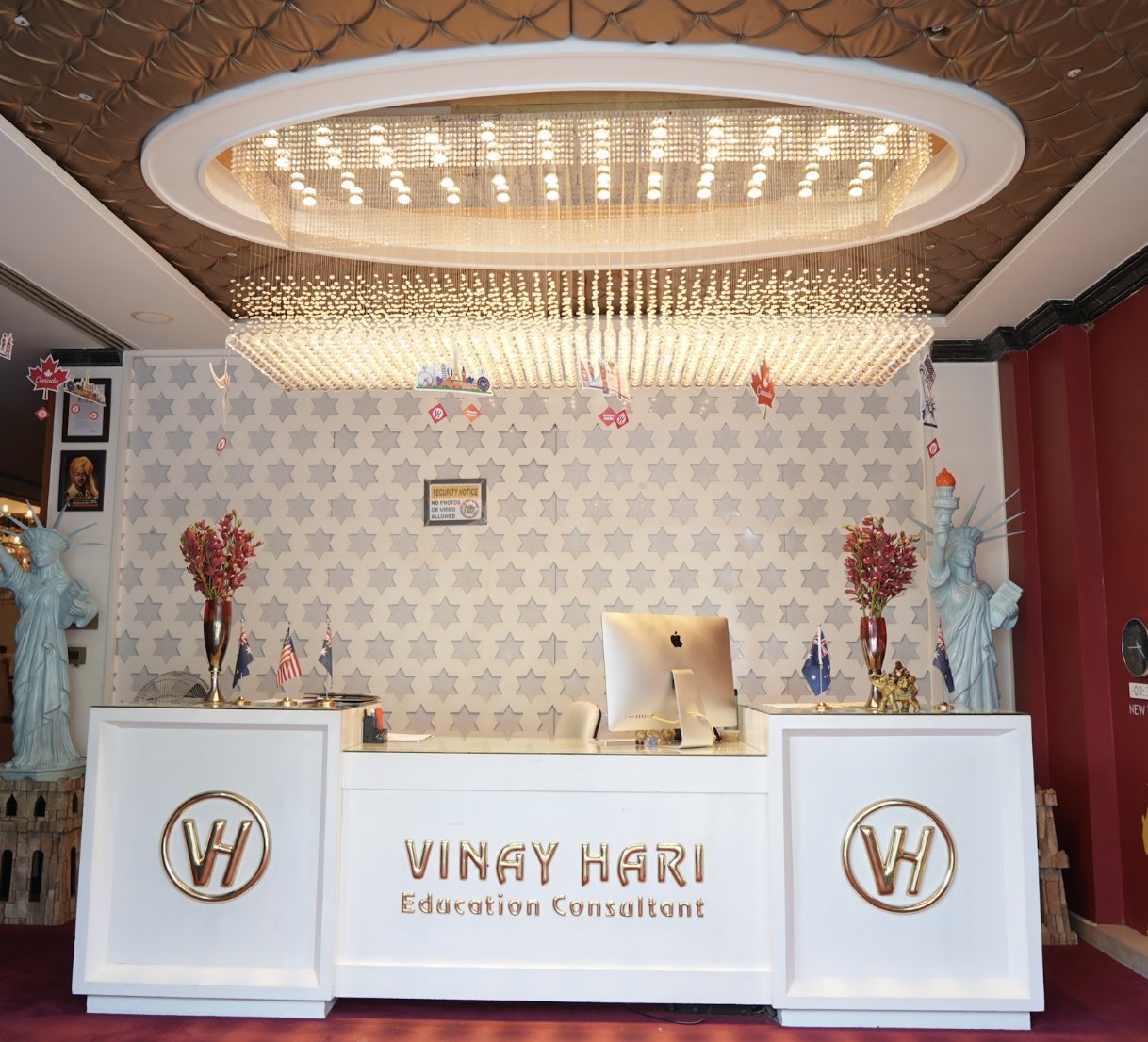
Our reception in Mohali. Walk in, sit down, and we will go through your file together.

Talk to us before you move money
Our first step is always an honest profile check. We look at your studies, your course choice, your family's documents and your funds, and we tell you plainly whether to apply now, fix something first, or wait. If the honest answer is "not yet", we will say so. Also read: Australia student visa changes from 2 October 2026 and our Study in Australia page.
WhatsApp: 73075 30886
Call: 95131 65527 or 73075 30886
Email: me@vinayhari.com
Head office, Mohali: SCO 505, Sector 82, Mohali, Punjab
Branch, Jalandhar: BMC Chowk, Jalandhar, Punjab
Disclaimer: This article is general information as of October 2026, not legal or immigration advice. Australian visa rules, fees and processing priorities change often. The decision on every visa belongs only to the Department of Home Affairs, and no consultant can guarantee a visa, a job or permanent residency. Rupee figures are approximate and depend on the exchange rate. Confirm current rules on official government websites before applying.
Sources
-
ABC News: Australian student visa refusal rate hits 10 year high (9 September 2026)
-
PIE News: Nearly half of South Asian applicants refused Australian study visas
-
Gulf News: Australia flags India and three other countries as high risk for student visas
-
Erickson Immigration Group: Australia raises visa and citizenship fees
Vinay Hari, Angels Immigration & Education Consultant Pvt. Ltd.
Head office: SCO 505, Sector 82, Mohali, Punjab. Branch: BMC Chowk, Jalandhar, Punjab. Phone and WhatsApp: 95131 65527, 73075 30886. Email: me@vinayhari.com. Website: vinayhari.com
Government links and references
Below are the official pages behind this blog, checked on 14 October 2026, with what each one says and where it was last updated when the page shows a date. Rules change, so open the link and check the date before you rely on a figure. Where a point comes from a university or a consultancy and not from a government page, the third table says so.
1. Official sources by topic
| Topic | What the official source says | Link |
|---|---|---|
| Student visa (subclass 500) main page | The starting page for who can apply, how to apply and the requirements. Last updated 12 October 2026 | Home Affairs: Student visa (subclass 500) |
| Genuine Student (GS) requirement | Applies to applications lodged on or after 23 March 2024. Applicants must be genuine and understand that study is the primary reason for applying. Future plans to apply for permanent residence do not count against an applicant under GS. The application form asks about current circumstances (ties to family, community, employment, economic position), why this course with this provider (including understanding of the course and of studying and living in Australia), how the course will benefit the applicant, and any other relevant information. There is a further question for people who have held a student visa. Each answer has a limit of 150 words and must be in English. Home Affairs prefers answers in the form over a separate statement and gives more weight to statements backed by evidence. Last updated 24 September 2026 | Home Affairs: Genuine Student requirement |
| How GS is assessed (legal direction) | The GS page points to Ministerial Direction No. 106, which sets out how officers assess the criterion | Ministerial Direction No. 106 (PDF) |
| Evidence to attach for GS | The same page lists what to include: transcripts, provider names and length of study, employment details with a contact who can confirm them, personal ties, reasons for not studying at home if a similar course exists there, documents showing employment or business activity for 12 months before lodging, and tax returns or bank statements | Home Affairs: Genuine Student requirement |
| Immigration history and earlier refusals | Under GS, officers consider visa and travel history for Australia and other countries, previous visa applications, and visa refusals or cancellations. This is the basis of the section on refusals from Canada, the USA, New Zealand, the UK and Europe | Home Affairs: Genuine Student requirement |
| Genuine access to funds | You must show genuine access to funds for yourself and any family travelling with you. When someone else provides the funds, show the relationship and any history of support, give their ID, and if a business is involved show it is operating. Explain recent large deposits and ongoing ones such as wages. For an education loan, the money should be paid out under the agreement between you, the bank and the provider. For other loans, show the security, the terms and your ability to cover ongoing costs. The best evidence of access to a loan is disbursement | Home Affairs: Genuine access to funds |
| Which banks Home Affairs recognises in India | From the Australian High Commission in New Delhi: Home Affairs only recognises banks regulated by the Reserve Bank of India. The listed categories are SBI and associates, nationalised banks, other public sector banks, Indian private sector banks (not payment banks or local area banks), foreign private banks, and regional rural banks. An education loan letter should show any collateral. For the annual income option, the Income Tax Return issued by the Income Tax Department is accepted evidence. NBFCs, small finance banks and cooperative banks are not named on the list, so check them before relying on them | Australian High Commission: country specific financial guidance |
| Living cost amounts and the annual income option | The current amounts are on the Student visa page under the financial capacity part of "How to apply". Check every AUD amount on that page before you lodge. The legal instruments are on the Federal Register of Legislation | Home Affairs: Student visa, how to apply and Federal Register of Legislation |
| Visa application charge | Home Affairs publishes the price in its visa pricing table and a pricing estimator. Last updated 1 July 2026. Confirm the AUD 2,500 figure there | Visa pricing table and Visa pricing estimator |
| Processing priorities (Ministerial Direction 115) | Applications lodged outside Australia on or after 14 November 2025 are prioritised under Direction 115. A Ministerial Direction is not a visa cap and does not set the criteria for approval or refusal. Priority 1 covers providers below their threshold and some groups such as schools and TAFE. Priority 2 applies to providers that have reached 80 per cent of their allocation. Priority 3 applies to providers 15 per cent over. Home Affairs aims to start processing Priority 1 within 1 to 4 weeks, Priority 2 within 5 to 8 weeks and Priority 3 within 9 to 12 weeks, and says these can change. Your priority is set by the provider's status on the day you lodge and does not decide whether you are granted or refused. Last updated 10 November 2025 | Student visa processing priorities and Ministerial Direction 115 (PDF) |
| Your provider's priority status | The Department of Education publishes each higher education provider's visa prioritisation status. For VET, ask the provider | Department of Education: visa prioritisation status |
| Processing time guide | Shows processing times for recently decided applications. It is a guide, not specific to your case | Global visa processing times |
| National Planning Level for 2027 | The government set a National Planning Level of 295,000 for 2027, the same as 2026, and a Ministerial Direction will continue to apply in 2027. No active provider gets a 2027 allocation lower than its 2026 one | DEWR: National Planning Level |
| English language tests | Home Affairs accepts scores from approved tests taken at a secure test centre. It does not accept at home or online tests such as IELTS Online, IELTS Indicator, TOEFL iBT Special Home Edition or OET@Home. The score needed for the visa is on the Student visa page | Study Australia: language testing organisations |
| Overseas Student Health Cover (OSHC) | Students on a student visa must hold OSHC for the duration of the visa. The Department of Health publishes the OSHC fact sheet and guidance | Private Health: Overseas student health cover |
| False or misleading information (PIC 4020) | A visa may be refused if a bogus document or false or misleading information is given to Home Affairs. The tribunal fact sheet describes the criterion, looks at a 12 month period before the application, and explains that evidence can be given to show information was not false or misleading. Ask a registered migration agent about the length of any bar on future applications | Tribunal fact sheet on PIC 4020 |
| Applying and preparing the file | You lodge in ImmiAccount. Home Affairs also publishes a page on preparing a complete application | ImmiAccount and Check twice, submit once |
2. Where each of our points comes from
| Our point | What the official source supports | What is our advice |
|---|---|---|
| Spend 2 to 4 weeks in your field before you apply | GS assesses your knowledge of the course, provider and life in Australia, the research you did, whether the course is relevant to past or planned work, and gives more weight to statements backed by evidence | The two to four week period is our advice, not an official number |
| Write your own statement, with strengths, weaknesses and a mentor | The questions are put to you about your circumstances, your reasons for the course and its benefit to you | Home Affairs does not say you cannot get help. "Write it yourself" and the mentor point are our advice, because the officer is judging your own understanding |
| Interview preparation | The official GS page does not describe interviews | Some providers interview and Home Affairs may ask for one. The question list and preparation steps are our advice, helped by the Adelaide FAQ |
| Refused before in Canada, the USA, New Zealand, the UK or Europe | GS lists immigration history, previous applications and refusals. PIC 4020 covers false information | The reading of each country's refusal is our reasoning. The Adelaide FAQ is a university's view |
| Recent funds: property, mutual fund, car, relatives, business | Explain recent large deposits. Show relationship, ID and support history when someone else provides funds. Show a business is operating | The document lists for each source are good practice, not a government checklist |
| Credit card, overdraft and Kisan Credit Card limits are not funds | Home Affairs asks for genuine access to funds, and says the best proof of a loan is disbursement | No page names these three limits. Our position is that an unused limit is not money you hold |
| Loans: which banks count | The High Commission list of banks regulated by the RBI | Our guidance on NBFCs, small finance banks and cooperative banks is a caution because they are not on the list |
3. Points that rest on sources outside government
These are useful but are not official. Treat them as guidance, not official rules.
| Point | Source | Note |
|---|---|---|
| Mutual funds accepted only after redemption into a bank account; recently registered businesses probably not accepted; two to three sponsors expected; statements covering about a year | University of Adelaide Genuine Student FAQ for India | A university's own assessment guidance, not Home Affairs law. It also names Punjab, Haryana and Gujarat as regions assessed more strictly |
| Gold sales and agreements to sell property not accepted | Consultancy guidance from earlier years | Treat as a caution only |
| Business accounts and business loans | Home Affairs policy text reproduced on consultancy websites | Home Affairs confirms that a business must be shown to be operating. It gives no rule on business loans. What we say about them is our own experience. Confirm with Home Affairs or your provider |
| India moved to Evidence Level 3 on 8 January 2026 | News reports quoting a Home Affairs spokesperson, such as Information Age | Home Affairs does not publish a list of countries by evidence level |
| India's refusal rates | News reports of Home Affairs data | No government table is published for this. These are reported figures |
How to use these links
-
Open the page and read the last updated date before you quote a rule or an amount.
-
Check every AUD figure again against the Student visa page on the day you lodge.
-
Use your provider's international office for questions about their own evidence requirements and interviews.
-
For anything that could change a decision (an earlier refusal, a doubtful document, an unusual source of funds), speak to a registered migration agent before lodging.
Chat with us on WhatsApp
Tap here to message us on WhatsApp or save 73075 30886 and send us a message. Share your course, marks, IELTS or PTE score and family funds, and our team will tell you where you stand.
Angels Immigration and Education Consultant. Head office: SCO 505, Sector 82, Mohali. Branch: BMC Chowk, Jalandhar. Email: me@vinayhari.com