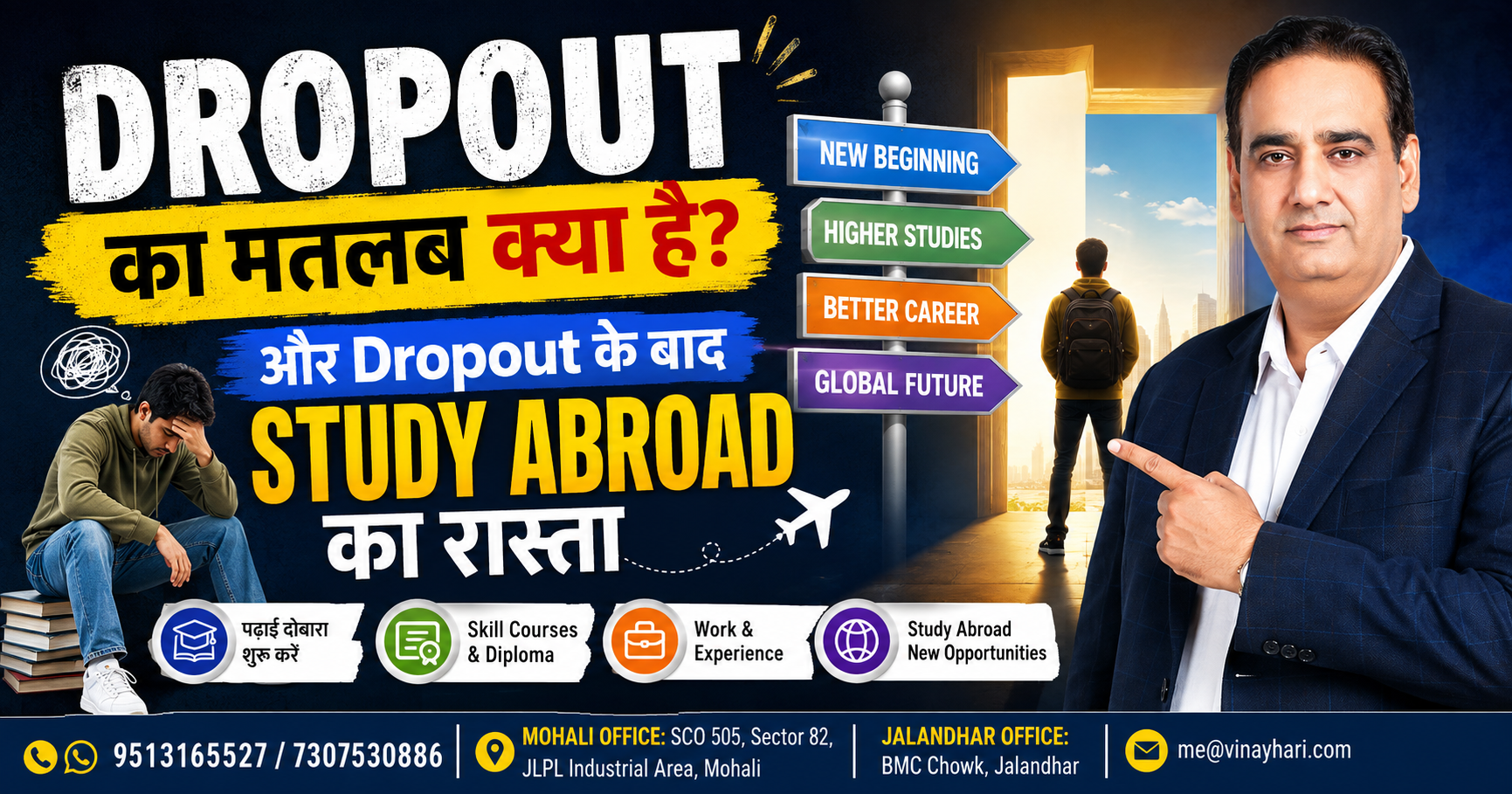

Wondering what to do after 12th? You are not alone. Every year, lakhs of students in Punjab and Haryana finish school with good marks and no clear plan. This guide explains what to do after 12th step by step: how to pick a course, how to compare India with study abroad, and how to choose between Australia, Canada, the USA, the UK and New Zealand.

You are not incapable. You are overloaded.
Most students who feel lost after 12th are not short of ability. They are short of clarity. There are hundreds of courses, dozens of countries, and an opinion from every relative.
School teaches you subjects. It rarely teaches you how to make a decision this big. One aptitude test in Class 10 does not settle it either.
This guide gives you a simple way to decide. It covers how to shortlist a course, whether studying abroad suits you, how to think about loans, and what parents should check before saying yes.
One honest point before we start: there is no perfect choice. The fear of choosing wrong keeps many students stuck for a full year. You do not need to know your exact job today. You only need to be moving in the right direction.
Stop comparing: “Sharma ji’s son went to Canada”
Comparison used to come from one neighbour. Now it comes from every reel. Someone is graduating in the US, someone posts a salary on LinkedIn, someone’s cousin has landed in Melbourne.
What you see is the result. What you do not see is their marks, their family budget, their loan, their rejections, and the years of work behind that one photo.
A course that worked for someone else can be the wrong one for you. Use other people’s stories as information, not as instructions. Your decision should start with you.
What to do after 12th: a 4-step method to shortlist your course
- Know your strengths. Ask what comes easily to you. Some students are good with people, some with numbers and logic, some with creative work, some with machines and code. Your marks, your hobbies and what friends ask your help with are all clues.
- Check your interest honestly. A strength you dislike using will not last four years. Pick a field you would still read about when no exam is coming.
- Face the budget early. Sit with your parents and put a real number on the table: fees, living costs, and how much loan the family can carry comfortably. A good plan within budget beats a dream plan that collapses in the second year.
- Study the scope. Look at where the jobs are, in India and outside. Check official occupation lists and placement data, not only what a college brochure says.
Where all four overlap, you have your shortlist of courses after 12th. It will usually be two or three courses, not twenty.
Test it before you commit. Do a short internship, volunteer with an NGO, help organise an event, or take a short online course in the field. A month of real exposure tells you more than a year of thinking at home.
Courses after 12th, stream by stream
These are the common courses after 12th, not a complete list. Entry requirements and course availability vary by country and institution, so confirm them for the intake you are targeting.
| Stream | Popular directions in India | Fields students often consider abroad |
|---|---|---|
| Science (Non-Medical) | Engineering, computer applications, architecture, B.Sc. | IT and software, data analytics, engineering, construction management |
| Science (Medical) | Medicine, nursing, pharmacy, allied health, biotechnology | Nursing, health sciences, aged care, biomedical science, public health |
| Commerce | B.Com, BBA, CA, CS, economics | Business, accounting, finance, business analytics, supply chain, hospitality |
| Arts / Humanities | BA, law, journalism, design, psychology | Early childhood education, social work, design, media, psychology, hospitality |
Your stream is a starting point, not a cage. It does not lock your choice of courses after 12th. Many students change direction at the bachelor’s level, as long as they meet the subject requirements of the new course.
Study abroad after 12th or stay in India? 5 questions to ask first
Study abroad after 12th is a good path for some students and the wrong one for others. It is not a status symbol and it is not for everybody. Answer these before you decide.
- Do I know what I want to study, and why? “I just want to go abroad” is not a plan. Visa officers also look for a clear, genuine study purpose.
- Does my chosen field have real demand there? Some fields have strong demand in one country and very little in another.
- Can my family afford it without breaking? Count tuition, living costs, travel, insurance and a buffer for emergencies.
- Am I ready to live independently? Cooking, budgeting, part-time work, loneliness and a new education system all arrive together.
- What is my plan B? If the visa is refused, or plans change after graduation, what will I do with this qualification in India?
If you can answer all five with confidence, abroad deserves serious thought. If not, a good Indian degree now and a master’s abroad later is a perfectly strong route.
Course first, country later
When planning study abroad after 12th, most students choose the country first because a friend is there. Do it the other way round. Pick the field, then find the country where that field is valued.
Several countries publish official lists of occupations they are short of. Australia has its skilled occupation lists. New Zealand has its Green List. Other countries publish similar shortage or in-demand lists.
These lists show which skills a country currently needs. If your course leads to an occupation on such a list, your qualification is more likely to be relevant to that job market.
Two cautions. These lists are revised regularly, so an occupation listed today may not be there when you graduate. And being on a list does not guarantee a job, a work visa or permanent residency. Each has its own eligibility rules, which also change. Always check the latest version on the official government website.
Study abroad after 12th: benefits of the top 5 destinations
Each country below offers something different. Read them with your course and budget in mind, not as a ranking.
🇦🇺 Australia

Full guide: Study in Australia from India
- Globally recognised universities alongside a strong vocational (TAFE) sector, so there are options for both degree and practical, job-oriented study.
- Visible skill demand. Published skilled occupation lists make it easier to see which fields the country needs, such as health, IT, engineering, early childhood education and trades.
- Post-study work options for eligible graduates, with the length depending on qualification and current rules.
- Part-time work rights during study, within government-set hour limits.
- Multiple intakes each year, which gives flexibility on when you start.
- A large Indian student community and a climate many Indian students find easy to adjust to.
🇨🇦 Canada
Full guide: Study in Canada from India
- A wide range of public colleges and universities, from practical diplomas to research degrees.
- Co-op programmes in many courses, which build paid work experience into the study period.
- Post-graduation work permit for eligible programmes and institutions.
- A well-established Punjabi and Indian community, which makes settling in easier for many students.
- A multicultural, welcoming society with English and French as official languages.
- Good to know: Canada has tightened its international student rules in recent years, so choosing the right course and institution matters more than before.
🇺🇸 USA

Full guide: Study in the USA from India
- The largest concentration of top-ranked universities in the world.
- Flexible academics. Many bachelor’s programmes let you explore subjects before fixing your major, which suits students who are still deciding.
- Research and STEM strength, with close links between universities and industry.
- Work authorisation after study (OPT) for eligible graduates, with a longer period available for qualifying STEM fields.
- Scholarships and assistantships at many institutions, mostly merit-based and competitive.
- Community college pathways that can lower the cost of the first two years.
🇬🇧 UK
Full guide: Study in the UK from India
- Shorter courses. Bachelor’s degrees usually take three years and many master’s degrees take one, which saves time and living costs.
- Historic, globally respected universities with qualifications recognised in India and worldwide.
- Graduate Route post-study work option for eligible graduates.
- Strong in business, finance, law, design and the humanities, as well as science and engineering.
- Closer to India than North America or Oceania, with good flight connections.
🇳🇿 New Zealand

Full guide: Study in New Zealand from India
- Consistent quality. A small number of universities, all of which feature in global rankings, plus institutes of technology for applied study.
- Green List of in-demand occupations, which makes skill needs clear.
- Post-study work options for eligible qualifications.
- Safe, peaceful environment with smaller class sizes and more personal attention.
- Practical, hands-on teaching style and a good work-life balance.
Country comparison at a glance
Cost levels are relative to each other and vary widely by city, institution and course. Use this table to narrow your list, then check current figures and rules for your intake.
| 🇦🇺 Australia | 🇨🇦 Canada | 🇺🇸 USA | 🇬🇧 UK | 🇳🇿 New Zealand | |
|---|---|---|---|---|---|
| Best known for | Health, IT, engineering, trades | Diplomas with co-op, tech, business | STEM, research, flexible degrees | Short degrees, business, law, design | Applied study, agriculture, health, IT |
| Usual bachelor’s length | 3 to 4 years | 3 to 4 years (diplomas 2 to 3) | 4 years | 3 years | 3 years |
| Relative overall cost | High | Medium to high | Highest | High, offset by shorter courses | Medium |
| Post-study work | Available for eligible graduates | Available for eligible programmes | OPT, longer for STEM | Graduate Route | Available for eligible qualifications |
| Official skill-demand list | Skilled occupation lists | Category-based and provincial lists | No single national list | Shortage-based salary list | Green List |
| Visa process | Online application, genuine student test | Online application, intake caps apply | In-person interview required | Online application, points-based | Online application |
| Suits students who | Want a course linked to clear skill demand | Want practical study with work experience | Have strong academics and higher budget | Want to finish faster | Prefer a quieter, safer setting |
| Keep in mind | Higher living costs in big cities | Rules have tightened; choose institution carefully | Highest cost; outcome after study less predictable | Short post-study window to find work | Smaller job market |
How to use this comparison: pick your field first, then mark the two countries where that field is strongest and the cost fits your family. Compare those two in detail instead of all five.
Post-study work, part-time hours and visa conditions are set by each government and are revised often. None of them is a guarantee of a job or permanent residency.
5 in-demand fields in every country: Healthcare, Construction, Trades, Agriculture, Technology
If you are comparing courses after 12th, these five fields appear again and again on skill shortage lists across the five countries. The reason is simple: ageing populations need care, growing cities need building, every economy needs skilled hands and food production, and every industry now runs on software and data.
| Field | 🇦🇺 Australia | 🇨🇦 Canada | 🇺🇸 USA | 🇬🇧 UK | 🇳🇿 New Zealand |
|---|---|---|---|---|---|
| Healthcare | Nursing, aged care, allied health, early childhood health | Nursing, personal support work, medical laboratory technology | Nursing, public health, health informatics | Nursing, adult social care, biomedical science | Nursing, healthcare assistance, medical imaging |
| Construction | Civil engineering, construction management, quantity surveying | Civil engineering technology, construction project management | Construction management, civil engineering | Quantity surveying, construction project management | Construction management, quantity surveying, civil engineering |
| Trades | Carpentry, electrical, automotive, commercial cookery | Welding, electrical, HVAC, heavy equipment | HVAC, welding, automotive technology (community and technical colleges) | Engineering technician and building services courses | Carpentry, electrical, plumbing, automotive |
| Agriculture | Agricultural science, agribusiness, horticulture | Agricultural technology, agribusiness, food science | Agricultural science, food science, agri-tech | Agriculture, agri-food technology | Agricultural science, dairy, horticulture, viticulture |
| Technology | Software engineering, cyber security, data analytics, networking | Computer programming, software development, data analytics, cloud computing | Computer science, artificial intelligence, data science, cyber security | Computer science, data science, artificial intelligence, fintech | Software development, ICT, data analytics, networking |
Healthcare
Demand is strong in all five countries, and nursing leads everywhere. Courses are competitive and usually ask for science subjects in 12th and a higher English score. To work after graduation, you must register with that country’s nursing or health authority, which has its own exams and requirements.
Construction
Housing and infrastructure projects keep this field busy, especially in Australia, Canada and New Zealand. Non-Medical students fit degree routes such as civil engineering. Students from any stream can look at diploma routes such as construction management.
Trades
This is the most practical route and often the shortest. Australia, Canada and New Zealand have clear study pathways for international students in trades. In the USA and UK, most trade training runs through local apprenticeships, so options for international students are narrower. Most trades need a local licence or certification before you can work independently.
Agriculture
A natural fit for students from farming families in Punjab and Haryana. Modern courses focus on agribusiness, food technology and farm management, not only fieldwork. New Zealand, Australia and Canada are the strongest choices. Many jobs are in regional areas, so be ready to live outside the big cities.
Technology
Technology is offered in all five countries and suits Non-Medical students best, though many IT diplomas accept students from any stream with maths. The USA is the strongest for research and advanced fields such as artificial intelligence. Canada and Australia offer practical diplomas and degrees with work placements. Cyber security and data analytics are in demand almost everywhere. Competition for entry-level jobs is high, so projects, internships and certifications matter as much as the degree.
Remember: demand today does not guarantee a job or residency tomorrow. Check the latest official occupation list, the course entry requirements and the registration or licensing rules before you choose.
Education loans: when they make sense and when they do not
For study abroad after 12th, a loan is a tool. Used with a plan, it opens a door. Used on hope, it becomes a burden on the whole family.
A loan can make sense when:
- The course is in a field with visible demand
- The institution is recognised and the qualification has value in India too
- The family can manage the EMIs even if your income starts later than expected
- You have read the repayment terms, interest rate and moratorium period yourself
Think again when:
- The plan depends fully on part-time income to pay fees
- The course was chosen only because admission was easy
- The family would have to sell or mortgage its only home or land
- Nobody has calculated the total cost including living expenses
Part-time work helps with daily expenses in many countries, but work-hour limits apply and they change. Treat it as support, not as your fee plan. Repayment timelines also differ for every student, so do not plan around someone else’s story.
A note for parents
Your child’s confusion is normal at 17 or 18. What helps most is a calm conversation, not pressure and not comparison with someone else’s child.
Before you agree to any plan for what to do after 12th, in India or abroad, check these:
- Is the course your child’s choice? A student pushed into a course often drops out or switches, and that costs more.
- Is the institution recognised? Verify it on official government or regulator websites, not only in a brochure.
- What is the full cost? Ask for a written breakdown of tuition, living costs, insurance and visa-related expenses.
- Where will your child live, and who is the support contact? Accommodation and student support matter as much as rankings.
- What is promised, and is it in writing? Be careful with anyone who guarantees a visa, a job or PR. Nobody can guarantee these. Decisions rest with the governments and employers concerned.
A good counsellor will tell you when a plan does not suit your child. That honesty is worth more than a fast admission.
Official government references
Always confirm visa rules, work rights and occupation lists on the official websites below before you decide.
| Country | Student visa and immigration | Official study guide |
|---|---|---|
| 🇦🇺 Australia | Department of Home Affairs | Study Australia |
| 🇨🇦 Canada | Immigration, Refugees and Citizenship Canada | EduCanada |
| 🇺🇸 USA | US Department of State, student visas | EducationUSA |
| 🇬🇧 UK | GOV.UK Student visa | Study UK, British Council |
| 🇳🇿 New Zealand | Immigration New Zealand | Study with New Zealand |
What to do after 12th: frequently asked questions
What to do after 12th if I am totally confused?
Start with the 4-step method above: list your strengths, check your interest, fix the budget with your family, and study the scope. Then speak to a counsellor with that shortlist in hand.
Which are the best courses after 12th?
There is no single best course. The right one sits where your strengths, interest, budget and job scope overlap.
Is study abroad after 12th better than going after graduation?
Both routes work. After 12th suits students with clear goals, family budget and maturity to live alone. After graduation suits those who want more clarity and a lower total cost.
Can I change my field after 12th?
Often yes, if you meet the subject requirements of the new course. Check this with the specific institution.
Does a course on a skill shortage list guarantee PR?
No. It only shows current demand. Migration rules have separate criteria and they change.
The first step
Deciding what to do after 12th feels heavy, but you do not have to solve your whole life this month. Identify your strengths, be honest about the budget, and choose a direction you can explain in two sentences.
If you want help working through it, Angels Immigration & Education Consultant offers one-on-one counselling for students and parents. We will look at your profile, discuss your options in India and abroad, and tell you plainly what fits and what does not.
Call or WhatsApp: 9513165527 / 7307530886
Email: me@vinayhari.com
Visit: SCO 505, Sector 82, Mohali | BMC Chowk, Jalandhar
Visa, work and migration rules change often. Information in this article is general guidance and not a promise of any visa, job or residency outcome.