
Aged care courses abroad for Indian students are one of the most-asked study options in 2027 — but the visa, work and PR rules now differ sharply between Canada, Australia, the UK, New Zealand and the USA. This guide compares all five, with costs in rupees.
By Vinay Hari, Founder, Vinay Hari Education Consultant · Published 7 November 2026 · Last verified 7 November 2026
Every week, parents walk into our Mohali and Jalandhar offices with the same question: “Beta ne GNM kiya hai / 12th pass hai — kya aged care course karke bahar settle ho sakta hai?” It is a fair question. Countries with ageing populations genuinely need care workers. But the rules for international students changed sharply in 2025 and 2026, and the course that worked for your cousin in 2022 may not work for your child in 2027.
This guide puts five countries side by side — Canada, Australia, the UK, New Zealand and the USA — using official government sources for visa, work and PR rules. Where data is missing or a rule is in flux, we say so plainly. Nothing in this article is a promise of a job, sponsorship, visa or PR. Those decisions belong to employers and governments, not to any consultant.
Note: ⚠️ marks a rule that is under review or recently changed — always confirm on the official site before applying. Rupee figures use planning exchange rates (CAD ₹67, AUD ₹62, GBP ₹128, NZD ₹54, USD ₹95) as of November 2026.
Aged Care Courses Abroad for Indian Students: Executive Summary
- Demand is real, but visa access is narrowing. The WHO projects a global shortage of about 11 million health and care workers by 2030 (WHO, State of the World’s Nursing 2025, May 2025). Yet the UK closed overseas recruitment of care workers in July 2025, Canada paused its Home Care Worker PR pilots in December 2025, and New Zealand’s Level 3–4 care certificates do not lead to a post-study work visa.
- A short care certificate is rarely enough on its own. In every country, the strongest long-term route is to use care work as a first step and progress to a regulated nursing qualification (Practical/Enrolled Nurse or Registered Nurse).
- Canada: 1-year PSW certificates are on the PGWP-eligible field list (frozen for 2026), but a 1-year course generally means a short work permit, and 2026 Express Entry healthcare draws needed CRS scores of 467–475. A 2-year Practical Nursing diploma is the more durable plan.
- Australia: Certificate III in Individual Support is affordable and leads to the jobs employers sponsor through the Aged Care Industry Labour Agreement, but a Cert III does not reliably lead to the Temporary Graduate (485) visa. Sponsorship depends entirely on an employer.
- UK: Do not go to the UK planning to become a care worker. Overseas care worker sponsorship has closed. Nursing (NMC registration) remains a sponsored occupation.
- New Zealand: A care workforce work-to-residence pathway exists after 24 months of qualifying work at the required wage, but you first need an accredited employer job offer — the Level 4 certificate itself gives no post-study work visa.
- USA: Short CNA courses are generally not a student-visa route. The realistic path is a nursing degree (ADN/BSN) → NCLEX-RN → employer sponsorship, with long green card queues for Indian nationals.
- Budget (first year, all-in, indicative): NZ ₹23–27.5 lakh · Australia ₹25–30 lakh · Canada ₹27.5–29.5 lakh · USA ₹29–67 lakh · UK nursing ₹40–49 lakh (year 1 only).
Why the World Needs Care Workers: Ageing and Workforce Demand
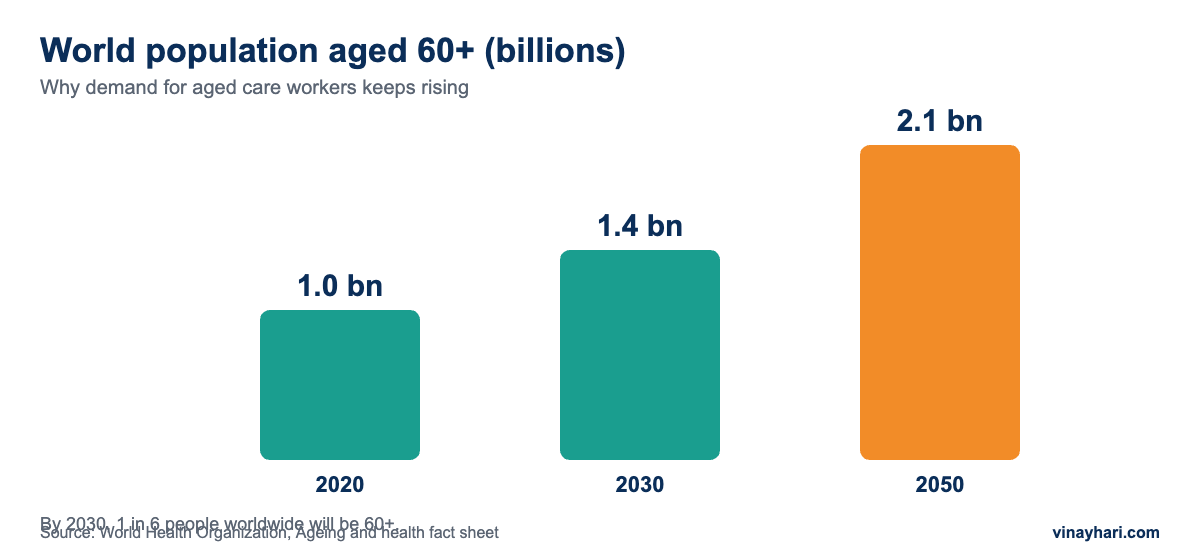
The world is getting older faster than ever. According to the World Health Organization, by 2030 one in six people worldwide will be 60 or older (1.4 billion people); by 2050 that number will double to 2.1 billion, and the number of people aged 80+ is expected to triple to 426 million between 2020 and 2050 (WHO Ageing and Health fact sheet).
Older people need help with daily living — bathing, mobility, meals, medication reminders, dementia support and companionship. Most of that work is done by care workers and nurses. The WHO’s 2025 nursing report projects an 11-million health and care worker shortfall by 2030, including about 4.1 million nurses (WHO SoWN 2025).
What government labour data shows in our five countries:
| Country | Official workforce signal | Source |
|---|---|---|
| Canada | Job Bank outlook for nurse aides, orderlies and patient service associates (NOC 33102) is “Good” to “Very good” in many regions for 2025–2027, driven by an ageing population | Job Bank – NOC 33102 outlook (updated Dec 2025) |
| Australia | Aged and Disabled Carers employ about 369,400 people with annual employment growth of about 27,300 | Jobs and Skills Australia, ANZSCO 4231 |
| UK (England) | Adult social care vacancy rate fell to 6.2% in 2025/26 (~96,000 vacancies on any day); the sector is projected to need 410,000 more posts by 2040 | Skills for Care, Size and Structure (June 2026) |
| New Zealand | Care roles kept a dedicated work-to-residence pathway after the other AEWV sector agreements ended in March 2025 | Immigration NZ – sector agreements |
| USA | Home health and personal care aides held about 4.3 million jobs in 2024, projected to grow 17% (≈739,800 jobs) over 2024–34 | BLS Occupational Outlook Handbook |
Vinay Hari’s honest read: Demand for care workers is not the problem. The problem is that governments now decide who fills those jobs — and several prefer local workers, people already in the country, or higher-qualified nurses. Plan for the visa reality, not the vacancy headline.
Aged Care Worker, PSW, HCA, Nursing Assistant or Registered Nurse? Know the Difference
Most aged care courses for international students are certificate-level programmes — in effect a certificate in old age care or a certificate in healthcare and elderly care — and every one of them includes work placement requirements in a real care setting before you graduate.
Before comparing aged care courses abroad for Indian students, it helps to know the job titles. Many families mix these titles up. They are not the same job, the same pay or the same visa outcome.
| Role | Typical titles by country | Training | Regulated? | What they do |
|---|---|---|---|---|
| Aged care / personal care worker | Australia: Personal Care Assistant, Aged or Disabled Carer; NZ: Health Care Assistant / Support Worker | Certificate III (AU) or NZ Level 3–4 certificate, 6–12 months | Not a registered profession (screening checks apply) | Daily living support, hygiene, mobility, companionship |
| Personal Support Worker (PSW) | Canada (esp. Ontario); Health Care Aide (Alberta), Continuing Care Assistant (Nova Scotia) | College certificate, ~8–12 months | Varies by province | Personal care in long-term care, home care and hospitals |
| Healthcare Assistant (HCA) / Care Worker | UK: Care Worker, Senior Care Worker, NHS HCA (Band 2–3) | On-the-job + Care Certificate / Level 2–3 diplomas | Not registered | Personal care in care homes, home care, hospital wards |
| Nursing Assistant / CNA | USA: Certified Nursing Assistant, Home Health Aide | State-approved programme (often weeks) + state exam | State certification | Basic patient care under nurse supervision |
| Practical / Enrolled Nurse | Canada: RPN/LPN; Australia: Enrolled Nurse; USA: LPN | 1.5–2 year diploma | Yes – licensed | Clinical care and medications within scope |
| Registered Nurse (RN) | All five countries | Degree (or diploma + bridging) + licensing exam/registration | Yes – licensed | Full assessment, care planning, supervision |
Why this matters: In every one of these countries, registered nurses have far broader visa and PR options than care workers. An Indian GNM or B.Sc Nursing graduate should usually be counselled towards a nurse registration pathway, not a carer certificate.
Canada: Personal Support Worker (PSW) and Practical Nursing
Courses and qualifications
- Personal Support Worker – Ontario College Certificate (about 8–12 months) at public colleges such as Conestoga, Fanshawe, St. Lawrence, Canadore and Durham.
- Practical Nursing diploma (2 years) leading to the RPN/LPN licensing exam — a stronger long-term route.
- Bachelor of Science in Nursing (4 years, or compressed options for some graduates).
Entry requirements and English
- 12th pass with English; colleges commonly ask for IELTS Academic 6.0 overall (no band below 5.5) or equivalent for PSW — confirm per college.
- Police check, immunisations and first aid/CPR are usually needed before clinical placement.
- A Provincial/Territorial Attestation Letter (PAL/TAL) is needed for college study permits; in 2026 only master’s and doctoral students at public institutions (and school students) are exempt (IRCC, 2026 cap allocations).
Tuition, living costs and total investment
| Item | CAD | INR (₹67) |
|---|---|---|
| PSW tuition + fees, 1 year (indicative: Conestoga ~15,000 to Canadore ~18,600 incl. ancillary) | 15,000–18,600 | ₹10.0–12.5 lakh |
| IRCC minimum living funds, single applicant (applications from 1 Sept 2026) | 23,448 | ₹15.7 lakh |
| Study permit + biometrics, books, uniform, travel (estimate) | 2,500–3,000 | ₹1.7–2.0 lakh |
| Indicative first-year total | ≈41,000–44,000 | ≈₹27.5–29.5 lakh |
Sources: IRCC – Proof of financial support (CAD 23,448 for applications on or after 1 September 2026); college fee pages such as Canadore College PSW (2027 international total CAD 18,603.51). Tuition varies by college and intake; always use the amount on your offer letter.
Study permit and work rights
- For 2026, IRCC expects to issue up to 408,000 study permits, including 155,000 to new arrivals (IRCC notice). Competition for college seats with a PAL is real.
- Eligible students can work up to 24 hours per week off campus during academic sessions and full-time during scheduled breaks (IRCC – Work off campus).
- PSW clinical placements are part of the programme and are unpaid.
Jobs and salary
PSWs work in long-term care homes, home care agencies and hospitals. National Job Bank wages for NOC 33102 are about CAD 19.00 (low), 24.00 (median) and 28.84 (high) per hour (Government of Newfoundland & Labrador LMI, citing Job Bank). At 37.5 hours a week the median works out to roughly CAD 46,000–47,000 a year before tax — but many PSW jobs are part-time or shift-based, so real income varies.
Post-graduation work permit (PGWP)
- College graduates must study in a field on IRCC’s eligible list. PSW programmes coded CIP 51.2602 (Home health aide/home attendant) or 51.3902 appear on colleges’ PGWP-eligible lists, and IRCC froze the field-of-study list for all of 2026 (announced 15 January 2026) (IRCC – PGWP). ⚠️ The list may change for 2027 — verify the CIP code on your letter of acceptance against the IRCC list on the day you apply.
- College graduates must also submit language results at the required level (CLB 5 for college programmes) with the PGWP application.
- Key risk: for programmes under two years, the PGWP generally matches the programme length. A 1-year PSW certificate usually means about a 1-year work permit — tight for building PR eligibility.
Permanent residency pathways
- Express Entry – Healthcare and Social Services category includes NOC 33102 in 2026. Healthcare draws in 2026 invited candidates at CRS cut-offs of 467 (20 February), 475 (25 June) and 475 (4 September) (IRCC – Express Entry rounds). A young PSW with a 1-year certificate can still fall short of these scores — be realistic.
- Provincial Nominee Programs in some provinces target healthcare workers; criteria change frequently.
- Home Care Worker Immigration Pilots: IRCC paused new intake on 19 December 2025 and confirmed it would not reopen in March 2026; no reopening date has been given (IRCC – Caregivers).
Family and dependants
Spouses of college and undergraduate students are generally not eligible for open work permits; spousal open work permits are focused on master’s, doctoral and certain professional programmes (IRCC – Bring your family). Married PSW applicants should plan for the spouse to stay in India initially.
Canada risk summary
Short PGWP, high CRS cut-offs, limited PAL seats and the 2027 field-of-study review. Our usual advice: consider a 2-year Practical Nursing diploma or, for B.Sc Nursing graduates, an RN registration route instead of a stand-alone PSW certificate.
Australia: Certificate III in Individual Support and Nursing
Courses and qualifications
- CHC33021 Certificate III in Individual Support (Ageing / Disability / Home & Community), usually 6–12 months for international students, including at least 120 hours of mandatory work placement (training.gov.au – CHC33021).
- CHC43015 Certificate IV in Ageing Support — the next step towards team-leader roles.
- HLT54121 Diploma of Nursing (Enrolled Nurse, ~18–24 months) and Bachelor of Nursing (3 years) for registration with the Nursing and Midwifery Board of Australia.
Entry requirements and English
- Age 18+, 12th pass or equivalent; providers commonly ask for IELTS Academic 5.5–6.0 for Cert III (higher for nursing). Confirm on your offer letter and against Home Affairs English rules.
- Every applicant must meet the Genuine Student requirement — your study plan must make sense for your background (Home Affairs – Student visa 500).
Tuition, living costs and total investment
| Item | AUD | INR (₹62 ⚠️ planning rate) |
|---|---|---|
| Cert III tuition (indicative: ~5,500 to ~14,000 depending on provider and length) | 5,500–14,000 | ₹3.4–8.7 lakh |
| Home Affairs minimum living costs (12 months) | 29,710 | ₹18.4 lakh |
| Student visa application charge (from 1 July 2026) | 2,500 | ₹1.55 lakh |
| OSHC health cover + travel (estimate) | 2,500–3,000 | ₹1.6–1.9 lakh |
| Indicative first-year total | ≈40,000–49,000 | ≈₹25–30 lakh |
Sources: Home Affairs – Student visa 500 (living costs AUD 29,710); Study Australia – VAC increase (AUD 2,000 → 2,500 from 1 July 2026). Unusually low tuition at some private colleges deserves extra checking — ask about trainers, placement arrangements and completion rates.
Work rights
Student visa holders can work up to 48 hours per fortnight while the course is in session and unlimited hours during scheduled breaks (visa condition 8105) (Home Affairs – visa conditions). Work placement that is a registered part of the course does not count towards the limit.
Jobs and salary
Aged and Disabled Carers have median full-time weekly earnings of about AUD 1,761 before tax, but around 60% of carers work part-time (Jobs and Skills Australia). That full-time median (≈AUD 91,000 a year) includes experienced workers, penalty rates and overtime. A new Cert III graduate working part-time shifts will usually earn much less. Award rates are published by the Fair Work Ombudsman.
Post-study work (485 visa): read carefully
The Temporary Graduate visa’s Post-Vocational Education Work stream is for an eligible associate degree, diploma or trade qualification closely related to a nominated occupation, plus a skills assessment (Home Affairs – 485). ⚠️ A Certificate III in Individual Support is not generally treated as a trade qualification, so do not assume it leads to a 485 visa. The 485 application charge also rose to AUD 5,750 from 1 July 2026 (Study Australia).
Employer sponsorship and PR
- Aged Care Industry Labour Agreement: approved aged care providers can sponsor overseas workers as a Personal Care Assistant, Nursing Support Worker or Aged or Disabled Carer, with concessions that include a pathway to permanent residence through the Employer Nomination Scheme after a qualifying period (Home Affairs – Labour agreements). Skills assessments are done by ANMAC (PCA, Nursing Support Worker) and ACWA (Aged or Disabled Carer) (ANMAC).
- Only employers who hold such an agreement can sponsor through it. There is no sponsorship without an employer’s decision, and no student or consultant can secure it in advance.
- Regional and DAMA pathways exist in some areas; criteria differ by region.
Family and dependants
Family members can be included on a student visa if you show extra living funds (Home Affairs sets partner and child amounts). Dependants of VET students can generally work up to 48 hours per fortnight once the course starts.
Australia risk summary
Genuine Student refusals, quality of low-cost private providers, no reliable 485 after a Cert III, and dependence on a labour-agreement employer. Strongest route: Cert III as a stepping stone while preparing for the Diploma or Bachelor of Nursing, or nurse registration through AHPRA/NMBA for Indian B.Sc Nursing graduates.
United Kingdom: Why Nursing, Not Care Work, Is the Route in 2026
The big change families must know
Since 22 July 2025, UK employers cannot sponsor new care workers or senior care workers (SOC 6135/6136) from overseas. A transition period lets people already in the UK switch or extend in these roles until 22 July 2028, and that period is under review (GOV.UK – Health and Care Worker visa; Statement of Changes HC 997). We therefore do not recommend going to the UK on a student visa with a plan to become a care worker.
Courses that still make sense
- BSc (Hons) Nursing – Adult (3 years) at UK universities, leading to NMC registration (Nursing and Midwifery Council).
- MSc Nursing (pre-registration) (2 years) for graduates with a relevant first degree.
- For experienced Indian GNM/B.Sc nurses: NMC registration via the CBT and OSCE as an internationally educated nurse, followed by employer sponsorship. This is a work route, not a study route.
Entry requirements and English
Universities usually ask for IELTS 7.0 overall for nursing (the NMC registration standard), strong 12th marks with Biology/Science, an interview, and occupational health and DBS checks. The Skilled Worker English requirement rose to B2 for new applicants from 8 January 2026.
Costs (year 1)
| Item | GBP | INR (₹128) |
|---|---|---|
| Nursing tuition per year (indicative international fee) ⚠️ verify per university | 17,000–24,000 | ₹21.8–30.7 lakh |
| Maintenance outside London (9 × £1,203, applications from 30 Nov 2026) | 10,827 | ₹13.9 lakh |
| Visa fee + Immigration Health Surcharge (paid upfront) + travel (estimate) | 3,500–4,000 | ₹4.5–5.1 lakh |
| Indicative first-year total | ≈31,500–38,500 | ≈₹40–49 lakh |
London maintenance is £1,570 a month (£14,130 for nine months) for applications made on or after 30 November 2026 (GOV.UK – Student visa money; Statement of Changes HC 584, 3 September 2026). A full 3-year nursing degree can total ₹1.1–1.4 crore including living costs.
Work rights and placements
Degree-level students can usually work up to 20 hours a week in term time (GOV.UK – Student visa). Nursing degrees include about 2,300 hours of supervised clinical practice as part of the course.
Jobs and salary
- Care workers in England earned a median of £12.00 an hour in March 2025 (Skills for Care).
- NHS pay 2026/27 (England): Band 2 (HCA) £25,272; Band 3 £25,760–£27,476; Band 5 newly qualified nurse £32,073–£39,043 (NHS Employers 2026/27 pay scales).
Post-study work, sponsorship and settlement
- Graduate visa: 2 years if you apply on or before 31 December 2026; 18 months for bachelor’s and master’s graduates applying from 1 January 2027 (GOV.UK – Graduate visa).
- Registered nurses remain eligible for the Health and Care Worker visa with a licensed sponsor. ⚠️ The UK government is reforming long-term settlement rules, so check the current qualifying period before planning.
Family and dependants
Most students on taught courses cannot bring dependants. Only those on postgraduate research courses (and some government-sponsored students) can (GOV.UK – Student visa family members).
UK risk summary
Highest cost, no overseas care-worker sponsorship, a shorter Graduate visa from 2027, and changing settlement rules. Only nursing-focused students with the budget should consider the UK.
New Zealand: Health and Wellbeing Certificates and Nursing
Courses and qualifications
- New Zealand Certificate in Health and Wellbeing — Level 3 (Health Assistance) and Level 4 (Advanced Care and Support, or Social and Community Services), typically 6–12 months.
- Bachelor of Nursing (Level 7, 3 years) leading to Nursing Council of New Zealand registration (NCNZ).
Entry requirements and English
Level 4 certificates often ask for IELTS 5.5–6.0 (or completion of Level 3), a minimum age of 18–20, and police vetting before placement. Nursing degrees require higher English, often IELTS 6.5–7.0.
Costs
| Item | NZD | INR (₹54) |
|---|---|---|
| Level 4 tuition (indicative: NZSE ~18,900; Toi Ohomai 26,520; UCOL 27,300) | 18,900–27,300 | ₹10.2–14.7 lakh |
| INZ living-cost funds (per year) | 20,000 | ₹10.8 lakh |
| Visa fee, insurance, travel (estimate) | 3,500–4,000 | ₹1.9–2.2 lakh |
| Indicative first-year total | ≈42,500–51,000 | ≈₹23–27.5 lakh |
Sources: Study with New Zealand – UCOL Level 4 (2026 international fee NZD 27,300); Toi Ohomai international fees; Immigration NZ – Study (NZD 20,000 living funds).
Work rights
Eligible students can work up to 25 hours a week during term (up from 20 since 3 November 2025) and full-time in scheduled holidays (Immigration NZ).
Post-study work: the critical gap
- From 16 November 2026, INZ is launching a 6-month Short-Term Graduate Work Visa for NZQCF Level 5–7 qualifications studied full-time for at least 24 weeks (INZ – Short-Term Graduate Work Visa). It is also extending the Post-Study Work Visa to Level 7 graduate diplomas for bachelor’s holders (INZ announcement, 10 September 2026).
- A Level 3 or Level 4 Health and Wellbeing certificate qualifies for neither visa. After the course you need an Accredited Employer Work Visa (AEWV) job offer to stay and work.
Employer sponsorship and residence
- Care workforce roles (such as Aged or Disabled Carer, Personal Care Assistant and Nursing Support Worker) have a Care Workforce Work to Residence pathway after 24 months of work in New Zealand, paid at least NZD 28.25 an hour during that work (INZ – Sector agreements). ⚠️ AEWV settings (English, wage thresholds, maximum stay for lower-paid care roles) change often — verify before applying.
- Registered nurses are on New Zealand’s Green List, which gives qualifying registered nurses faster residence options (Immigration NZ).
Family and dependants
Partners of most sub-degree students do not automatically get open work visas, and Short-Term Graduate Work Visa holders cannot support family visas. Check INZ partner rules for your exact course level.
NZ risk summary
No post-study visa after a Level 3–4 care certificate, a small job market, and residence only through a qualifying employer and wage. Best fit: students ready for a Bachelor of Nursing, or experienced Indian nurses pursuing NCNZ registration.
USA: CNA, ADN and BSN Nursing
Courses and qualifications
- CNA / Home Health Aide programmes: short, state-approved courses, often a few weeks long. They are designed mainly for local residents and are not a practical F-1 student visa route; F-1 study needs a full-time programme at an SEVP-certified school (Study in the States).
- Associate Degree in Nursing (ADN, ~2 years) at community colleges and BSN (4 years) at universities lead to the NCLEX-RN licensing exam (NCSBN).
Entry requirements and English
TOEFL or IELTS (often 6.5+), school transcripts with science, prerequisite courses, background checks and immunisations. Proof of funds must cover the cost estimate on the I-20.
Costs (year 1)
| Item | USD | INR (₹95) |
|---|---|---|
| Tuition (indicative: community college ADN ~12,000 to university BSN ~45,000) ⚠️ | 12,000–45,000 | ₹11.4–42.8 lakh |
| Living costs (varies by city; per I-20 estimate) | 15,000–22,000 | ₹14.3–20.9 lakh |
| SEVIS fee $350, visa fee $185, health insurance, travel; plus a $250 visa integrity fee ⚠️ if implemented | 4,000–4,500 | ₹3.8–4.3 lakh |
| Indicative first-year total | ≈31,000–71,000 | ≈₹29–67 lakh |
Work rights, OPT and policy changes
- F-1 students can generally work on campus up to 20 hours a week in term; off-campus work needs CPT or OPT authorisation. OPT gives up to 12 months of work after graduation (USCIS – OPT). Nursing is generally not on the STEM OPT list.
- DHS published a final rule on 17 July 2026 replacing “duration of status” with fixed admission periods from 15 September 2026. ⚠️ A federal court preliminary injunction issued on 14 September 2026 put it on hold (UC Berkeley International Office). Track this before applying.
- Student visa applicants now face in-person interviews and social media vetting (U.S. Department of State – Student visa).
Jobs and salary
- Home health and personal care aides: median $34,900 a year (May 2024), with 17% projected growth over 2024–34 (BLS OOH).
- Nursing assistants: nearly 1.4 million jobs and an average of $19.84 an hour in May 2024 (BLS TED).
- Registered nurses earn substantially more; see the latest BLS Registered Nurses data.
Sponsorship and PR
CNAs and aides are rarely sponsored for work visas. US employers can sponsor registered nurses for employment-based green cards (often EB-3), but Indian nationals face long waits in the visa bulletin (Department of State – Visa Bulletin).
Family and dependants
F-2 dependants can accompany F-1 students but cannot work.
USA risk summary
High cost, no student-visa route for CNA courses, uncertainty over student admission rules, and long green card backlogs. Best fit: academically strong students who can fund a full nursing degree.
Aged Care Courses Abroad: Cost Comparison in INR
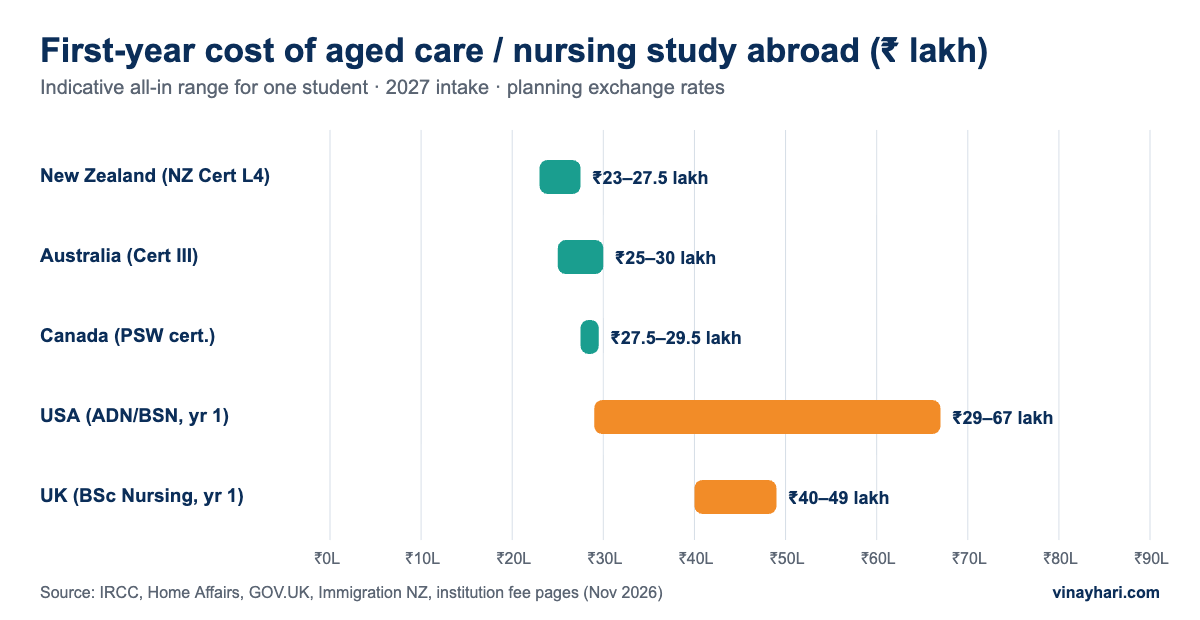
Indicative first-year cost for one student, all-in. Planning rates: CAD ₹67, AUD ₹62, GBP ₹128, NZD ₹54, USD ₹95. Recheck before paying fees.
| Country | Typical course | Duration | Tuition (local) | Govt living-cost minimum | First-year total (INR) |
|---|---|---|---|---|---|
| New Zealand | NZ Cert Health & Wellbeing L4 | ~1 year | NZD 18,900–27,300 | NZD 20,000 | ₹23–27.5 lakh |
| Australia | Cert III Individual Support | 6–12 months | AUD 5,500–14,000 | AUD 29,710 | ₹25–30 lakh |
| Canada | PSW certificate | 8–12 months | CAD 15,000–18,600 | CAD 23,448 | ₹27.5–29.5 lakh |
| USA | ADN / BSN | 2–4 years | US$12,000–45,000/yr | Per I-20 estimate | ₹29–67 lakh (year 1) |
| UK | BSc Nursing (Adult) | 3 years | £17,000–24,000/yr | £10,827 (outside London, 9 months) | ₹40–49 lakh (year 1) |
Practical example (Punjab family): A 19-year-old from Ludhiana with IELTS 6.0 choosing an Australian Cert III at AUD 8,000 tuition needs about AUD 42,000–43,000 available for year 1 (≈₹26–27 lakh). Part-time work at 48 hours a fortnight can help with living costs, but families should never plan to pay tuition from part-time earnings — visa officers expect the money to be available upfront.
Visa and Post-Study Work Comparison
| Factor | Canada | Australia | UK | New Zealand | USA |
|---|---|---|---|---|---|
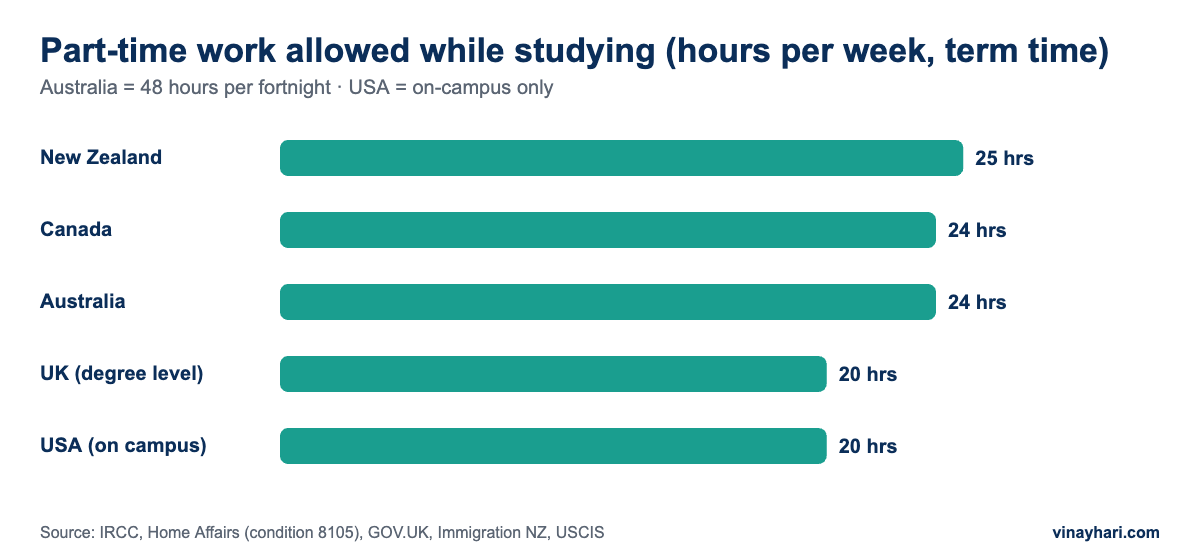
| Study work hours (term) | 24 hrs/week off campus | 48 hrs/fortnight | 20 hrs/week (degree level) | 25 hrs/week | 20 hrs/week on campus |
| Post-study work after a care certificate | PGWP ≈ course length (if field eligible) | 485 not reliable for Cert III ⚠️ | Care route closed to overseas entrants | None for Level 3–4 | Not applicable (CNA is not an F-1 route) |
| Post-study work after a nursing degree | Up to 3 years PGWP (programmes of 2+ years) | 485 Post-Higher Education Work stream | Graduate visa 18 months (applications from 1 Jan 2027) | Post-Study Work Visa | OPT 12 months |
| Main care-worker PR route | Express Entry healthcare category; PNPs (HCWP paused) | Aged Care Industry Labour Agreement → ENS | None for new entrants | Care Workforce Work to Residence (24 months) | Rare |
| Spouse work rights (care certificate) | Generally no open work permit | Up to 48 hrs/fortnight | Generally no dependants | Limited | F-2 cannot work |
| Policy direction in 2026 | Tightening (study permit caps) | Higher fees, stricter Genuine Student test | Tightening | Mixed (new graduate visa from 16 Nov 2026) | Tightening, in litigation |
Admission Guide: Aged Care Courses Abroad for Indian Students
- Profile check first. Academic history, study gaps, age, previous refusals, funds and family plans decide the right country — not the other way round.
- English test. Target IELTS 6.0–6.5 for care courses and 7.0 for nursing. PTE and TOEFL are accepted by many institutions and visa systems; check each.
- Shortlist public or well-reviewed institutions. Check placement partners, clinical hours and graduate outcomes.
- Verify eligibility codes before paying a deposit: the Canada CIP code against the IRCC list, the Australian CRICOS code, the NZQCF level in New Zealand, and SEVP certification in the USA.
- Prepare genuine funds. Show savings, education loans and parents’ income with a clear source. Large unexplained deposits are a common refusal reason.
- Write a credible statement of purpose. Explain why care or nursing, why this country, and your realistic career plan — including what you would do back in India.
- Medical, police and vaccination documents — care placements require them.
- Visa application and pre-departure: accommodation, insurance and a placement-ready checklist (uniform, shoes, first aid/CPR).
Career Progression: From Carer to Registered Nurse
| Stage | Canada | Australia | UK | New Zealand | USA |
|---|---|---|---|---|---|
| Entry | PSW | Cert III carer / PCA | HCA (in-country only) | HCA / Support Worker | CNA / Aide |
| Step 2 | Practical Nurse (RPN/LPN) | Cert IV Ageing / Diploma of Nursing (EN) | Nursing Associate | Level 5–7 study | LPN |
| Professional | RN (BScN or bridging) | RN (Bachelor of Nursing) | RN (NMC) | RN (NCNZ) | RN (NCLEX) |
| Senior | Nurse practitioner, manager | Clinical nurse, facility manager | Band 6–7 specialist | Nurse specialist | Specialist / NP |
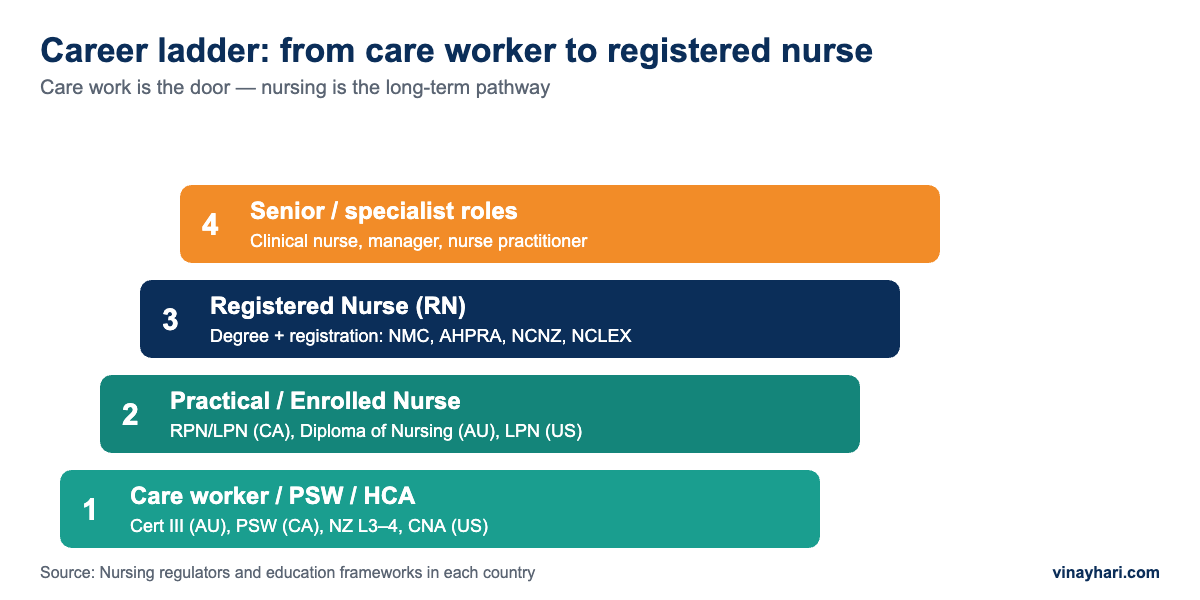
The lesson is simple: care work is a door, nursing is the house. Families who plan the full ladder from day one make better financial decisions.
Risks Every Family Must Understand
- Policy change: Every rule in this article can change mid-course. Caps, field lists, fees and wage thresholds have all changed in the last 18 months.
- No guarantee of jobs or sponsorship: Employers choose whom to hire and sponsor. Anyone promising a “guaranteed job” or “PR in X months” is not being honest with you.
- Physical and emotional demands: Care work involves lifting, night shifts, dementia care and end-of-life support. Volunteer or shadow at an Indian hospital or old-age home before committing.
- Low-quality providers: Unusually cheap or “visa-friendly” courses can mean poor training, weak placements and a higher refusal risk.
- Funds and debt: A ₹25–50 lakh loan for a care certificate with a short post-study window is a heavy risk. Plan for the worst case: what if no sponsor is found?
- Recruitment fraud: Never pay anyone for a “job offer” or “sponsorship”. In the UK and Australia, charging workers for sponsorship can breach immigration rules.
- Family separation: Spouse and child options are limited for sub-degree courses in Canada, the UK and New Zealand.
FAQs: Aged Care Courses Abroad for Indian Students
1. Which country is best for aged care courses for Indian students in 2027? There is no single best country. Australia and Canada offer the clearest care-worker study options, but each has limits: no reliable 485 after a Cert III in Australia, and a short PGWP after a 1-year PSW in Canada. For long-term settlement, a nursing qualification in any of the five countries is stronger than a care certificate alone.
2. Can I get PR after an aged care course? PR is possible in some countries through employer sponsorship or points systems — for example Australia’s Aged Care Industry Labour Agreement, Canada’s Express Entry healthcare category, or New Zealand’s Care Workforce Work to Residence pathway. None is automatic, and no college or consultant can guarantee it.
3. Can I still go to the UK as a care worker? Not from overseas. Since 22 July 2025, UK employers cannot sponsor new care workers or senior care workers from outside the UK. Nursing remains a sponsored occupation.
4. Is the PSW course in Canada eligible for PGWP? PSW programmes whose CIP codes are on IRCC’s list (such as 51.2602) are PGWP-eligible in 2026, because IRCC froze the list for the year. But a programme under two years usually gets a PGWP equal to its length, so a 1-year PSW often means about a 1-year work permit.
5. How much does an aged care course in Australia cost in Indian rupees? Certificate III in Individual Support tuition is roughly AUD 5,500–14,000. With the AUD 29,710 living-cost requirement, the visa fee and insurance, plan for about ₹25–30 lakh for the first year.
6. What IELTS score do I need for an aged care course abroad? Most care certificates ask for IELTS 5.5–6.0; nursing degrees and registration usually need 6.5–7.0. Employer sponsorship and PR programmes may set their own English levels.
7. Can GNM or B.Sc Nursing graduates from India work as nurses abroad? Yes, through each country’s nurse registration process: the NMC in the UK, AHPRA/NMBA in Australia, NCNZ in New Zealand, provincial regulators in Canada, and the NCLEX in the USA. This is usually a better route than starting again as a carer.
8. Can my spouse work if I study aged care abroad? It depends on the country. In Canada, spouses of college students generally do not get open work permits. In Australia, dependants can usually work up to 48 hours a fortnight. In the UK, most taught-course students cannot bring dependants.
9. Is a CNA course in the USA a good option for international students? Generally not as a student-visa route. CNA programmes are short and state-based. Indian students targeting the US should look at ADN or BSN nursing programmes.
10. Does a Level 4 Health and Wellbeing certificate in New Zealand give a post-study work visa? No. The new Short-Term Graduate Work Visa (from 16 November 2026) covers Level 5–7 qualifications. Level 3–4 graduates need an employer-sponsored work visa to stay.
11. How long is an aged care course in Australia? The CHC33021 Certificate III in Individual Support usually takes about 6–12 months for international students, including at least 120 hours of mandatory work placement (training.gov.au). The exact length is set by each CRICOS-registered provider, so check the duration on your Confirmation of Enrolment.
12. Are there 3-month aged care courses for international students? Short courses exist, but a student visa generally needs a full-time CRICOS (Australia) or DLI (Canada) registered programme, and short courses rarely lead to post-study work rights. Treat any “3-month course to PR” offer with caution.
Conclusion: Choosing Aged Care Courses Abroad for Indian Students
- 12th pass, limited budget, open to hands-on care: Australia (Cert III, with a plan towards nursing) or Canada (prefer Practical Nursing over a 1-year PSW).
- GNM / B.Sc Nursing graduate: pursue nurse registration in Australia, New Zealand, the UK or Canada rather than a carer certificate.
- Strong academics, larger budget: USA (ADN/BSN) or UK (BSc/MSc Nursing).
- Married with family: compare dependant rules carefully; at sub-degree level Australia currently offers more flexibility than Canada or the UK.
Aged care is a respected, needed and meaningful career, and aged care courses abroad for Indian students can be a good first step when chosen carefully. In 2027, the students who do well will be the ones who choose the right qualification level, institution and country for their profile — and who plan for policy changes instead of hoping they won’t happen.
Free Counselling Checklist (bring this to your session)
- ☐ 10th, 12th and any degree/GNM/B.Sc marksheets and certificates
- ☐ IELTS/PTE score (or your target test date)
- ☐ Passport and any previous visa refusals (with refusal letters)
- ☐ Work experience letters (hospital, nursing home, caregiving)
- ☐ Approximate funds: savings, FDs, property, education loan eligibility
- ☐ Parents’ income proof and ITRs
- ☐ Marital status and family plans (spouse/children travelling?)
- ☐ Preferred countries and budget ceiling
- ☐ Long-term goal: care work, nursing registration, or return to India
- ☐ Questions for us: placement partners, CIP/CRICOS/NZQCF codes, refund policy
Talk to Vinay Hari Before You Pay Any Fee
At Vinay Hari Education Consultant, led by Vinay Hari with 18+ years of counselling experience and 20,000+ students guided, we follow a simple parent-first rule: we tell families what the rules actually say, even when it isn’t what they hoped to hear. We will check your profile, compare these five countries against your budget, verify course eligibility codes and show you a realistic plan — risks included.
WhatsApp for a profile assessment: 7307530886
Website: www.vinayhari.com
Offices: 505, Sector 82, Mohali · BMC Chowk, Jalandhar
We do not promise jobs, sponsorship, visas or PR — no honest consultant can. What we promise is clear, current, written advice so your family can decide with confidence.
Official Government Websites for Aged Care Courses Abroad
Always check rules on the official site before you pay a fee or apply. Bookmark these:
- Canada: IRCC – Study permit · Designated learning institutions (DLI) list · Express Entry · Job Bank (wages & outlooks)
- Australia: Home Affairs – Student visa 500 · CRICOS course register · Study Australia · Nursing and Midwifery Board of Australia (AHPRA) · Fair Work Ombudsman (pay rates)
- United Kingdom: GOV.UK – Student visa · Health and Care Worker visa · Graduate visa · Nursing and Midwifery Council (NMC) · NHS Health Careers
- New Zealand: Immigration New Zealand · NZQA (qualification levels) · Study with New Zealand · Nursing Council of New Zealand
- USA: Study in the States (DHS) · U.S. Department of State – Student visa · EducationUSA · BLS Occupational Outlook Handbook
- India: Ministry of External Affairs · eMigrate (overseas employment) · MADAD (consular help abroad)
Related guides: Study in Canada from India · Study in Australia from India · Study in the UK from India · Study in New Zealand from India · Study in the USA from India · Canada study visa with spouse · What to do after 12th · Study visa refused? Refusal help
About the Author
Vinay Hari — Founder, Vinay Hari Education Consultant. 18+ years in education and immigration counselling, helping Indian students and families from Punjab, Haryana, Delhi and across India plan study abroad with a practical, parent-first approach.
Website: www.vinayhari.com · WhatsApp: 7307530886
Sources (official, checked 7 November 2026)
- WHO: Ageing and health fact sheet; State of the World’s Nursing 2025 (May 2025)
- Canada (IRCC): Proof of financial support (updated 28 Aug 2026); Work off campus; PGWP (field list frozen 15 Jan 2026); 2026 cap allocations (25 Nov 2025); Express Entry rounds; Caregivers (HCWP intake paused 19 Dec 2025); Bring your family
- Canada (wages): Government of NL LMI, NOC 33102, citing Job Bank; Job Bank outlook
- Australia: Student visa 500; Temporary Graduate 485; Labour agreements; Study Australia – VAC increase (1 July 2026); Jobs and Skills Australia – ANZSCO 4231; training.gov.au CHC33021
- UK: Health and Care Worker visa; Student visa – money; Graduate visa; Statements of changes (HC 997, July 2025; HC 584, 3 Sept 2026); Skills for Care; NHS Employers 2026/27 pay scales
- New Zealand: Immigration NZ – Study; Short-Term Graduate Work Visa; PSWV extension announcement (10 Sept 2026); Sector agreements and care workforce residence; Study with New Zealand
- USA: BLS – Home Health and Personal Care Aides; BLS TED – Nursing assistants; USCIS – OPT; Study in the States; State Department – Student visa
- Course fees (institution pages): Canadore College PSW; Toi Ohomai; UCOL via Study with NZ