
%20scale(0.05)%22%3E%3Crect%20x%3D%22-2400%22%20y%3D%220%22%20width%3D%221200%22%20height%3D%222400%22%20fill%3D%22%23D52B1E%22%2F%3E%3Crect%20x%3D%221200%22%20y%3D%220%22%20width%3D%221200%22%20height%3D%222400%22%20fill%3D%22%23D52B1E%22%2F%3E%3Cuse%20href%3D%22%23c11leaf%22%20transform%3D%22translate(0%201200)%20scale(0.55)%20translate(0%20-230)%22%2F%3E%3C%2Fg%3E%3Crect%20x%3D%2224%22%20y%3D%2240%22%20width%3D%22240%22%20height%3D%22120%22%20rx%3D%220%22%20fill%3D%22none%22%20stroke%3D%22%23A7AFBA%22%20stroke-width%3D%221%22%2F%3E%3Ctext%20x%3D%22296%22%20y%3D%2272%22%20font-size%3D%2219%22%20class%3D%22b%22%3EFrom%20Indian%20business%20owner%20to%20Canadian%20PR%3C%2Ftext%3E%3Ctext%20x%3D%22296%22%20y%3D%22102%22%3EC11%20work%20permit%2C%20then%20a%20provincial%20entrepreneur%20stream%3C%2Ftext%3E%3Ctext%20x%3D%22296%22%20y%3D%22126%22%20font-size%3D%2211.5%22%20class%3D%22q%22%3EA%202026%20guide%20for%20business%20families%20from%20Punjab%20and%20Haryana%3C%2Ftext%3E%3Ctext%20x%3D%22296%22%20y%3D%22152%22%20font-size%3D%2211.5%22%20class%3D%22b%22%20style%3D%22fill%3A%23D52B1E%22%3EVinay%20Hari%2C%20Angels%20Immigration%3C%2Ftext%3E%3Crect%20x%3D%2224%22%20y%3D%22200%22%20width%3D%22166%22%20height%3D%2240%22%20rx%3D%2220%22%20fill%3D%22%231F5FBF%22%20fill-opacity%3D%220.1%22%20stroke%3D%22%231F5FBF%22%20stroke-width%3D%221.25%22%2F%3E%3Ctext%20x%3D%22107%22%20y%3D%22225%22%20class%3D%22b%22%20text-anchor%3D%22middle%22%3E51%25%20ownership%3C%2Ftext%3E%3Crect%20x%3D%22206%22%20y%3D%22200%22%20width%3D%22166%22%20height%3D%2240%22%20rx%3D%2220%22%20fill%3D%22%231F5FBF%22%20fill-opacity%3D%220.1%22%20stroke%3D%22%231F5FBF%22%20stroke-width%3D%221.25%22%2F%3E%3Ctext%20x%3D%22289%22%20y%3D%22225%22%20class%3D%22b%22%20text-anchor%3D%22middle%22%3EUp%20to%2018%20months%3C%2Ftext%3E%3Crect%20x%3D%22388%22%20y%3D%22200%22%20width%3D%22166%22%20height%3D%2240%22%20rx%3D%2220%22%20fill%3D%22%231F5FBF%22%20fill-opacity%3D%220.1%22%20stroke%3D%22%231F5FBF%22%20stroke-width%3D%221.25%22%2F%3E%3Ctext%20x%3D%22471%22%20y%3D%22225%22%20class%3D%22b%22%20text-anchor%3D%22middle%22%3ENo%20LMIA%20needed%3C%2Ftext%3E%3Crect%20x%3D%22570%22%20y%3D%22200%22%20width%3D%22166%22%20height%3D%2240%22%20rx%3D%2220%22%20fill%3D%22%231F5FBF%22%20fill-opacity%3D%220.1%22%20stroke%3D%22%231F5FBF%22%20stroke-width%3D%221.25%22%2F%3E%3Ctext%20x%3D%22653%22%20y%3D%22225%22%20class%3D%22b%22%20text-anchor%3D%22middle%22%3EPR%20via%20a%20province%3C%2Ftext%3E%3C%2Fsvg%3E)
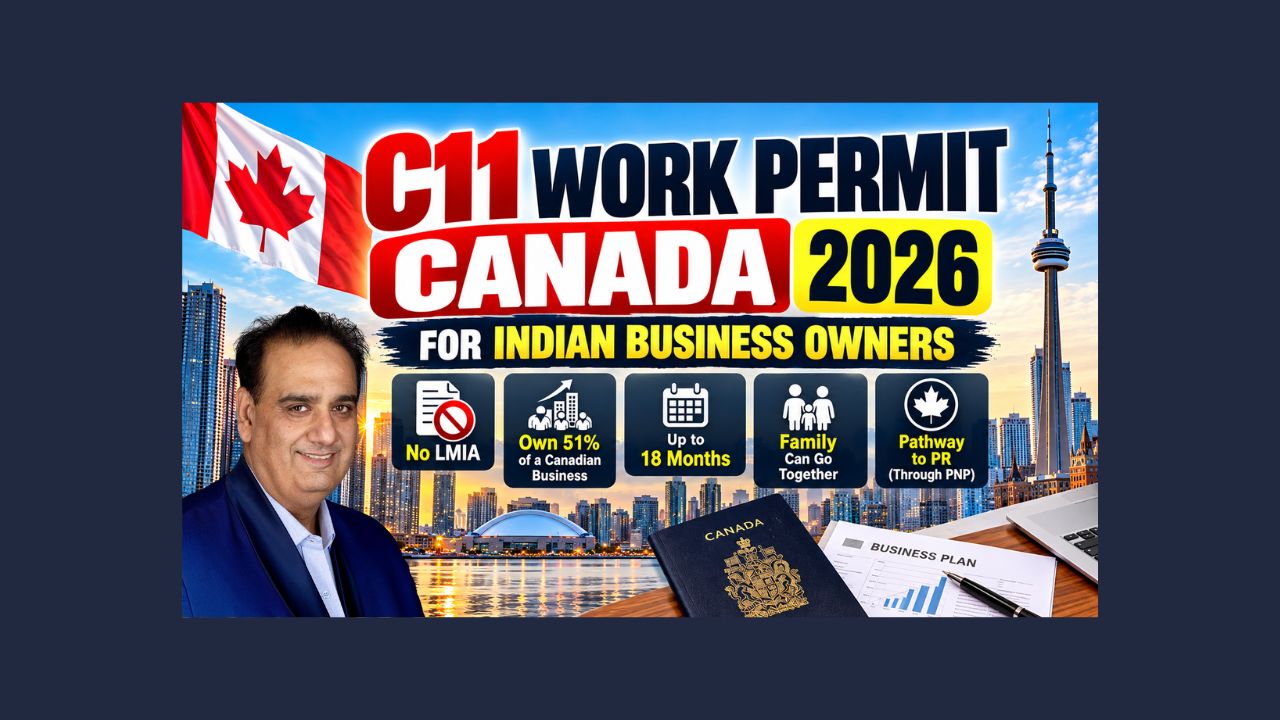
The C11 work permit lets an Indian business owner move to Canada, own at least 51% of a Canadian business and run it, without an LMIA. It is a temporary permit, usually capped at 18 months. Permanent residency does not come from C11 itself. It comes later, through a provincial entrepreneur stream (PNP), if the business performs.
That last line is the one most agents skip. We are putting it first because the families who walk into our Mohali and Jalandhar offices deserve the full picture before they move money.
Here is what this guide covers:
- What C11 is, and what changed in 2025 and 2026
- Benefits, and the money IRCC expects to see
- 40 types of Indian business owners who are realistic candidates
- What your spouse and children can do in Canada
- How a C11 business can lead to PR through a provincial entrepreneur stream, with current investment and net worth figures
- A clear roadmap, the risks, and answers to common questions
Quick facts (as of October 2026)
| Point | C11 rule |
|---|---|
| LMIA needed? | No. C11 is exempt from the LMIA under R205(a) |
| Ownership | At least 51% of the Canadian business |
| Permit length | Normally up to 18 months; extensions need proof the business is delivering |
| Money | Two separate pools: family support funds and business funds |
| Counts for CEC (Express Entry)? | No |
| Route to PR | Mostly through a provincial entrepreneur stream |
| Spouse and children | Spouse may qualify for an open work permit; children can study |
What the C11 work permit is
C11 is an administrative code inside Canada’s International Mobility Program. It covers foreign nationals who come to Canada to set up or run their own business, where that business creates a “significant benefit” for Canada. Because of that benefit test, no LMIA (labour market test) is needed.
On 27 May 2025, IRCC rewrote the C11 instructions. The category is now called “Business owners seeking only temporary residence” (IRCC program delivery update). The main changes:
- 51% ownership floor. You must control at least 51% of the Canadian business. Below that, you are treated as an employee, not an owner.
- 18 months is the normal limit. Longer stays need a clear plan to hand over the business.
- Two separate fund pools. Money to support your family, and separate money for the business.
- No CEC credit. Time spent on a C11 work permit, whether self-employed or as an entrepreneur, does not count as Canadian Experience Class work experience.
- Exit plan. For a business that runs all year, IRCC wants a plan for who runs it after you leave (for example, a hired manager).
IRCC also separates two kinds of owners. A self-employed owner works mostly alone or with family. An entrepreneur hires people outside the family to run the business while they manage it. Both can apply, but the self-employed owner has a harder time proving significant benefit.
Why C11 matters more in 2026
The federal Start-Up Visa stopped taking new applications on 1 January 2026, and the Self-Employed Persons Program is also paused. IRCC has said a new entrepreneur pilot is coming, but no rules are public yet. That leaves the C11 work permit as the main federal door for an owner who wants to arrive first and build.
C11 or C60? This decides your PR plan
Read this part carefully. The C11 work permit is meant for owners with temporary intent. IRCC’s own instructions say that a person who intends to seek permanent residence should be assessed under a different code, C60. C60 is for business candidates who have support from a province’s entrepreneur program (IRCC C11 instructions).
In practice, Indian business owners use two routes:
- C11 first. Enter on a C11 work permit with a genuine temporary business plan, run a real business, then apply to a provincial entrepreneur stream later if the business has grown and the stream is open.
- PNP first (C60). Apply to a provincial entrepreneur stream from India, get selected, sign a performance agreement, then receive a work permit on the province’s support letter.
%3C%2Ftext%3E%3Crect%20x%3D%2250%22%20y%3D%2292%22%20width%3D%22300%22%20height%3D%2256%22%20rx%3D%228%22%20class%3D%22e%22%2F%3E%3Ctext%20x%3D%22200%22%20y%3D%22116%22%20class%3D%22b%22%20text-anchor%3D%22middle%22%3EC11%20work%20permit%3C%2Ftext%3E%3Ctext%20x%3D%22200%22%20y%3D%22134%22%20font-size%3D%2211.5%22%20class%3D%22q%22%20text-anchor%3D%22middle%22%3ETemporary%20intent%2C%20normally%20up%20to%2018%20months%3C%2Ftext%3E%3Cpath%20d%3D%22M200%20148V172%22%20class%3D%22e%22%20marker-end%3D%22url(%23arw)%22%2F%3E%3Crect%20x%3D%2250%22%20y%3D%22172%22%20width%3D%22300%22%20height%3D%2256%22%20rx%3D%228%22%20class%3D%22e%22%2F%3E%3Ctext%20x%3D%22200%22%20y%3D%22196%22%20class%3D%22b%22%20text-anchor%3D%22middle%22%3ERun%20the%20business%20in%20Canada%3C%2Ftext%3E%3Ctext%20x%3D%22200%22%20y%3D%22214%22%20font-size%3D%2211.5%22%20class%3D%22q%22%20text-anchor%3D%22middle%22%3ECanadian%20staff%2C%20revenue%2C%20taxes%20filed%3C%2Ftext%3E%3Cpath%20d%3D%22M200%20228V252%22%20class%3D%22e%22%20marker-end%3D%22url(%23arw)%22%2F%3E%3Crect%20x%3D%2250%22%20y%3D%22252%22%20width%3D%22300%22%20height%3D%2256%22%20rx%3D%228%22%20class%3D%22e%22%2F%3E%3Ctext%20x%3D%22200%22%20y%3D%22276%22%20class%3D%22b%22%20text-anchor%3D%22middle%22%3EApply%20to%20a%20provincial%20stream%3C%2Ftext%3E%3Ctext%20x%3D%22200%22%20y%3D%22294%22%20font-size%3D%2211.5%22%20class%3D%22q%22%20text-anchor%3D%22middle%22%3EOnly%20if%20it%20is%20open%20and%20your%20numbers%20fit%3C%2Ftext%3E%3Crect%20x%3D%22410%22%20y%3D%2292%22%20width%3D%22300%22%20height%3D%2256%22%20rx%3D%228%22%20class%3D%22e%22%2F%3E%3Ctext%20x%3D%22560%22%20y%3D%22116%22%20class%3D%22b%22%20text-anchor%3D%22middle%22%3EProvincial%20EOI%20and%20invitation%3C%2Ftext%3E%3Ctext%20x%3D%22560%22%20y%3D%22134%22%20font-size%3D%2211.5%22%20class%3D%22q%22%20text-anchor%3D%22middle%22%3EPoints%20for%20net%20worth%2C%20experience%2C%20language%3C%2Ftext%3E%3Cpath%20d%3D%22M560%20148V172%22%20class%3D%22e%22%20marker-end%3D%22url(%23arw)%22%2F%3E%3Crect%20x%3D%22410%22%20y%3D%22172%22%20width%3D%22300%22%20height%3D%2256%22%20rx%3D%228%22%20class%3D%22e%22%2F%3E%3Ctext%20x%3D%22560%22%20y%3D%22196%22%20class%3D%22b%22%20text-anchor%3D%22middle%22%3EPerformance%20agreement%3C%2Ftext%3E%3Ctext%20x%3D%22560%22%20y%3D%22214%22%20font-size%3D%2211.5%22%20class%3D%22q%22%20text-anchor%3D%22middle%22%3EWork%20permit%20on%20the%20province%20support%20letter%3C%2Ftext%3E%3Cpath%20d%3D%22M560%20228V252%22%20class%3D%22e%22%20marker-end%3D%22url(%23arw)%22%2F%3E%3Crect%20x%3D%22410%22%20y%3D%22252%22%20width%3D%22300%22%20height%3D%2256%22%20rx%3D%228%22%20class%3D%22e%22%2F%3E%3Ctext%20x%3D%22560%22%20y%3D%22276%22%20class%3D%22b%22%20text-anchor%3D%22middle%22%3ERun%20the%20business%2C%20meet%20targets%3C%2Ftext%3E%3Ctext%20x%3D%22560%22%20y%3D%22294%22%20font-size%3D%2211.5%22%20class%3D%22q%22%20text-anchor%3D%22middle%22%3EUsually%2012%20to%2024%20months%20of%20operation%3C%2Ftext%3E%3Cpath%20d%3D%22M200%20308V328H300V348%22%20class%3D%22e%22%20marker-end%3D%22url(%23arw)%22%2F%3E%3Cpath%20d%3D%22M560%20308V328H460V348%22%20class%3D%22e%22%20marker-end%3D%22url(%23arw)%22%2F%3E%3Cpath%20d%3D%22M380%20404V428%22%20class%3D%22e%22%20marker-end%3D%22url(%23arw)%22%2F%3E%3Crect%20x%3D%22230%22%20y%3D%22348%22%20width%3D%22300%22%20height%3D%2256%22%20rx%3D%228%22%20class%3D%22e%22%2F%3E%3Ctext%20x%3D%22380%22%20y%3D%22372%22%20class%3D%22b%22%20text-anchor%3D%22middle%22%3EProvincial%20nomination%3C%2Ftext%3E%3Ctext%20x%3D%22380%22%20y%3D%22390%22%20font-size%3D%2211.5%22%20class%3D%22q%22%20text-anchor%3D%22middle%22%3EProvince%20confirms%20the%20targets%20were%20met%3C%2Ftext%3E%3Crect%20x%3D%22230%22%20y%3D%22428%22%20width%3D%22300%22%20height%3D%2256%22%20rx%3D%228%22%20fill%3D%22%231F5FBF%22%20fill-opacity%3D%220.12%22%20stroke%3D%22%231F5FBF%22%20stroke-width%3D%222%22%2F%3E%3Ctext%20x%3D%22380%22%20y%3D%22452%22%20class%3D%22b%22%20text-anchor%3D%22middle%22%3EPermanent%20residence%20(IRCC)%3C%2Ftext%3E%3Ctext%20x%3D%22380%22%20y%3D%22470%22%20font-size%3D%2211.5%22%20text-anchor%3D%22middle%22%3EYou%2C%20your%20spouse%20and%20dependent%20children%3C%2Ftext%3E%3C%2Fsvg%3E)
A C11 work permit alone never ends in PR. Both routes need a province to select you and confirm that your business met its targets.
Which route fits depends on your money, your industry and which provinces are open the month you apply. Never let anyone tell you the C11 work permit is a “PR visa”. It is not, and saying so to an officer can get your file refused.
Benefits of the C11 work permit
The biggest benefit is speed of entry. You get to Canada and start building without waiting years for a provincial draw.
%20scale(0.0055)%20translate(0%20-230)%22%2F%3E%3Ctext%20x%3D%2238%22%20y%3D%22112%22%20class%3D%22b%22%3ENo%20LMIA%3C%2Ftext%3E%3Ctext%20x%3D%2238%22%20y%3D%22129%22%20font-size%3D%2211.5%22%20class%3D%22q%22%3EYou%20are%20the%20employer%3C%2Ftext%3E%3Crect%20x%3D%22206%22%20y%3D%2256%22%20width%3D%22166%22%20height%3D%2284%22%20rx%3D%228%22%20class%3D%22e%22%2F%3E%3Cuse%20href%3D%22%23c11leaf%22%20transform%3D%22translate(232%2080)%20scale(0.0055)%20translate(0%20-230)%22%2F%3E%3Ctext%20x%3D%22220%22%20y%3D%22112%22%20class%3D%22b%22%3ENo%20fixed%20minimum%3C%2Ftext%3E%3Ctext%20x%3D%22220%22%20y%3D%22129%22%20font-size%3D%2211.5%22%20class%3D%22q%22%3EYour%20plan%20sets%20the%20amount%3C%2Ftext%3E%3Crect%20x%3D%22388%22%20y%3D%2256%22%20width%3D%22166%22%20height%3D%2284%22%20rx%3D%228%22%20class%3D%22e%22%2F%3E%3Cuse%20href%3D%22%23c11leaf%22%20transform%3D%22translate(414%2080)%20scale(0.0055)%20translate(0%20-230)%22%2F%3E%3Ctext%20x%3D%22402%22%20y%3D%22112%22%20class%3D%22b%22%3EYou%20keep%20control%3C%2Ftext%3E%3Ctext%20x%3D%22402%22%20y%3D%22129%22%20font-size%3D%2211.5%22%20class%3D%22q%22%3E51%25%20or%20more%20is%20yours%3C%2Ftext%3E%3Crect%20x%3D%22570%22%20y%3D%2256%22%20width%3D%22166%22%20height%3D%2284%22%20rx%3D%228%22%20class%3D%22e%22%2F%3E%3Cuse%20href%3D%22%23c11leaf%22%20transform%3D%22translate(596%2080)%20scale(0.0055)%20translate(0%20-230)%22%2F%3E%3Ctext%20x%3D%22584%22%20y%3D%22112%22%20class%3D%22b%22%3EFamily%20comes%20too%3C%2Ftext%3E%3Ctext%20x%3D%22584%22%20y%3D%22129%22%20font-size%3D%2211.5%22%20class%3D%22q%22%3ESpouse%20and%20children%3C%2Ftext%3E%3Crect%20x%3D%2224%22%20y%3D%22156%22%20width%3D%22166%22%20height%3D%2284%22%20rx%3D%228%22%20class%3D%22e%22%2F%3E%3Cuse%20href%3D%22%23c11leaf%22%20transform%3D%22translate(50%20180)%20scale(0.0055)%20translate(0%20-230)%22%2F%3E%3Ctext%20x%3D%2238%22%20y%3D%22212%22%20class%3D%22b%22%3EBuy%20or%20start%3C%2Ftext%3E%3Ctext%20x%3D%2238%22%20y%3D%22229%22%20font-size%3D%2211.5%22%20class%3D%22q%22%3ESuccession%20buys%20welcome%3C%2Ftext%3E%3Crect%20x%3D%22206%22%20y%3D%22156%22%20width%3D%22166%22%20height%3D%2284%22%20rx%3D%228%22%20class%3D%22e%22%2F%3E%3Cuse%20href%3D%22%23c11leaf%22%20transform%3D%22translate(232%20180)%20scale(0.0055)%20translate(0%20-230)%22%2F%3E%3Ctext%20x%3D%22220%22%20y%3D%22212%22%20class%3D%22b%22%3ETrack%20record%3C%2Ftext%3E%3Ctext%20x%3D%22220%22%20y%3D%22229%22%20font-size%3D%2211.5%22%20class%3D%22q%22%3EStrengthens%20a%20PNP%20file%3C%2Ftext%3E%3Crect%20x%3D%22388%22%20y%3D%22156%22%20width%3D%22166%22%20height%3D%2284%22%20rx%3D%228%22%20class%3D%22e%22%2F%3E%3Cuse%20href%3D%22%23c11leaf%22%20transform%3D%22translate(414%20180)%20scale(0.0055)%20translate(0%20-230)%22%2F%3E%3Ctext%20x%3D%22402%22%20y%3D%22212%22%20class%3D%22b%22%3ELand%20first%3C%2Ftext%3E%3Ctext%20x%3D%22402%22%20y%3D%22229%22%20font-size%3D%2211.5%22%20class%3D%22q%22%3EBuild%20before%20you%20apply%3C%2Ftext%3E%3Crect%20x%3D%22570%22%20y%3D%22156%22%20width%3D%22166%22%20height%3D%2284%22%20rx%3D%228%22%20class%3D%22e%22%2F%3E%3Cuse%20href%3D%22%23c11leaf%22%20transform%3D%22translate(596%20180)%20scale(0.0055)%20translate(0%20-230)%22%2F%3E%3Ctext%20x%3D%22584%22%20y%3D%22212%22%20class%3D%22b%22%3ECanadian%20banking%3C%2Ftext%3E%3Ctext%20x%3D%22584%22%20y%3D%22229%22%20font-size%3D%2211.5%22%20class%3D%22q%22%3EAccounts%2C%20credit%2C%20tax%3C%2Ftext%3E%3C%2Fsvg%3E)
- No LMIA. You don’t need a Canadian employer or a labour market test. You are the employer.
- No fixed minimum investment in the rules. IRCC judges whether the money fits the plan, not a set number. Officers look at the impact your business has on its area, not only the cash.
- You keep control. With 51% or more, the business is yours to run.
- Your family can come with you. Your spouse may qualify for an open work permit and your children can go to school (details below).
- A live business before any PR application. Most provincial entrepreneur streams score you on business experience, investment and jobs. A Canadian business that is already trading, with Canadian staff, is a strong file.
- Real Canadian knowledge. You learn the market, banking, tax and hiring on the ground instead of from a brochure.
- Buying an existing business is allowed. The C11 work permit is not only for new businesses. A succession purchase in a small town can show benefit quickly because the jobs already exist.
- Works with a Canadian corporation. You can incorporate, open a business bank account and build a credit history in Canada.
Eligibility, investment and net worth for C11
The C11 work permit has no published minimum investment or net worth. What IRCC does require is two separate pools of money, legal proof of where that money came from, and a business plan that shows real benefit to a Canadian community (IRCC C11 instructions).
%22%2F%3E%3Cpath%20d%3D%22M430%2096V114H566V132%22%20class%3D%22e%22%20marker-end%3D%22url(%23arw)%22%2F%3E%3Crect%20x%3D%2224%22%20y%3D%22132%22%20width%3D%22340%22%20height%3D%22122%22%20rx%3D%228%22%20fill%3D%22%231F5FBF%22%20fill-opacity%3D%220.08%22%20stroke%3D%22%231F5FBF%22%20stroke-width%3D%221.5%22%2F%3E%3Ctext%20x%3D%2240%22%20y%3D%22158%22%20class%3D%22b%22%3EPool%201%3A%20Family%20support%20funds%3C%2Ftext%3E%3Ctext%20x%3D%2240%22%20y%3D%22182%22%20font-size%3D%2211.5%22%3EYour%20family's%20living%20costs%20in%20Canada%3C%2Ftext%3E%3Ctext%20x%3D%2240%22%20y%3D%22200%22%20font-size%3D%2211.5%22%3ELow-income%20cut-off%20(LICO)%20for%2018%20months%3C%2Ftext%3E%3Ctext%20x%3D%2240%22%20y%3D%22218%22%20font-size%3D%2211.5%22%3EAvailable%20now%2C%20not%20tied%20up%20in%20loans%3C%2Ftext%3E%3Ctext%20x%3D%2240%22%20y%3D%22236%22%20font-size%3D%2211.5%22%20class%3D%22q%22%3EOur%20estimate%3A%20about%20CAD%2085%2C000%20for%204%20people%3C%2Ftext%3E%3Crect%20x%3D%22396%22%20y%3D%22132%22%20width%3D%22340%22%20height%3D%22122%22%20rx%3D%228%22%20fill%3D%22%23E2622F%22%20fill-opacity%3D%220.08%22%20stroke%3D%22%23E2622F%22%20stroke-width%3D%221.5%22%2F%3E%3Ctext%20x%3D%22412%22%20y%3D%22158%22%20class%3D%22b%22%3EPool%202%3A%20Business%20funds%3C%2Ftext%3E%3Ctext%20x%3D%22412%22%20y%3D%22182%22%20font-size%3D%2211.5%22%3ESet-up%2C%20stock%2C%20rent%2C%20wages%2C%20your%20salary%3C%2Ftext%3E%3Ctext%20x%3D%22412%22%20y%3D%22200%22%20font-size%3D%2211.5%22%3EAmount%20must%20match%20your%20business%20plan%3C%2Ftext%3E%3Ctext%20x%3D%22412%22%20y%3D%22218%22%20font-size%3D%2211.5%22%3EEvery%20rupee%20traced%20to%20a%20legal%20source%3C%2Ftext%3E%3Ctext%20x%3D%22412%22%20y%3D%22236%22%20font-size%3D%2211.5%22%20class%3D%22q%22%3ENo%20fixed%20minimum%20in%20the%20C11%20rules%3C%2Ftext%3E%3Crect%20x%3D%2224%22%20y%3D%22274%22%20width%3D%22712%22%20height%3D%2242%22%20rx%3D%228%22%20fill%3D%22%23D99A00%22%20fill-opacity%3D%220.12%22%20stroke%3D%22%23D99A00%22%20stroke-width%3D%221.25%22%2F%3E%3Ctext%20x%3D%22380%22%20y%3D%22300%22%20class%3D%22b%22%20text-anchor%3D%22middle%22%3EKeep%20the%20two%20pools%20in%20separate%20accounts.%20One%20mixed%20account%20is%20a%20refusal%20risk.%3C%2Ftext%3E%3C%2Fsvg%3E)
The core requirements
| Requirement | What IRCC wants to see |
|---|---|
| Ownership | At least 51% of the Canadian business |
| Active role | You run the business. Passive investment does not qualify |
| Significant benefit | Jobs for Canadians, regional growth, exports, new technology or a service the area lacks |
| Business plan | A concrete start-up plan: location, suppliers, costs, marketing, customers, hiring. A market report alone is not enough |
| Skills | Experience in the same industry, and enough English (or French) to run the business |
| Temporary intent | A plan to leave, or to hand the business to a manager, and ties to India |
| Offer of employment | You submit an offer to yourself through IRCC’s Employer Portal and pay the employer compliance fee |
Support funds for your family
You must show money for your family’s living costs, separate from the business. IRCC sets this at the low-income cut-off (LICO) for your family size for at least 18 months. It must be available and not tied up in loans.
IRCC publishes LICO-based figures every year. Its July 2025 Express Entry table is based on 50% of LICO: CAD 15,263 for one person and CAD 28,362 for a family of four (IRCC proof of funds). Doubling that for full LICO and stretching it over 18 months, our rough estimate is:
| Family size | Approx. support funds for 18 months (CAD) |
|---|---|
| 1 (you alone) | about 46,000 |
| 2 (you + spouse) | about 57,000 |
| 3 | about 70,000 |
| 4 | about 85,000 |
These are our estimates, not IRCC numbers. Use them for planning and confirm the current LICO before you file.
Business funds
On top of the family money, you need funds to set up and run the business and to pay yourself. There is no fixed number. The amount must match your plan. Buying a running motel needs far more than opening a small IT consultancy.
You also need proof of provenance: bank statements, ITRs, property sale deeds, business balance sheets and gift deeds that show how the money was earned. This is where many Indian files fail.
What it usually costs in practice
For a realistic C11 work permit file that also sets up a later PNP application, plan for business capital in the same range as the province you are aiming for, usually CAD 100,000 to 250,000 in invested funds, plus the family support funds above. A file showing CAD 30,000 for a “consultancy” in Toronto rarely convinces anyone.
40 types of Indian business owners who can apply
Every owner below already runs a real business in India and can show how the same skill creates jobs or fills a gap in a Canadian town. The examples below are illustrations of strong profiles, not promises of approval. Every file is judged on its own facts.
- Restaurant, dhaba or sweet shop owner. A Ludhiana owner with two outlets and 15 staff buys a family restaurant in a small Alberta town where the owner is retiring. Ten local jobs are kept, and the menu adds something new. Succession buys like this score well because the jobs already exist.
- Transport and trucking fleet owner. A Jalandhar transporter with 20 trucks sets up a regional freight company in Manitoba or Alberta, hiring licensed Canadian drivers and a dispatcher. Canada’s freight sector needs operators, and fleet management experience transfers directly.
- Farmer, dairy owner or agri-input dealer. A Punjab family with a dairy, or a seeds and fertiliser dealership, buys or starts a farm supply or dairy business in rural Manitoba or Alberta. Agricultural experience is valued, and rural location strengthens the benefit case.
- Hotel, guest house or banquet owner. A Mohali hotelier buys a motel with 20 rooms on a highway route in rural BC. Hospitality experience, existing staff and tourist traffic make the case. This profile often fits a regional entrepreneur stream later.
- IT or software services company owner. A Chandigarh founder with a development company of 40 people opens a Canadian office that serves North American clients and hires local developers and sales staff. Export of services and skilled hiring are both strong benefit points.
- Manufacturer. A Jalandhar sports goods or hand tool manufacturer, or a Ludhiana auto parts unit, sets up assembly, warehousing or distribution in Canada. Canadian jobs plus new supply links count as real economic benefit.
- Import and export trader. A rice, spice or textile exporter opens a Canadian distribution company that imports from India and supplies stores across a province. The plan must show customers, warehousing and staff, not only buying and selling.
- Construction contractor or builder. A builder with completed projects starts a renovation or small construction firm in a growing town. Housing demand in Canada is high, but provincial trade licensing must be planned for.
- Healthcare business owner. A pharmacy chain owner, diagnostics lab owner or medical distributor sets up a medical supply or home-care services company. Note that running a pharmacy or clinic in Canada needs Canadian licensing for the professionals involved, so the owner usually manages and hires licensed staff.
- Retail or franchise owner. A supermarket, petrol pump or franchise owner buys a grocery store or franchise outlet in a town with few options. IRCC’s own example: a store in a rural area 20 km from the nearest grocery can be a real benefit, while the same store on a busy Toronto street may not be.
- Education or coaching institute owner. A Jalandhar IELTS centre or private school owner opens a tutoring, test preparation or skills training centre in a smaller Canadian city, hiring Canadian teachers. Childcare or anything regulated needs provincial licensing, so check that first.
- Real estate developer or property dealer. A Mohali developer starts a property management, renovation or small residential construction company that hires trades and office staff. Buying flats to rent out does not count: passive real estate investment never qualifies for C11 or a provincial stream.
- Textile, hosiery or garment business owner. A Ludhiana hosiery manufacturer or boutique chain owner opens an apparel design, import and wholesale business supplying Canadian retailers, with its own warehouse and staff.
- Auto workshop or vehicle dealership owner. A Jalandhar dealership or service centre owner buys a tyre and repair shop in a small town where the nearest garage is far away. IRCC treats an auto shop as a business that runs all year, so the file needs a clear plan for who runs it long term.
- Food processing unit owner. A pickle, frozen food, namkeen or dairy products maker sets up a small food production unit for the South Asian grocery market in Canada. Food businesses need Canadian food safety licences, which belong in the business plan from day one.
- Logistics, courier or warehousing owner. A courier franchisee or cold storage owner starts a last-mile delivery or warehousing company serving local retailers and e-commerce sellers, with Canadian drivers and staff.
- Travel agency or tour operator. An established travel agency owner opens a tour and travel company that brings Indian and other overseas tourists into a Canadian region, adding spending to local hotels and attractions.
- Beauty salon or spa chain owner. A salon chain owner with several branches opens a salon or spa in an underserved town and hires Canadian stylists. A salon run by one person is a self-employed case and harder to approve, so the plan should include staff.
- Event management, wedding planning or catering owner. A Punjab wedding planner or caterer starts an events and catering company for the large South Asian community in Canada, hiring local chefs, decorators and event staff.
- Digital marketing or media agency owner. A Chandigarh agency owner with a client base opens a Canadian agency that serves local small businesses and exports services, hiring Canadian designers, editors and account managers.
- Furniture manufacturer or woodwork unit owner. A Kartarpur furniture maker sets up a custom furniture workshop and showroom, combining Canadian craftsmen with designs and supply from India.
- Rice mill or flour mill owner. A Punjab miller starts a specialty flour, atta or grain processing unit supplying South Asian stores and bakeries, with Canadian production staff.
- Poultry or livestock farm owner. An experienced poultry farmer buys an existing farm in a rural province. Egg, chicken and dairy production in Canada runs on supply quotas, so the plan must include buying or leasing quota.
- Nursery, horticulture or greenhouse owner. A plant nursery or polyhouse owner starts a greenhouse growing vegetables or flowers for local markets, a sector many rural communities want to grow.
- Jewellery business owner. A jeweller with a family store opens a jewellery design and retail business for Canada’s South Asian community. Expect close scrutiny of gold stock valuation and source of funds.
- Printing press or packaging unit owner. A Ludhiana printing and packaging owner sets up commercial printing, labels and packaging for local manufacturers and food businesses.
- Electrical contractor or solar installer. A solar EPC or electrical contracting firm owner starts a solar installation company, hiring licensed Canadian electricians. Trade licensing is provincial and must be planned for.
- Building materials, sanitary or hardware dealer. A sanitary fittings or hardware wholesaler opens a building supplies or hardware store in a growing town that is short of suppliers.
- Mobile and electronics retail or repair chain owner. A phone shop chain owner opens a device sales and repair business with Canadian technicians, in a town without one nearby.
- Gym or fitness centre owner. A gym owner with several branches opens a fitness studio in an underserved suburb or town, hiring certified Canadian trainers.
- Bakery or confectionery owner. A bakery chain owner starts a bakery and cake shop that supplies cafés and stores as well as walk-in customers, with Canadian bakers on staff.
- Security services agency owner. A security agency owner starts a guarding and alarm monitoring company. Security businesses and guards need provincial licences, which shape the timeline.
- Cleaning or facility management company owner. A housekeeping and facility services owner starts a commercial cleaning company for offices, clinics and warehouses, a business that needs many workers and creates local jobs.
- Pharma, ayurvedic or nutraceutical company owner. A manufacturer of ayurvedic or nutritional products sets up import and distribution in Canada. Natural health products need Health Canada licensing before they can be sold.
- Tractor and farm machinery dealer. A Punjab tractor or combine dealer opens a farm equipment sales, parts and repair business in a farming region, with Canadian mechanics.
- Accounting or tax practice owner. A chartered accountant who runs a firm opens a bookkeeping, payroll and back-office services company for small businesses. Some services in Canada are reserved for licensed CPAs, so the plan must stay within what is allowed or hire licensed staff.
- Taxi, car rental or tour vehicle fleet owner. A cab or car rental fleet owner starts a car rental, airport shuttle or limousine company in a tourist or regional hub, hiring Canadian drivers.
- Spare parts or hardware wholesaler. An auto spare parts or industrial hardware wholesaler opens a distribution business supplying workshops and farms across a region.
- Film, music or media production studio owner. A Punjabi music or film production house owner opens a production studio in Canada serving the large Punjabi diaspora and local clients, hiring Canadian crew.
- E-commerce brand owner. An online seller with an established brand sets up a Canadian company with its own warehouse, fulfilment staff and customer service, selling across North America.
Who usually struggles? a person with no business history in India, a “consultancy” with no clients, a business in a crowded big-city market, or someone planning to run the business alone. Those files have a much harder time proving significant benefit.
What your spouse and children can do in Canada
Your family can usually come with you, but the rules changed on 21 January 2025. Your spouse’s work rights now depend on your occupation level and how long your permit has left. Working-age children no longer get open work permits through you (IRCC family open work permits).
%22%2F%3E%3Cpath%20d%3D%22M380%20100V150%22%20class%3D%22e%22%20marker-end%3D%22url(%23arw)%22%2F%3E%3Cpath%20d%3D%22M430%20100V124H626V150%22%20class%3D%22e%22%20marker-end%3D%22url(%23arw)%22%2F%3E%3Crect%20x%3D%2224%22%20y%3D%22150%22%20width%3D%22220%22%20height%3D%2298%22%20rx%3D%228%22%20class%3D%22e%22%2F%3E%3Ctext%20x%3D%2236%22%20y%3D%22174%22%20class%3D%22b%22%3ESpouse%20or%20partner%3C%2Ftext%3E%3Ctext%20x%3D%2236%22%20y%3D%22196%22%20font-size%3D%2211.5%22%3EOpen%20work%20permit%20possible%3C%2Ftext%3E%3Ctext%20x%3D%2236%22%20y%3D%22214%22%20font-size%3D%2211.5%22%3EIf%20your%20job%20is%20TEER%200%20or%201%3C%2Ftext%3E%3Ctext%20x%3D%2236%22%20y%3D%22232%22%20font-size%3D%2211.5%22%20class%3D%22q%22%3E16%2B%20months%20left%20on%20your%20permit%3C%2Ftext%3E%3Cpath%20d%3D%22M134%20248V276%22%20class%3D%22e%22%20marker-end%3D%22url(%23arw)%22%2F%3E%3Crect%20x%3D%22270%22%20y%3D%22150%22%20width%3D%22220%22%20height%3D%2298%22%20rx%3D%228%22%20class%3D%22e%22%2F%3E%3Ctext%20x%3D%22282%22%20y%3D%22174%22%20class%3D%22b%22%3EChildren%20under%2018%3C%2Ftext%3E%3Ctext%20x%3D%22282%22%20y%3D%22196%22%20font-size%3D%2211.5%22%3EPublic%20primary%20and%20secondary%3C%2Ftext%3E%3Ctext%20x%3D%22282%22%20y%3D%22214%22%20font-size%3D%2211.5%22%3Eschool%20while%20you%20can%20work%3C%2Ftext%3E%3Ctext%20x%3D%22282%22%20y%3D%22232%22%20font-size%3D%2211.5%22%20class%3D%22q%22%3EConfirm%20with%20the%20school%20board%3C%2Ftext%3E%3Cpath%20d%3D%22M380%20248V276%22%20class%3D%22e%22%20marker-end%3D%22url(%23arw)%22%2F%3E%3Crect%20x%3D%22516%22%20y%3D%22150%22%20width%3D%22220%22%20height%3D%2298%22%20rx%3D%228%22%20class%3D%22e%22%2F%3E%3Ctext%20x%3D%22528%22%20y%3D%22174%22%20class%3D%22b%22%3EChildren%2018%20and%20over%3C%2Ftext%3E%3Ctext%20x%3D%22528%22%20y%3D%22196%22%20font-size%3D%2211.5%22%3ENo%20open%20work%20permit%20via%20you%3C%2Ftext%3E%3Ctext%20x%3D%22528%22%20y%3D%22214%22%20font-size%3D%2211.5%22%3ENeed%20their%20own%20study%20permit%3C%2Ftext%3E%3Ctext%20x%3D%22528%22%20y%3D%22232%22%20font-size%3D%2211.5%22%20class%3D%22q%22%3Eor%20their%20own%20work%20permit%3C%2Ftext%3E%3Cpath%20d%3D%22M626%20248V276%22%20class%3D%22e%22%20marker-end%3D%22url(%23arw)%22%2F%3E%3Crect%20x%3D%2224%22%20y%3D%22276%22%20width%3D%22712%22%20height%3D%2244%22%20rx%3D%228%22%20fill%3D%22%231A8F4C%22%20fill-opacity%3D%220.1%22%20stroke%3D%22%231A8F4C%22%20stroke-width%3D%221.5%22%2F%3E%3Ctext%20x%3D%22380%22%20y%3D%22303%22%20class%3D%22b%22%20text-anchor%3D%22middle%22%3EAfter%20PR%3A%20spouse%20and%20dependent%20children%20become%20permanent%20residents%20too%3C%2Ftext%3E%3C%2Fsvg%3E)
| Family member | What they can do | Conditions |
|---|---|---|
| Spouse or common-law partner | May apply for an open work permit and work for any employer | Your job must be TEER 0 (management) or TEER 1, or a listed TEER 2/3 occupation, and your permit must have at least 16 months left when your spouse applies |
| Spouse (if not eligible for an open permit) | Can come as a visitor, study, or apply for their own work permit | Separate application and eligibility |
| Children of school age (under 18) | Can attend public primary and secondary school | Usually allowed while a parent is authorised to work in Canada; check with the provincial school board |
| Children going to college or university | Need their own study permit | Normal international student rules and fees apply |
| Dependent children 18+ who want to work | No open work permit through you since January 2025 | Need their own work or study permit |
The 16-month catch. A C11 work permit is normally issued for up to 18 months. If your spouse applies late, your permit may have less than 16 months left and the spouse will not qualify. Apply for both together, or soon after you land.
Is a business owner TEER 0? An entrepreneur on a C11 work permit uses a generic code, not a standard management code. Whether your role supports a spousal open work permit is something to confirm with a licensed consultant on your specific file. Don’t assume it.
After PR: once the family gets permanent residence through a provincial nomination, your spouse and dependent children become PRs too. They can then work or study anywhere in Canada, children pay domestic fees at college and university, and the family gets public health coverage.
How you get PR through a PNP entrepreneur stream
Since May 2025, time on a C11 work permit does not count for the Canadian Experience Class, so the main route from business owner to PR is a provincial entrepreneur stream. The province selects you, you run the business under a performance agreement, and once you meet the targets the province nominates you. You then apply to IRCC for PR.
How a provincial entrepreneur stream works
- Expression of Interest (EOI). You register a profile with your net worth, investment, experience, language score and business idea. You get points.
- Invitation. Top-scoring candidates are invited to apply.
- Net worth verification. An approved accounting firm checks your net worth and where every rupee came from.
- Business plan and interview. The province reviews the plan and may interview you.
- Performance agreement. You sign targets: how much you will invest, how many jobs you will create, and that you will live near and run the business.
- Work permit. The province gives you a support letter, and you get a work permit to go and start the business.
- Run the business. Usually 12 to 24 months of active operation, investment and hiring.
- Final report and nomination. You prove you met the targets. The province nominates you.
- PR application to IRCC. You, your spouse and dependent children apply for permanent residence.
Investment and net worth by province (October 2026)
All figures are in Canadian dollars. Programs change often, so check the official page in the same week you apply.
| Province and stream | Min. net worth | Min. investment | Jobs | Key conditions | Status |
|---|---|---|---|---|---|
| BC Entrepreneur Immigration: Base | 600,000 | 200,000 | At least 1 full-time job for a Canadian or PR | Verified net worth, business experience, anywhere in BC | Active |
| BC Entrepreneur Immigration: Regional | 300,000 | 100,000 | At least 1 | Smaller BC community, community referral, 51% ownership | Active |
| Manitoba Business Investor Stream: Entrepreneur Pathway | 500,000 | 250,000 in Winnipeg region; 150,000 outside | At least 1 | 3 years as owner or senior manager in the last 5 years; business research visit | Active |
| Alberta Rural Entrepreneur Stream | 300,000 | 100,000 | At least 1 | Community under 100,000 people, outside Edmonton and Calgary; Community Support Letter | Accepting EOIs |
| New Brunswick, Nova Scotia, PEI, Newfoundland and Labrador, Yukon, NWT | Varies | Varies | Varies | Each has its own stream and intake pattern | Active or irregular; check each |
| Ontario OINP Entrepreneur | n/a | n/a | n/a | Closed November 2024 | Closed |
| Saskatchewan SINP Entrepreneur | n/a | n/a | n/a | Business categories closed in 2025 | Closed |
Net worth means everything you and your spouse own (property, business equity, bank balances, investments) minus loans. It must be legally earned and traceable. Investment means money you actually put into the Canadian business, not a deposit sitting in a bank.
In rupees, roughly
At about ₹60 to a Canadian dollar (rates move, check on the day), CAD 300,000 net worth is roughly ₹1.8 crore and CAD 600,000 is roughly ₹3.6 crore. An investment of CAD 100,000 to 250,000 is roughly ₹60 lakh to ₹1.5 crore.
Where C11 fits in
There are two ways the C11 work permit connects to a provincial stream:
- You are already running a business on a C11 work permit. Some streams, such as Alberta’s rural stream, can consider candidates who already own and operate an eligible business in the community. Your Canadian track record, staff and revenue become your evidence.
- You go PNP-first. If you know you want PR from day one, applying to a province first and entering on its support letter (code C60) is often the cleaner, more honest route, because it allows dual intent.
Either way, PR depends on the province’s draws, your points and whether you hit the targets in your agreement. Nobody can promise a nomination.
Your roadmap from India to Canadian PR
A realistic journey from C11 work permit to PR takes about 3 to 4 years from first planning to PR. Here is the order we walk families through.

- Profile check (weeks 1 to 2). Business history, ITRs, net worth, source of funds, English level, family size. This decides whether C11, a PNP-first route or neither makes sense.
- Pick the province and town (weeks 2 to 6). Match your industry to a place that needs it. Smaller communities usually mean a stronger benefit case and lower investment thresholds.
- IELTS or CELPIP. Aim for at least CLB 4 to 5. Higher scores earn more PNP points and help the C11 officer believe you can run the business.
- Exploratory visit. Visit the town, meet the economic development office, see the business for sale or the premises. Many streams expect or reward this.
- Business plan and fund documents (months 2 to 4). A plan written for Canada, with costs, hiring and customers. A clean trail showing where every lakh came from.
- Employer Portal offer and work permit application. Submit the offer to yourself, pay the compliance fee, then apply for the C11 work permit with family applications.
- Land and launch (first 6 months). Incorporate, open a Canadian business account, sign the lease or close the purchase, hire Canadian staff, start trading.
- Build the track record (months 6 to 18). Revenue, payroll, taxes filed, local suppliers. Keep every record.
- Apply to the provincial entrepreneur stream once the stream is open and your numbers fit its points grid.
- Meet the performance agreement, get nominated, apply for PR. The family applies together.
Timelines depend on IRCC and provincial processing, which changes month to month.
Risks, refusals and red flags
Officers check the C11 work permit closely. Most refusals come from a weak benefit case or unclear money, not from the applicant being unsuitable.
Common refusal reasons
- The business plan reads like a market report, with no real launch steps or costs
- The business competes in a crowded city market and adds few jobs
- Source of funds cannot be traced, or money appeared suddenly before filing
- The applicant has no experience in the industry they are proposing
- The file looks like an attempt to immigrate, not to run a temporary business
- Support funds and business funds are mixed together in one account
- Weak English for a role that needs dealing with Canadian customers and staff
Risks after approval
- Extension risk. A second permit needs proof that the business actually delivered the benefit you promised.
- PNP risk. Streams open, pause and change rules. The stream you planned for may be closed when you are ready.
- Business risk. Your capital is at risk like any business. Plan for slow first months.
- Family risk. If your spouse does not qualify for an open work permit, one income may have to carry the family for a while.
Red flags when choosing an agent
- Anyone who calls the C11 work permit a “PR visa” or a “guaranteed” route
- “Buy a ready business package” deals with no due diligence
- Advice to show borrowed or parked money as your own
- No licensed Canadian consultant (RCIC) or lawyer involved in the Canadian application
Canadian immigration applications for a fee should be handled by a licensed RCIC or a Canadian lawyer. Ask for their licence number and check it on the CICC public register.
FAQs
Is the C11 work permit still open in 2026? Yes. The C11 work permit is still available as an LMIA-exempt work permit. The federal Start-Up Visa is the program that paused on 1 January 2026, not C11.
What is the minimum investment for a C11 work permit? IRCC does not set one. You need business funds that match your plan plus separate family support funds. If you are aiming for a provincial stream later, plan around that stream’s minimum, usually CAD 100,000 to 250,000.
Does the C11 work permit give PR? No. The C11 work permit is temporary. PR usually comes later through a provincial entrepreneur stream, if you qualify and the stream is open.
Can I count C11 work permit time for Express Entry (CEC)? No. Since May 2025, IRCC says C11 work experience does not count for the Canadian Experience Class.
Can I buy an existing business instead of starting one? Yes. Buying a running business, especially from a retiring owner in a small town, is often a strong case because the jobs already exist.
Do I need IELTS? The C11 work permit has no fixed score, but you must show you can run the business in English or French. Provincial streams usually set a minimum, often around CLB 4 to 5.
Can my wife or husband work? Possibly. Your spouse may get an open work permit if your occupation qualifies and your permit has at least 16 months left. Confirm this on your file.
Can my children study? School-age children can usually attend public school while you are authorised to work. College and university students need their own study permit.
Can I own the business with a partner? Yes, but you must personally control at least 51% to apply as a business owner under C11. Provincial streams have their own ownership rules, often one-third or more.
How long does it take? Plan for about 3 to 4 years from first planning to PR, depending on processing and how quickly your business meets its targets.
Official government websites to check
Always confirm rules on the official site before you pay any fee. These are the government pages that decide your C11 and PNP application.
| Government body | What to check there | Official link |
|---|---|---|
| IRCC (Government of Canada) | C11 rules officers follow | C11 instructions |
| IRCC | How to apply for a work permit | Apply for a work permit |
| IRCC | Submitting your own offer of employment | Employer Portal guide |
| IRCC | Spouse open work permit rules | Family open work permits |
| IRCC | Current processing times | Check processing times |
| College of Immigration and Citizenship Consultants (CICC) | Whether a Canadian consultant is licensed | CICC public register |
| British Columbia (BC PNP) | Entrepreneur Immigration Base and Regional | WelcomeBC |
| Manitoba (MPNP) | Business Investor Stream | Immigrate Manitoba |
| Alberta (AAIP) | Rural Entrepreneur Stream | Alberta.ca: Rural Entrepreneur Stream |
| New Brunswick | Business Immigration Stream | WelcomeNB |
| Nova Scotia | Entrepreneur streams | Nova Scotia Immigration |
| Prince Edward Island | Business Impact streams | PEI Office of Immigration |
| Newfoundland and Labrador | International Entrepreneur | Gov NL Immigration |
| Yukon | Business Nominee | Yukon.ca Immigration |
| Northwest Territories | Business stream | Immigrate NWT |

Talk to us before you move money
The C11 work permit works well for business owners with a real track record, clean funds and a clear plan for a Canadian town. Our first step is always a profile check. We look at your business, your net worth, your source of funds and your family, and tell you honestly whether C11, a province-first route or neither fits you right now. You can also check your C11 work permit eligibility online or see our other Canada immigration options.
SCO 505, Sector 82, Mohali, Punjab
BMC Chowk, Jalandhar, Punjab
Disclaimer: This article is general information as of October 2026, not legal or immigration advice. Canadian immigration rules, provincial streams and fees change often. Eligibility, approval, nomination and permanent residence are decided only by IRCC and the provinces, and no outcome can be guaranteed. Investment figures are minimums set by each program; your business capital is at commercial risk. Confirm current rules on official government sites before applying.
Sources
- IRCC: Business owners seeking only temporary residence (R205(a), C11)
- IRCC: May 2025 program delivery update for C11
- IRCC: Provincial business candidates (C60)
- IRCC: Open work permits for family members of foreign workers
- IRCC: Proof of funds table
- WelcomeBC: Entrepreneur Immigration Base program guide
- Immigrate Manitoba: Entrepreneur Pathway eligibility
- Alberta: Rural Entrepreneur Stream eligibility
- Start-Up Visa pause and entrepreneur pilot (immigration.ca)
- Business PNP stream status, including Saskatchewan closure (Schindler Visa)