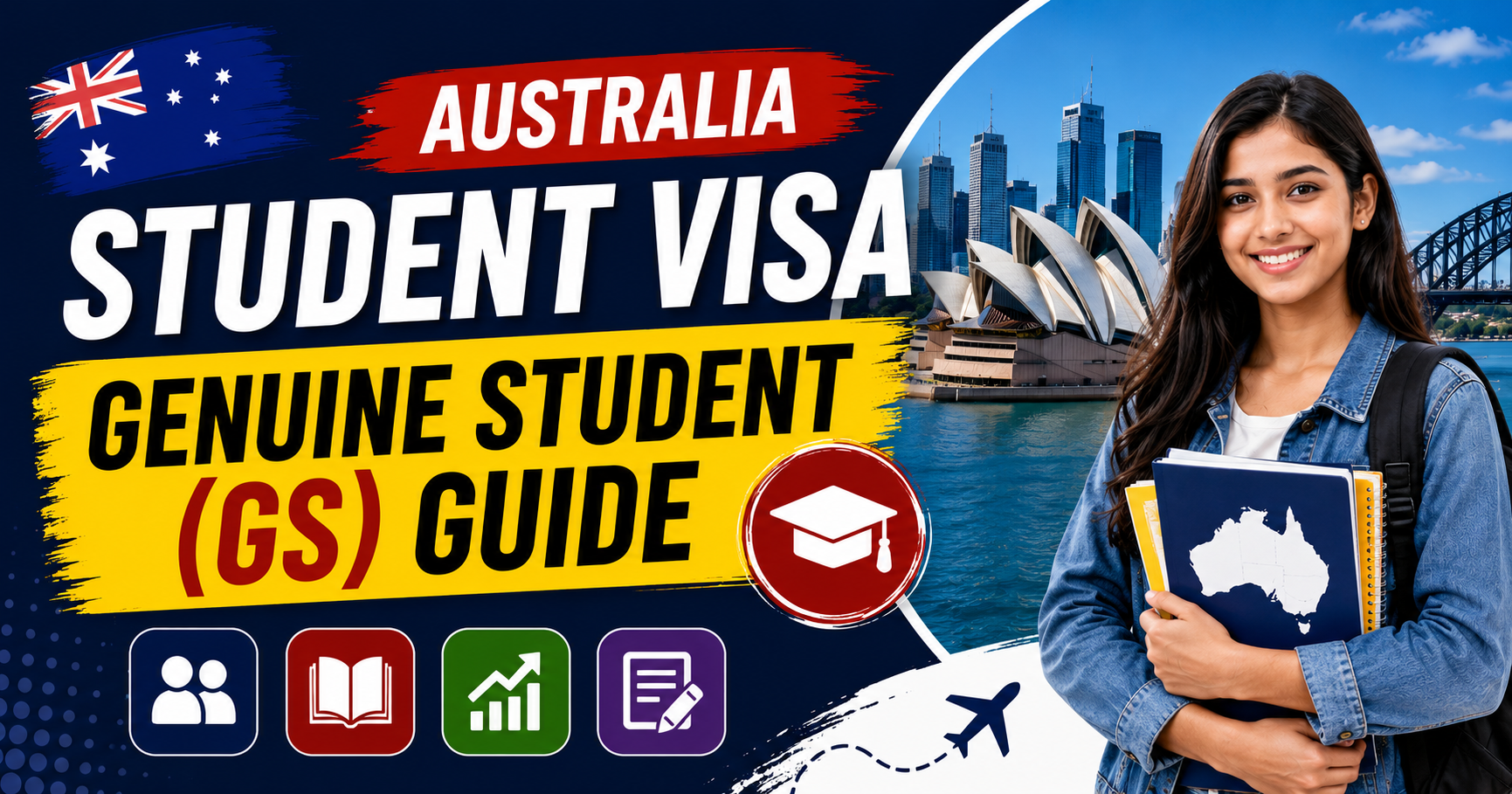

If you are searching for how to write a GS statement for an Australia student visa, start with one correction that saves a lot of wasted effort: there is no GS statement any more, at least not in the way most agents still describe it.
The Department of Home Affairs prefers you to answer the Genuine Student questions inside the online application form rather than attach a separate document. There is a limit of about 150 words per response, and all responses must be in English.
That single fact changes everything about how you should approach this. You are not writing a two-page essay. You are answering four short questions, and what actually carries the weight is the evidence you attach alongside them. The Department states directly that it gives more weight to statements supported by evidence.
This guide walks through how to write a GS statement the way the Department now expects it, question by question: what it is really asking, what to put in 150 words, what evidence to attach, and the mistakes that turn a decent answer into a weak one.
First, the rule that changed
The Genuine Student (GS) requirement applies to student visa applications lodged on or after 23 March 2024. Before that date, applications were assessed under the Genuine Temporary Entrant (GTE) requirement.
This is not a rename. The two ask different questions.
GTE was built around whether you intended to stay temporarily, which is why so much old advice tells you to write “I will definitely return to India immediately after my course.”
GS does not ask that. The Department states that the GS requirement recognises that genuine students may develop skills Australia needs and may later choose to apply for permanent residence, and that future intentions of this kind do not count against an applicant.
So if your consultant is still drafting a return-home declaration, they are answering a question that was retired in March 2024. What GS actually assesses is whether study is genuinely your primary purpose, and whether your course, provider and country choices make sense for someone with your background.
The four questions your GS statement has to answer
The online form asks you to:
- Give details of your current circumstances, including ties to family, community, employment and economic circumstances
- Explain why you wish to study this course in Australia with this particular education provider, including your understanding of the course requirements and of studying and living in Australia
- Explain how completing the course will benefit you
- Give any other relevant information you would like to include
There is an additional question for applicants who have held a student visa before, or who are applying in Australia from a non-student visa.
Four answers. Roughly 150 words each. That is around 600 words in total to make your entire case, which is why every sentence has to earn its place and why the attachments matter more than the prose.
Question 1: Your current circumstances
What it is really asking
This is where the officer builds a picture of your life as it stands. Home Affairs considers the nature of your personal ties to your home country, your economic circumstances, and where relevant, military service commitments or political and civil unrest.
Most applications get this backwards. They describe the Australian future in detail and leave the present almost blank. The officer is being asked to assess circumstances they cannot see.
What to put in 150 words
- Who is in your immediate family, what they do, and where they live
- What you are doing right now: studying, working, running or helping run a business
- Your family’s economic position in concrete terms, not adjectives
- Any dependants or responsibilities that are genuinely yours
- Property, land or business assets held by you or your family
What evidence to attach
This is the part that decides the answer.
- Business registration and GST returns if there is a family business, plus a letter setting out your role in it
- Employment records, and the name and contact details of someone who can confirm your position
- Income tax returns for whoever supports you
- Property or agricultural land documents: jamabandi, registry, mutation records
- Bank statements showing history, not a single-day balance
Common mistakes
Writing “my family has strong ties in India and a well-established business” and attaching nothing. That sentence is unverifiable, so it carries almost no weight.
The other frequent error is listing emotional ties only. Parents and siblings are relevant, but Home Affairs specifically mentions economic circumstances. A family you love is not the same as an economic position you are connected to.
A worked example
Weak: “I have very strong family ties in India. My parents are dependent on me and I have many relatives here. Our family is financially stable and well settled.”
Stronger: “I live in Jalandhar with my parents and younger sister. My father runs Sharma Traders, a wholesale distribution firm registered since 2009, and I have worked there part-time since 2022 handling inventory. Our family holds 4 acres of agricultural land in the same district. I have attached the firm’s registration, GST returns for three years, my father’s tax assessments and the land records.”
The second version is not better writing. It is the same length, but every claim in it has a document behind it.
Question 2: Why this course, this provider, and Australia
What it is really asking
Three things at once. Home Affairs assesses your level of knowledge of the proposed course, the education provider and living in Australia, and how much research you have actually undertaken. It also considers your reasons for not studying in your home country if a similar course is available there.
That last part is not optional, and it is the piece most applications skip entirely.
What to put in 150 words
- The specific units, majors or specialisation, named
- Why this provider rather than another one you considered
- The campus location and what you know about living there, including realistic costs
- Why the equivalent Indian qualification does not meet your need
What evidence to attach
- Course outline or curriculum page showing the units you mentioned
- Provider accreditation and CRICOS registration
- Any research you did comparing providers
- Cost of living information for the city you will be in
Common mistakes
Generic praise. “Australia has world-class education, a multicultural environment and globally recognised degrees” appears in a very large share of applications, and it tells the officer nothing about you. If your answer could be pasted into another student’s application without changing a single fact, it is a weak answer.
Skipping the India comparison. Silence here reads as an answer you did not want to give.
Naming a provider you cannot describe. If you cannot say which campus, which units, or what the course actually contains, the natural inference is that someone else chose it for you.
A worked example
Weak: “Australia is known for its world-class education system and multicultural society. The University has a great reputation and offers quality education which will help me gain international exposure.”
Stronger: “I chose the Master of Data Science at the Camperdown campus because the machine learning and statistical modelling units cover the analytics work I currently do manually in my father’s distribution business. The Indian equivalents I looked at are two-year programmes without the industry placement component. I compared this course with two other providers and chose this one for the placement and its CRICOS-registered specialisation. I have budgeted approximately AUD 420 per week for accommodation in that area.”
Question 3: How the course will benefit you
What it is really asking
Home Affairs considers whether the course is consistent with your current level of education, whether it will help you obtain employment or improve your employment prospects, whether it is relevant to your past or intended future employment, and the salary and other benefits the qualification would realistically bring.
Notice that last item. Expected salary is something the Department actively weighs, which means an inflated figure is not harmless optimism. It damages your credibility across the whole application.
What to put in 150 words
- The specific role or roles this qualification opens
- How it builds on what you already have, whether that is a degree or work experience
- A realistic salary range, with a source
- Where you intend to apply it, and why that makes sense
What evidence to attach
- Published salary information for that role and location
- A conditional employment offer, if one genuinely exists
- Industry or professional body information supporting your claim
- Evidence of your existing experience in the field, if any
Common mistakes
Stopping at “better career opportunities”. It is the single most common answer to this question and it gives the officer nothing to assess.
Claiming a senior salary straight after a diploma. That is not ambition, it is implausibility, and once one number looks inflated the rest of the file gets read more sceptically.
Going backwards without explaining it. A postgraduate applying for a diploma, or a B.Tech graduate applying for an unrelated certificate, has to address the drop directly. Silence makes it worse.
A worked example
Weak: “This course will improve my career prospects and help me get a good job with a high salary in the future.”
Stronger: “This qualification is the standard entry requirement for supply chain analyst roles, which is the function I already support informally at my father’s firm. Entry-level roles in this field in Punjab and Delhi advertise in the range I have referenced in the attached industry report. Combined with my B.Com and three years in the business, it gives me the technical layer I currently lack.”
Question 4: Any other relevant information
What it is really asking
This is not filler. It is where you address the thing an officer would otherwise have to guess about.
If there is a weakness in your profile, this is where it gets explained on your terms rather than inferred on theirs.
What belongs here
- A study gap, with documents for what you were doing
- A change of course or provider, and why
- A previous visa refusal from any country, declared and explained
- Modest academic results, with context if there is genuine context
- A career change, and the reasoning behind it
- Anything in your file that looks odd until it is explained
Common mistakes
Leaving it blank when you have an obvious gap. An unexplained three-year gap is a question mark sitting in the middle of your timeline, and the officer will fill it in themselves.
Explaining a refusal inaccurately or minimising it. If you were refused, state what the finding actually was and what has materially changed. A declared refusal can be explained. A discovered one is a much bigger problem, and non-disclosure can be treated as false or misleading information under PIC 4020, which generally carries a three-year exclusion period.
Using the space for more praise of Australia. You have already used your other three answers. This one is for substance.
The evidence checklist
The Department encourages applicants to provide evidence and information about the following. Work through it before you submit.
- Previous study: academic transcripts, provider names, length of study, certificates of attainment
- Previous study in Australia: a complete study record, reasons for any change of course or provider, course progress, and any study gaps of more than two months during an academic year
- Current employment: employer name and address, period of employment, position held, and the name and contact details of someone who can confirm it
- Circumstances at home: the nature of your family, community and employment ties, and your reasons for not studying at home if a similar course is available
- Economic circumstances: documents showing employment or business activity for the 12 months before lodging, income tax returns or bank statements, and any post-study employment offer including salary and benefits
If political or civil unrest, or military service commitments, would give you a significant incentive to leave your country, the Department asks for reasons and supporting evidence on that too.
Seven mistakes that weaken almost any GS statement
1. Writing a return-home declaration. “I will definitely come back to India” answers the old GTE test. Under GS, a future intention to apply for permanent residence does not count against you.
2. Letting the agent write it. Where one office submits many applications with near-identical wording, the pattern becomes visible. Officers read hundreds of these.
3. Attaching a separate GS statement anyway. The Department prefers responses inside the form. A long attached essay does not replace what the form asks for.
4. Claims with no documents. With 150 words per answer, the attachments are where your case is actually made. An unevidenced claim is close to no claim.
5. Contradicting yourself. Your form, your answers, your financial documents and your agent’s paperwork all need to say the same thing. Officers cross-check, and contradiction reads as unreliability.
6. Writing in English that is not yours. If your answers read like polished consultancy prose but your English test tells a different story, that gap is visible.
7. Ignoring the word limit. Roughly 150 words per response. Trying to cram everything in produces a dense block that says less, not more.
Frequently asked questions
Is a separate GS statement still required in 2026?
Not as a separate document in the way it used to be. The Department prefers you to answer the Genuine Student questions inside the online application form, with a limit of about 150 words per response, in English. Supporting documents are attached separately in ImmiAccount.
How long should each GS answer be?
Around 150 words per response. That is the limit set in the form. Use the space for facts specific to you, and let the attachments carry the proof.
Can I still say I will return to India after my course?
You can, but it is no longer what the requirement asks. Home Affairs states that GS recognises genuine students may later choose to apply for permanent residence and that such future intentions do not count against an applicant. What matters is that study is genuinely your primary purpose.
Should I write my GS answers myself or let my consultant do it?
The facts have to be yours and the English should be recognisably yours. A good consultant helps you identify what evidence is missing and where your reasoning has gaps. A poor one hands you a template that fifty other students received.
What happens if my GS answers are weak but my funds are strong?
You can still be refused. Home Affairs considers your overall personal circumstances. Funds, a valid CoE and a good English score do not compensate for a Genuine Student story that does not hold together.
Do I need to mention a previous visa refusal in my GS answers?
You must declare every previous refusal, from any country and for any visa type, in your application. The fourth GS question is the natural place to explain it. Non-disclosure can be treated as false or misleading information under PIC 4020, which generally carries a three-year exclusion period.
Before you submit
Read all four answers together, in order, as if you were the officer seeing them for the first time. Then check that five things connect: your academic background, your course choice, your career plan, your funds and where they came from, and your circumstances at home.
If any one of those does not follow from the others, that is the gap an officer will find. Fix it before you lodge, not after a refusal.
If you have already been refused, our guides to reading your refusal letter and reapplying and the Genuine Student requirement cover what comes next.
Official sources
- Department of Home Affairs, Genuine Student requirement
- Department of Home Affairs, Student visa (subclass 500)
- Department of Home Affairs, Ministerial Direction No. 106
Verified against these sources in August 2026. Immigration requirements change; confirm the current position before you lodge.
Want your GS answers reviewed before you lodge?
We assess your profile, tell you which claims currently have no evidence behind them, and help you fix the gaps before submission rather than after a refusal. No consultant can guarantee a visa outcome, and we will not pretend otherwise. The decision belongs to the Department of Home Affairs.
Vinay Hari
Education & Immigration Consultant
Angels Immigration & Education Consultant
Phone: +91 95131 65527 | +91 73075 30886
Email: me@vinayhari.com
Head Office: 505, Sector 82, Mohali, Punjab 140308
Branch Office: BMC Chowk, Jalandhar, Punjab 144001