

Let’s ask the question most people in the Australian education industry would rather avoid: who broke Australian education in India?
Was it the agents chasing commissions? The colleges and universities chasing enrolment numbers? The students who stopped seeing education as education and started seeing it as a shortcut to migration? The government, for letting the system grow faster than it could police it?
The honest answer is that no single villain did this. A whole system of incentives — aggressive recruitment, weak quality control, migration expectations and poor advice — slowly wore down the trust Australia had spent decades building. And now Australia is trying to clean it up. This is the real story of Australian education in India, and what it means for the next student who applies.
Australia was once India’s most trusted destination
For years, Australia carried a serious reputation among Indian students. They came for real reasons: strong universities, globally recognised qualifications, good employment prospects, a multicultural society, practical hands-on education, and the chance to build a career after graduation.
India became one of Australia’s biggest international education markets. According to Australia’s Department of Education, 145,012 Indian students were commencing or continuing study in Australia in 2025, and since 2005 more than 450,000 Indian students had studied there and moved on by 2025.
This is not a small market. India matters enormously to Australian education. Which is exactly why what happened next matters. That long record of trust is the backdrop to everything happening to Australian education in India today.
The problem started when education got tied to migration
There is nothing wrong with a student hoping to build a career in Australia after graduation. That’s normal, and it’s healthy.
The trouble begins when the education decision becomes secondary to the migration goal. The questions changed. “What should I study?” became “Which course gets me PR?” “Which university is best for my career?” became “Which college gives me the easiest pathway?” “What skills does Australia actually need?” became “Which course gets me into the country?”
That shift quietly rewired the entire market for Australian education in India.
The agent incentive problem
We have to be honest about agents too.
Not every agent is a problem. Thousands of Australian education agents work professionally and genuinely help students. But the system built in an obvious conflict: when an agent is paid per enrolment, is he recommending the best course for the student, or the course that’s easiest to sell?
Australia itself has recognised that agent–provider relationships need tighter oversight. Recent government reforms specifically target agent transparency, commissions, provider–agent ownership links, and the integrity of recruitment. In January 2026, Australia introduced a ban on education-agent commissions for certain onshore student transfers (effective 31 March 2026) — because those transfers were being driven by financial incentives rather than the student’s interests.
That tells you something. The issue was never just “bad agents.” The incentive structure itself needed fixing.
Anti-Fraud Satire Series“If an agent ‘guarantees’ your PR, ask him to also guarantee tomorrow’s weather. Same odds, same honesty.”— Vinay Hari
But blaming agents alone would be lazy
Providers carry responsibility too. They choose which markets to recruit from, which agents to appoint, how aggressively to grow, which courses to offer, how they assess students, and how closely they monitor recruitment.
Australia’s own Department of Education says providers are responsible for working with reliable agents and recruiting genuine students. It has also warned about incomplete applications and fraudulent documents, especially in fast-growing markets. So when a provider keeps waving through questionable applications because the revenue is attractive, it can’t later pretend the whole problem belonged to the agent.
Then came the flood of low-quality VET recruitment
This is where the story gets more uncomfortable.
Vocational education and training (VET) became a big part of the international student market. VET itself is not the villain — Australia has excellent vocational education. The problem is what happens when a course is designed primarily around migration demand instead of learning.
A course can be perfectly legal and still be a terrible choice for a particular student. Someone can spend a serious amount of money on a qualification without ever understanding the career outcomes, the employment prospects, the further-study or registration requirements, the migration rules, or the risk that policy changes overnight.
Australia is now moving hard against providers and courses it sees as problematic. In May 2026, the government temporarily suspended new applications for CRICOS registrations and courses (covering private VET and English-language/ELICOS providers) to ASQA for one year — running 19 May 2026 to 19 May 2027 — citing integrity concerns: poor-quality and non-genuine new entrants, and concentrated growth in certain course areas. That is a major signal.
Anti-Fraud Satire Series“Fake bank statements don’t fool visa officers. They just fund your own refusal.”— Vinay Hari
Australia itself admits there was an integrity problem
This is the part that matters most.
Australia has introduced significant reforms to its international education system. The 2025 legislation tightened requirements around providers and agents. New VET providers — with some exceptions such as TAFEs — now generally have to show around two years of domestic delivery before they’re allowed to teach overseas students. The government strengthened the “fit and proper” test for providers and gave itself stronger powers to cancel courses.
The goal is clear: stop organisations from entering the market simply because international students are an attractive source of revenue or migration-linked demand.
The visa environment changed too
The government has been tightening student-visa integrity for years. The 2023 Migration Strategy called for higher English requirements, more scrutiny of high-risk providers, stronger visa-integrity measures, tougher provider requirements, restrictions on visa hopping, and changes to graduate-visa settings.
For an industry addicted to very high growth, that was always going to hurt. Australia has since shifted toward managed growth. Over the past year, student-visa lodgements fell more than 26% and commencements fell around 16%, according to the Australian Government. For India specifically, student-visa grants dropped from 50,516 in 2023–24 to 48,536 in 2024–25.
This isn’t the death of Australian education. It’s a correction.
The data behind Australian education in India
You do not have to take any of this on faith. The Australian Government’s own figures show how sharply the market has cooled — and where India sits in the picture. Here is the recent data on Australian education in India and the wider international student pipeline.
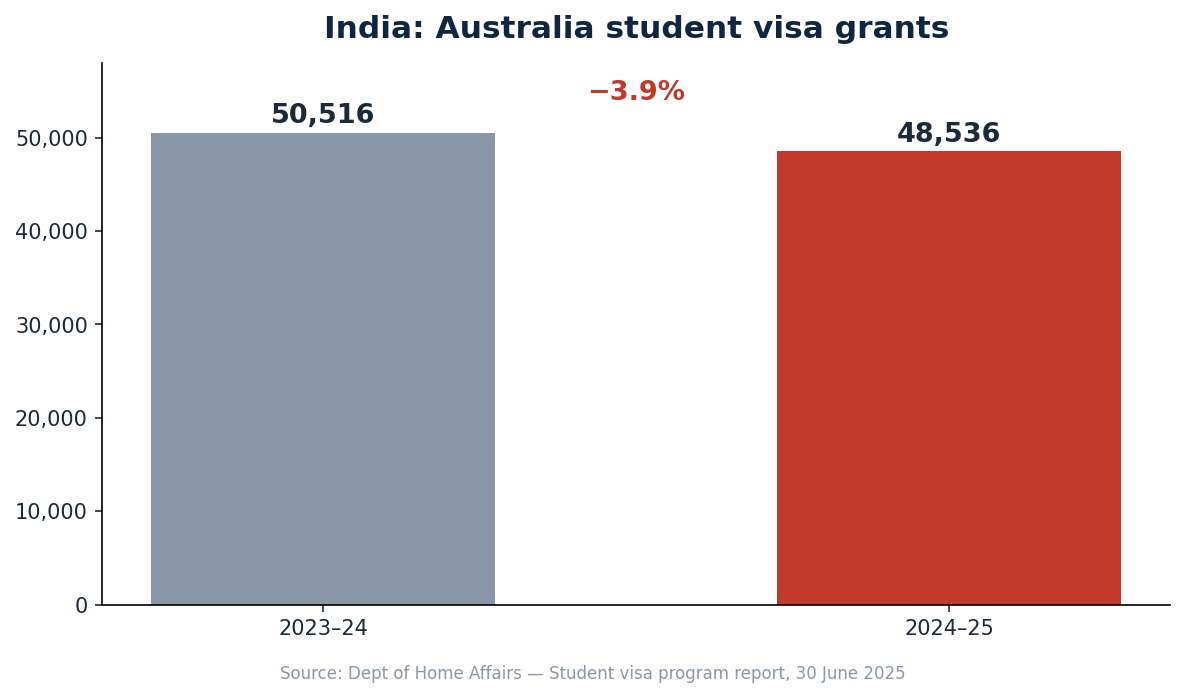
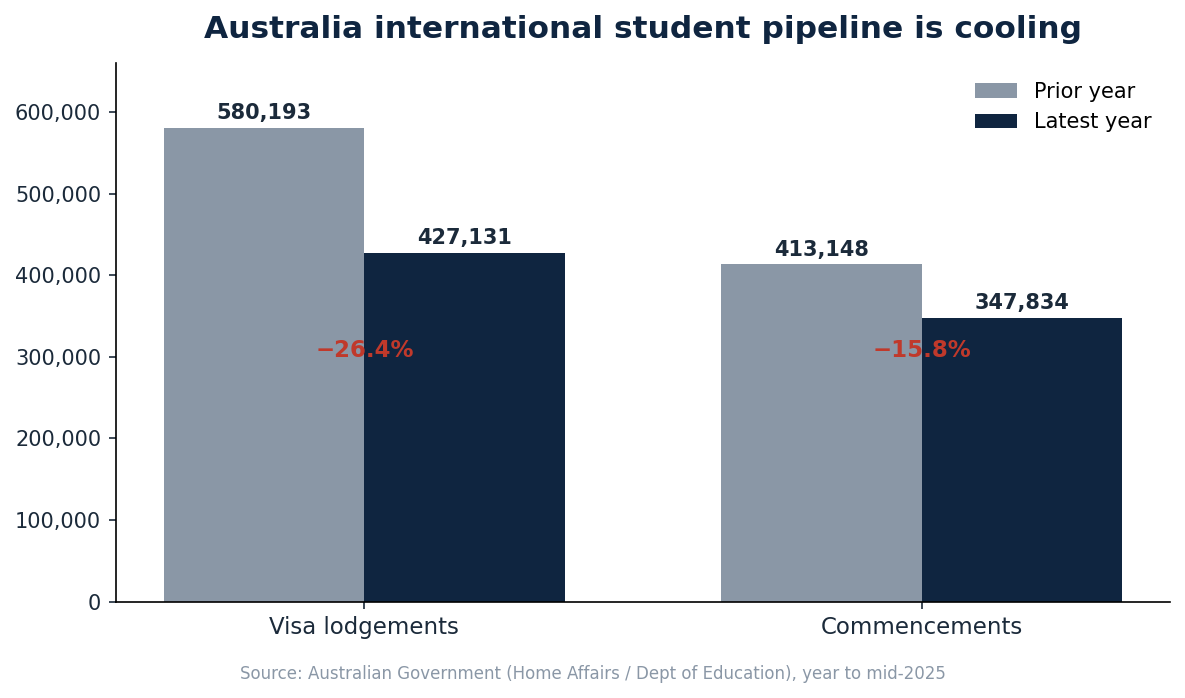
The table below summarises the key numbers behind Australian education in India.
| Metric | Earlier year | Latest year | Change |
|---|---|---|---|
| Indian students in Australia (2025) | 145,012 commencing or continuing | — | |
| India student visa grants | 50,516 (2023–24) | 48,536 (2024–25) | −3.9% |
| Total student visa lodgements | 580,193 | 427,131 | −26.4% |
| Total student commencements | 413,148 | 347,834 | −15.8% |
Sources on Australian education in India: Department of Home Affairs and Department of Education (figures to mid-2025).
For a short visual explainer on Australian education in India and why Australia moved to cap and tighten its international student intake, this news segment is a useful watch:
Students played a role too
Another uncomfortable truth: students can’t be blamed for everything, but demand shaped the market.
Many students were simply reacting to the information in front of them. But if thousands of students keep asking “Which course gives PR?”, the market will eventually produce people happy to sell that answer. If students say “I don’t care what I study, I just want to reach Australia,” someone will package exactly that.
The education decision drifted from Education + Skills + Career + Long-term value toward Visa + Job + PR + Part-time work. That’s a dangerous swap.
Social media made it bigger
YouTube, Instagram, Facebook and WhatsApp changed everything. One viral video reaches millions of students, and a complicated immigration policy gets flattened into “This course = PR.” A genuine possibility becomes “Guaranteed PR.” A hard pathway becomes “Easy Australia visa.” Repeat it a few hundred times and students start treating marketing as fact.
This is exactly where responsible consultants matter. No student should make a ₹10–20 lakh education decision off a 30-second reel.
Anti-Fraud Satire Series“The only thing ‘sirf $X mein PR’ guarantees is that someone else is getting rich off your dream.”— Vinay Hari
And then Australia started fighting back
Australia isn’t walking away from international education — or from Australian education in India — far from it. The government still describes it as an important contributor to the economy, communities and international relationships. But it wants a different model: smaller, more controlled, higher-integrity. Fewer questionable providers. Better student selection. More transparency around agents. More scrutiny of courses. A real focus on education outcomes, and harder consequences for anyone exploiting students or the migration system.
So who actually broke Australian education in India?
If you want an honest answer, stop hunting for one villain. There were several:
- Aggressive agents — pushing courses because they sold well, not because they fit.
- Poor-quality providers — expanding recruitment without protecting quality or student outcomes.
- Migration-driven marketing — education tied too tightly to PR promises.
- Students chasing shortcuts — prioritising getting in over choosing the right pathway.
- Regulatory gaps — rules that moved slower than the market.
- Social media misinformation — simplified, exaggerated claims spreading faster than the facts.
- The obsession with numbers — when enrolment counts matter more than outcomes, an education business starts behaving like a sales business. That’s where the real damage happened.
The biggest lesson for Indian students
Australia is still a serious destination. But 2026 is not 2019. The market for Australian education in India has changed.
Don’t choose Australia because someone says the visa is easy, promises PR, pushes a particular college, calls a course “hot,” or swears everyone gets a job. Ask the harder questions instead:
- What will I actually study?
- Why does this course make sense for my background?
- What career can I build after graduation?
- Is the provider genuinely reputable?
- What are the total costs?
- What are the current visa rules?
- What happens if migration policy changes?
- Is this decision still worth it if I never get PR?
That last one is the most important question you’ll ask. If the answer is yes, you’re choosing education. If the answer is no, you may just be buying a migration dream.
Australia doesn’t need fewer Indian students. It needs better decisions.
India remains one of Australia’s most important education markets, and the story of Australian education in India is far from over. The answer isn’t to shut the door — it’s to rebuild trust. Universities and colleges need to recruit students who genuinely benefit from their programs. Agents need to recommend courses based on student profiles, not commissions. Students need better information. And government needs regulation that protects both Australia’s reputation and the students themselves.
The current reforms are pointing that way. The government has said openly that the new measures are meant to make it harder for non-genuine providers and unscrupulous operators to work, while protecting the reputation of Australian international education.
Related reading
Before you commit money to Australian education in India, it helps to understand the full picture. See our guide to Australia’s student visa fee, the most common student visa refusal reasons and how to reapply, and your options for working abroad from India.
My conclusion
So who broke Australian education in India?
Not India. Not Indian students. Not even agents alone. The real problem was a system where education, migration, commissions, aggressive recruitment and commercial pressure got tangled together — and now the industry is paying for it.
The good news is that this correction can make Australian education in India better. The students who genuinely want to study, build skills and grow a career will still have opportunities. What’s ending is the era of selling Australia as “come here, study anything, work, get PR.”
Maybe that’s exactly what needed to happen. Because international education should start with education — not migration, not commissions, not shortcuts.
Education first. Career second. Migration, if it happens, comes later.

Frequently Asked Questions
Is Australian education in India still worth it in 2026?
Yes — for the right student. Australian education in India still opens real doors, and Australia still has strong universities and genuine career pathways. But the market has tightened, so the decision has to be built around a real course and career fit, not a PR promise.
Did Australia ban education agent commissions?
Australia introduced a ban on agent commissions for certain onshore student transfers, announced in January 2026 and effective from 31 March 2026. It targets “course-hopping” driven by incentives — it doesn’t stop students transferring or using agents for genuine advice.
Why did Australian student visa numbers fall?
Since the 2023 Migration Strategy, Australia has tightened English requirements, provider scrutiny and visa integrity, reshaping Australian education in India almost overnight. Over the past year, visa lodgements fell more than 26% and commencements around 16% as the country moved to managed growth.
Can I still get PR after studying in Australia?
Possibly, but it depends on your course, occupation, skills and the immigration rules at the time — which change. Never treat PR as guaranteed. Choose a course that’s worth it even if PR never happens.
Should I choose a VET course in Australia?
VET can be an excellent choice when it matches your background and career goal. Be cautious about courses marketed mainly as migration shortcuts, and check the provider’s reputation and the current rules before paying.
Official sources
- Department of Education — International students studying in Australia 2005–2025
- Department of Education — Ban on agent commissions for onshore transfers
- ASQA — Suspension on new CRICOS applications
- Department of Education — Migration Strategy
- Department of Home Affairs — Student visa program report at 30 June 2025