

Before you enrol in a skilled trade programme because a consultant, an agent or a thirty-second reel told you Canada is desperate for welders, do something simpler. Read the government’s own numbers on the Canada skilled trades shortage.
They are public, they are specific, and they say something more useful than any sales pitch. They also say something the sales pitch usually leaves out.
The number, and where it comes from
On 29 April 2026, alongside the Spring Economic Update, the Prime Minister’s Office published this: by 2033, Canada will need more than 1.4 million new trades workers to build homes, expand transit and develop energy infrastructure.
That is not a recruitment agency’s estimate. It is in the federal government’s own news release.
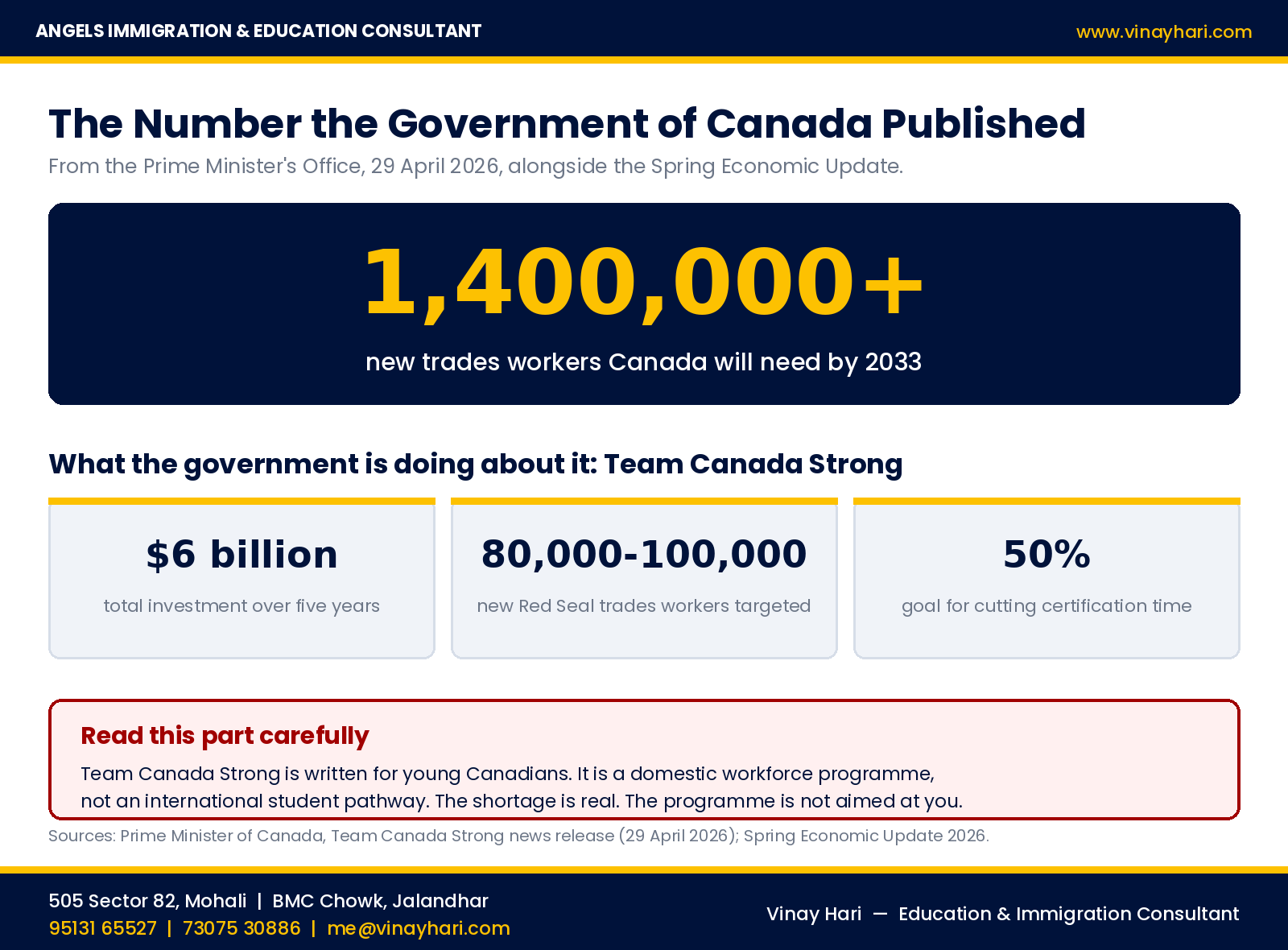
The same announcement launched Team Canada Strong — a $6 billion plan over five years to recruit, train and hire 80,000 to 100,000 new Red Seal trades workers, with a stated goal of cutting certification time by half.
Now read the part almost nobody quotes to students. The release describes Team Canada Strong as a plan for young Canadians. It is a domestic workforce programme. The shortage it responds to is real; the programme itself is not an international student pathway.
Both things are true at once, and holding both is the whole point of this article.
“A labour shortage tells you what Canada needs. It does not tell you that Canada has opened a door specifically for you.”
Vinay Hari · Education & Immigration Consultant
Why the shortage is structural, not a trend
Here is the number that explains everything else.
Canada’s Canadian Occupational Projection System projects 8.1 million job openings across the whole economy between 2024 and 2033. About 2.6 million come from economic growth. The other 5.5 million come from replacing workers who leave — and 4.3 million of those are retirements.
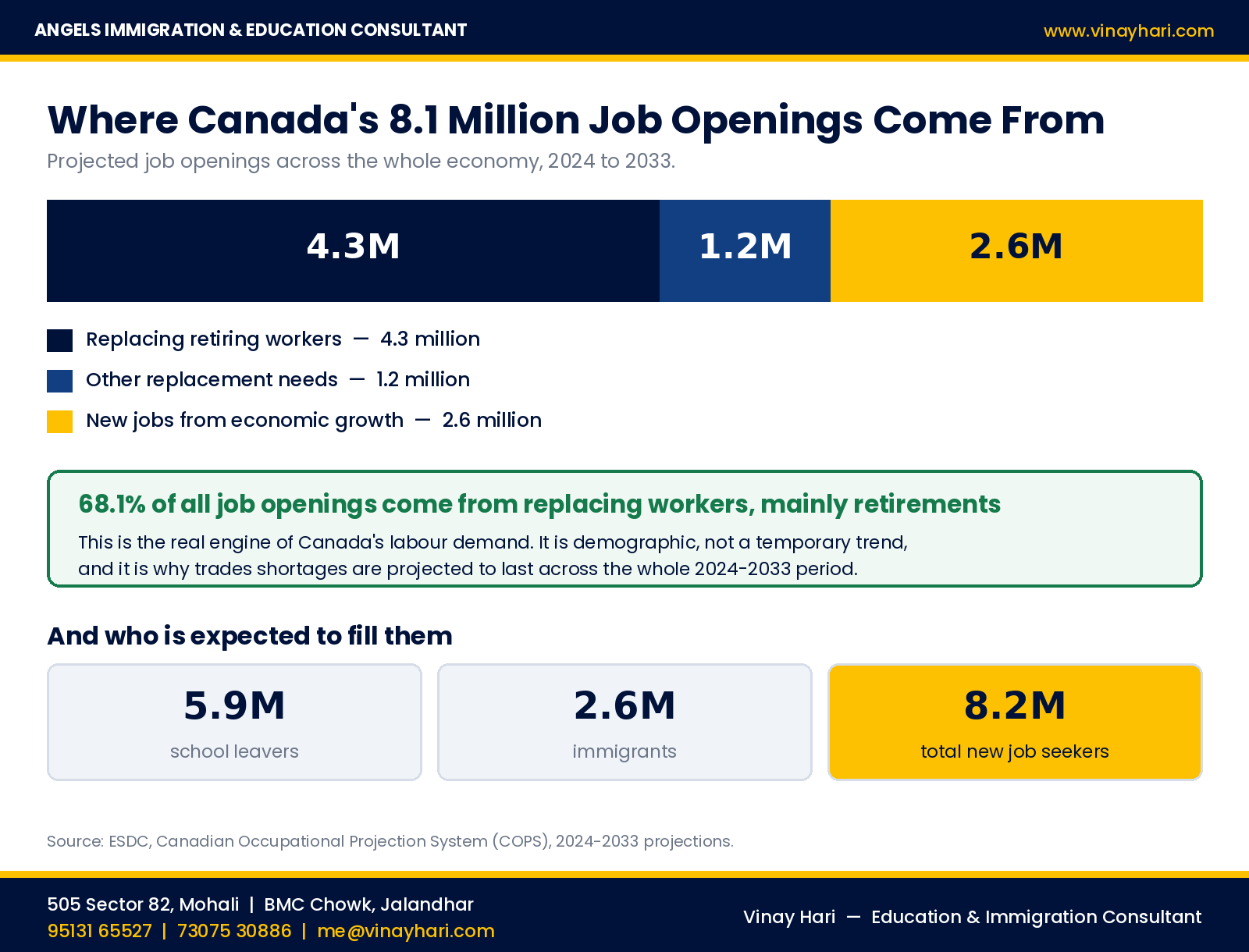
Retirements and other replacement needs account for 68.1% of every projected job opening in Canada.
That matters because a shortage driven by retirements does not switch off when the economy cools. The people leaving are leaving regardless. This is demography, and demography is slow, predictable and hard to reverse.
It also explains why trades appear so consistently in the shortage projections. The trades workforce skews older than the national average, and the work cannot be offshored — you cannot build a bridge in Vancouver from an office in another country.
On the supply side, the same projection expects 8.2 million new job seekers: about 5.9 million school leavers and about 2.6 million immigrants. So Canada is not short of people in aggregate. It is short of people with specific skills in specific places.
That distinction is the difference between a good course choice and an expensive one.
“Retirements do not cancel when the economy slows. That is why this is a decade-long fact, not a season.”
Vinay Hari · Education & Immigration Consultant
Construction alone: 410,000 openings
Employment and Social Development Canada put the construction figure plainly in a February 2026 news release:
By 2033 there will be more than 410,000 job openings for skilled trades in the construction sector alone, including 189,000 due to anticipated retirements.
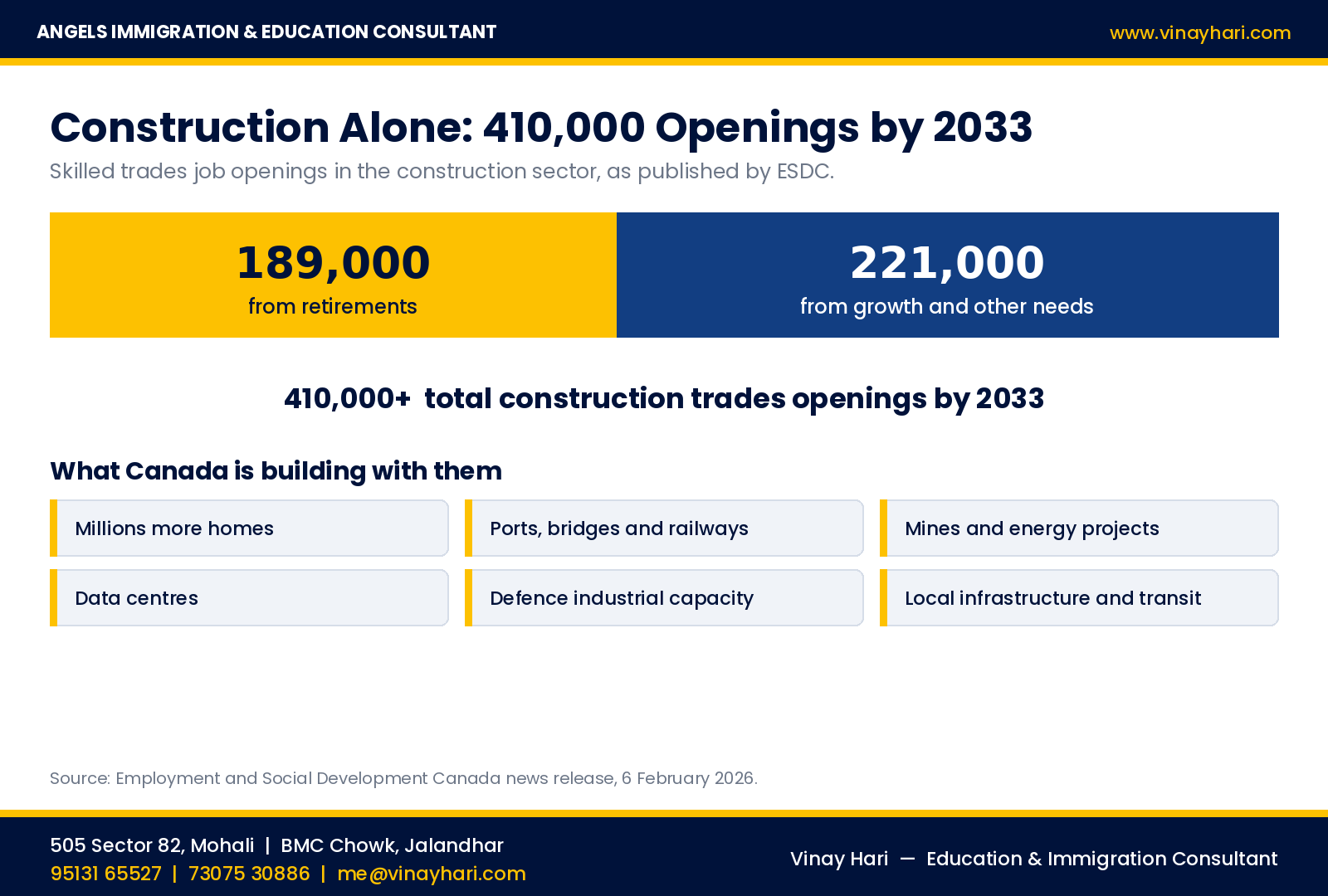
Nearly half of those openings exist simply because experienced people are stopping work.
The same release notes that Canada spends nearly $1 billion annually on apprenticeship support through loans, project funding, tax credits, deductions and Employment Insurance benefits. Since 2017, the Union Training and Innovation Program has supported over 145,000 participants, including 28,463 in 2024–25 alone.
A government does not spend at that level on a problem it considers temporary.
“Canada is not short of people. It is short of people who can do a specific job in a specific place. Be one of them.”
Vinay Hari · Education & Immigration Consultant
The list that should actually change your course choice
This is the section I would print and hand to every student who tells me they are choosing a programme because “everyone is doing it”.
The same COPS exercise that identifies shortage occupations also identifies surplus occupations — fields where projected job seekers outnumber projected openings. Both lists come from the same table, published by the same department, on the same day.
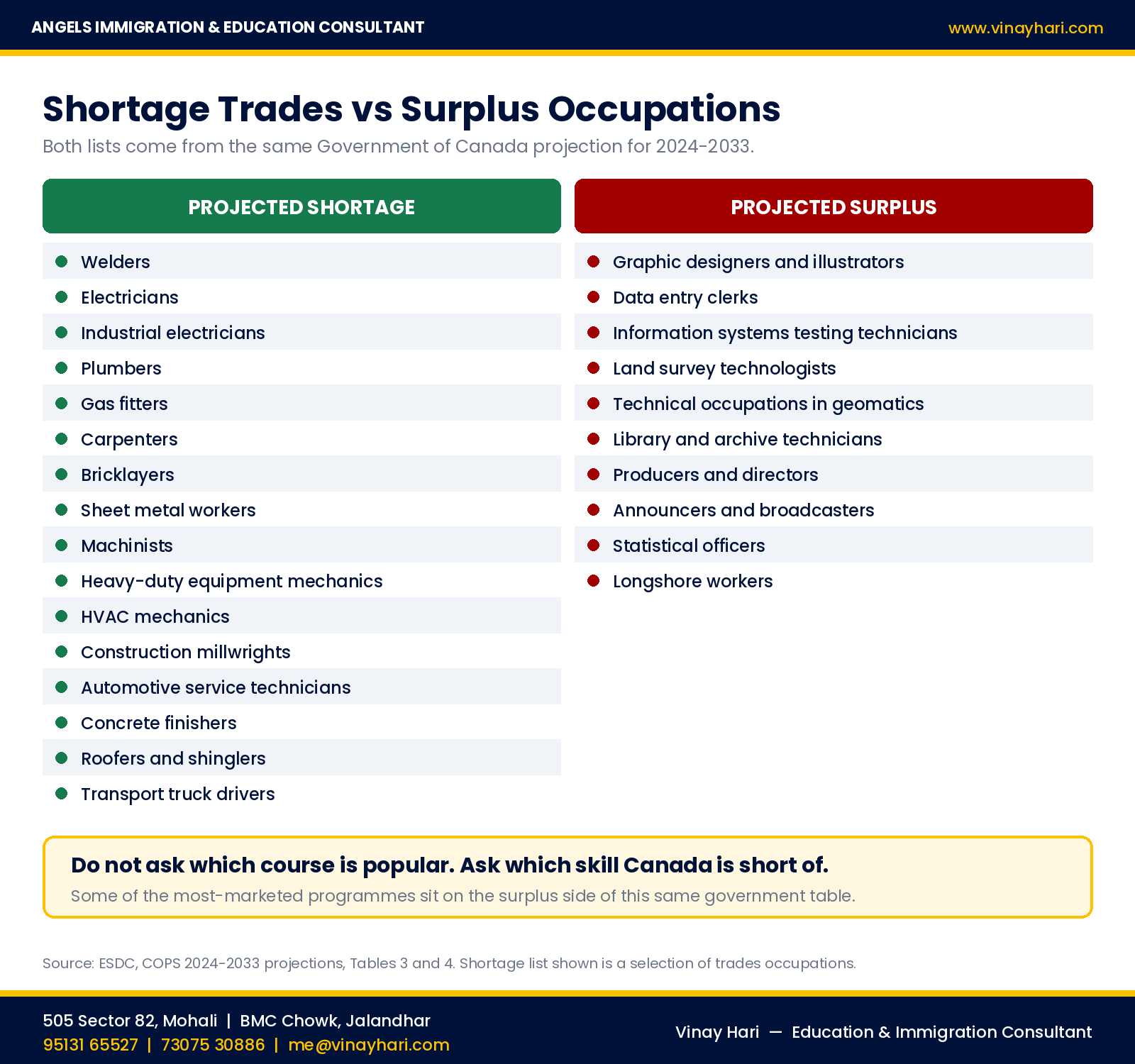
Look at the right-hand column carefully. Graphic design. Data entry. Information systems testing. Land survey technology. Geomatics. Library technicians. Broadcasting.
Several of those are heavily marketed to Indian students as safe, modern, employable choices. The Government of Canada’s own projection places them at risk of surplus through 2033.
Meanwhile welders, electricians, plumbers, carpenters, HVAC mechanics, heavy-duty equipment mechanics, machinists, millwrights, bricklayers, roofers and truck drivers sit on the shortage side.
“Don’t ask which course is popular. Ask which skill Canada is actually short of. The two lists are published side by side, and they are not the same list.”
Vinay Hari · Education & Immigration Consultant
The eight trade courses worth looking at
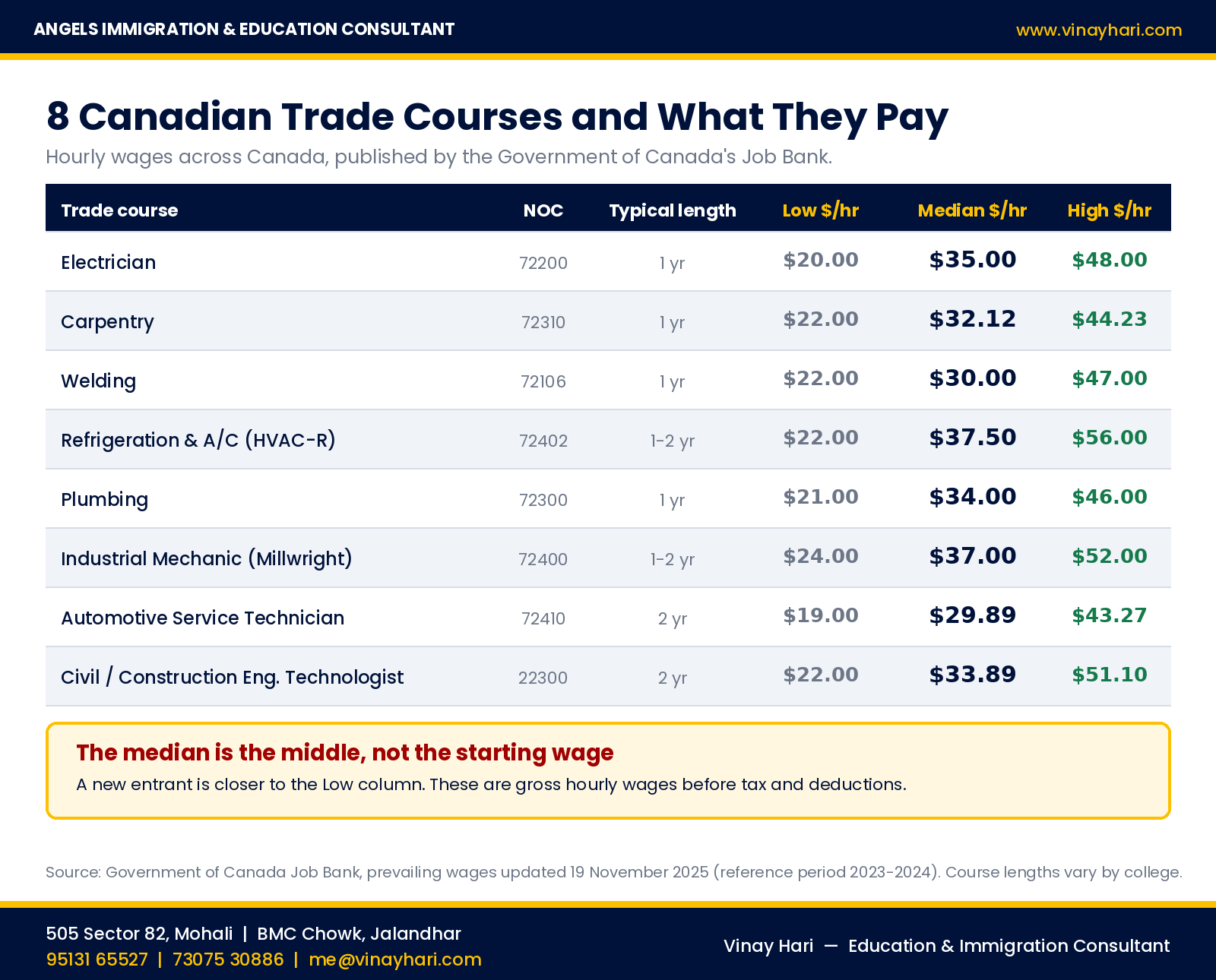
Here are eight programmes Canadian colleges run that map onto occupations on the shortage side of that table — with what the Government of Canada’s Job Bank says people in those occupations actually earn.
Prefer to hear this explained rather than read it? I walk through the same eight trade courses in Hindi in this video.
“A trade is not a backup plan for weak students. It is a licensed profession with an exam at the end of it.”
Vinay Hari · Education & Immigration Consultant
1. Electrician — NOC 72200. Typically a one-year college programme. Installation, maintenance and repair of electrical systems in homes, commercial buildings and industrial plants. Job Bank puts the national median at $35.00/hour, ranging from $20.00 at the low end to $48.00 at the high end. Suits ITI Electrician holders and anyone with real electrical site experience.
2. Carpentry — NOC 72310. Typically one year. Framing, formwork, finishing and renovation. Most Canadian housing is wood-frame construction, and the renovation market runs continuously alongside new builds. Median $32.12/hour, range $22.00 to $44.23. Suits students from carpentry, wood-working or general site-construction backgrounds.
3. Welding — NOC 72106. Typically one year. Used across construction, manufacturing, fabrication, shipbuilding, pipelines and mining. Median $30.00/hour, range $22.00 to $47.00. Wages vary sharply by region and sector — remote, mining and offshore work pays well above the median, which is exactly why the national figure understates what some welders earn and overstates what others do.
4. Refrigeration and air conditioning mechanic (HVAC-R) — NOC 72402. Typically one to two years. Heating, ventilation, air conditioning and refrigeration systems. In a country with both deep winters and increasingly hot summers, no building functions without these systems. This is the highest median on the list: $37.50/hour, range $22.00 to $56.00. Suits students who like machines, diagnostics and technical repair work.
5. Plumbing — NOC 72300. Typically one year. Water supply, drainage, gas fitting and fixture installation across residential and commercial buildings. Median $34.00/hour, range $21.00 to $46.00. Suits students with a plumbing or sanitary-works background.
6. Industrial mechanic (millwright) — NOC 72400. Typically one to two years. Installing, maintaining and repairing industrial machinery in manufacturing plants. In India this overlaps with fitter and machine-shop work. Median $37.00/hour, range $24.00 to $52.00 — and this occupation has the highest non-wage benefit coverage of the eight. Suits ITI Fitter holders and anyone from a plant or manufacturing environment.
7. Automotive service technician — NOC 72410. Typically two years. Diagnostics and repair for cars, trucks and buses, and increasingly electric-vehicle systems, which is where much of the new training demand sits. Median $29.89/hour, range $19.00 to $43.27. Suits diesel, petrol and EV mechanics with workshop experience.
8. Civil / construction engineering technologist — NOC 22300. Typically two years. The technical role between the site and the design office: surveying, estimating, quality control, project support. Median $33.89/hour, range $22.00 to $51.10. Suits civil engineering graduates and students from families in the building line who want a technical rather than a purely manual role.
Read those numbers correctly. The median is the middle of the range, not the starting point. Someone entering the trade with no Canadian experience sits closer to the Low column. All figures are gross hourly wages before tax and deductions, and Canadian living costs are considerably higher than Indian ones. Anyone converting these straight into monthly rupee figures is selling you something.
“The median is the middle, not the beginning. Anyone quoting you only the top number is selling, not counselling.”
Vinay Hari · Education & Immigration Consultant
What Canada is putting behind an apprentice
If you want to understand how seriously Canada is treating this, look at what an apprentice can now receive.
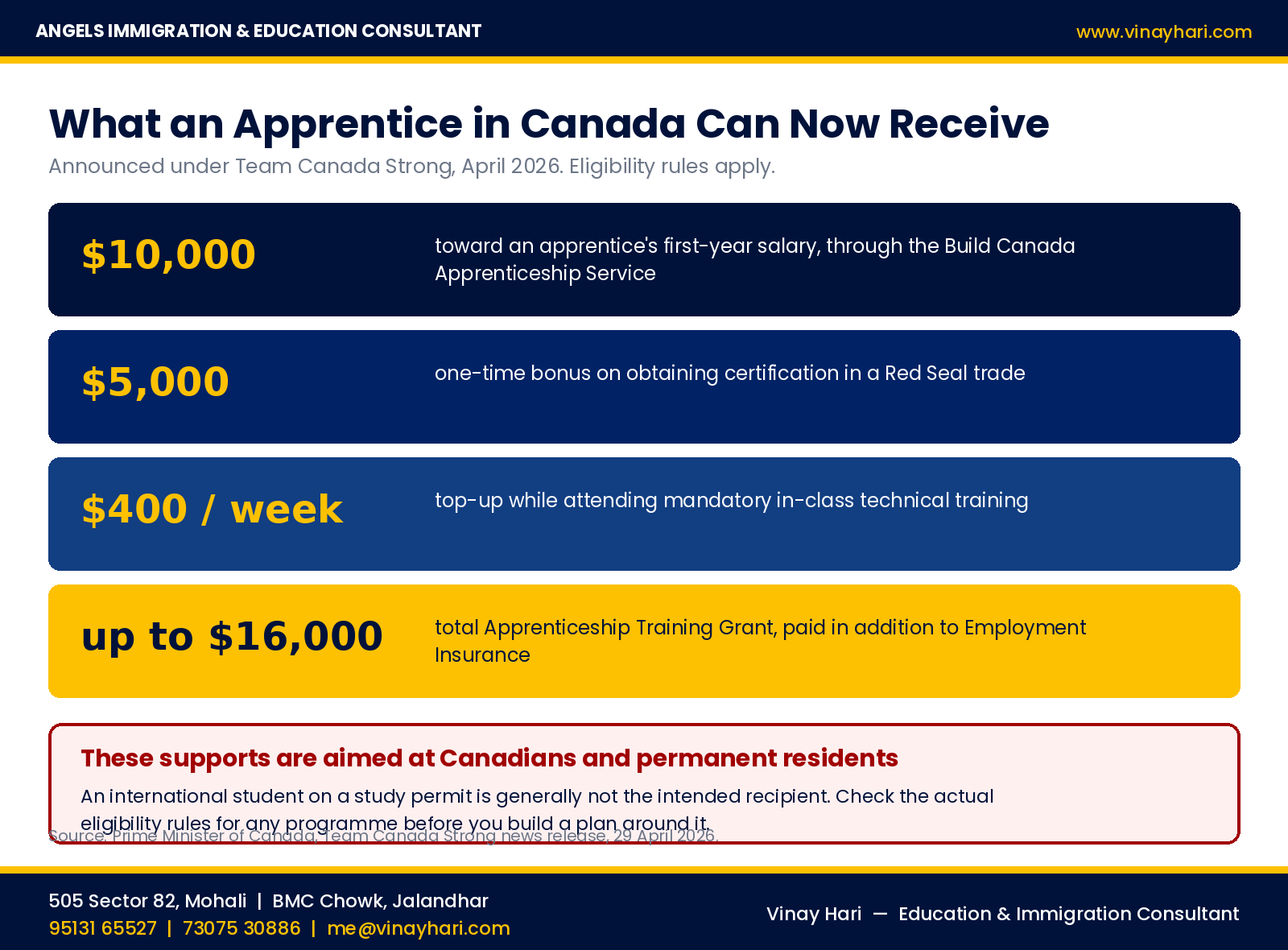
Up to $10,000 toward an apprentice’s first-year salary through the new Build Canada Apprenticeship Service. A $5,000 one-time bonus on obtaining Red Seal certification. A $400 weekly top-up during mandatory in-class technical training, paid on top of Employment Insurance, worth up to $16,000 per apprentice in total.
That is a serious amount of public money per person, and it tells you the value Canada places on a certified tradesperson.
It also tells you who the money is for. These supports are built around Canadians and permanent residents moving through the apprenticeship system. An international student on a study permit is generally not the intended recipient. Before anyone builds a plan around a figure like $16,000, check the actual eligibility rules for that specific programme.
“Read who a scheme was written for before you build your future on it.”
Vinay Hari · Education & Immigration Consultant
Now the part most articles skip
A labour shortage is an opportunity. It is not a promise, a pathway or a permit.
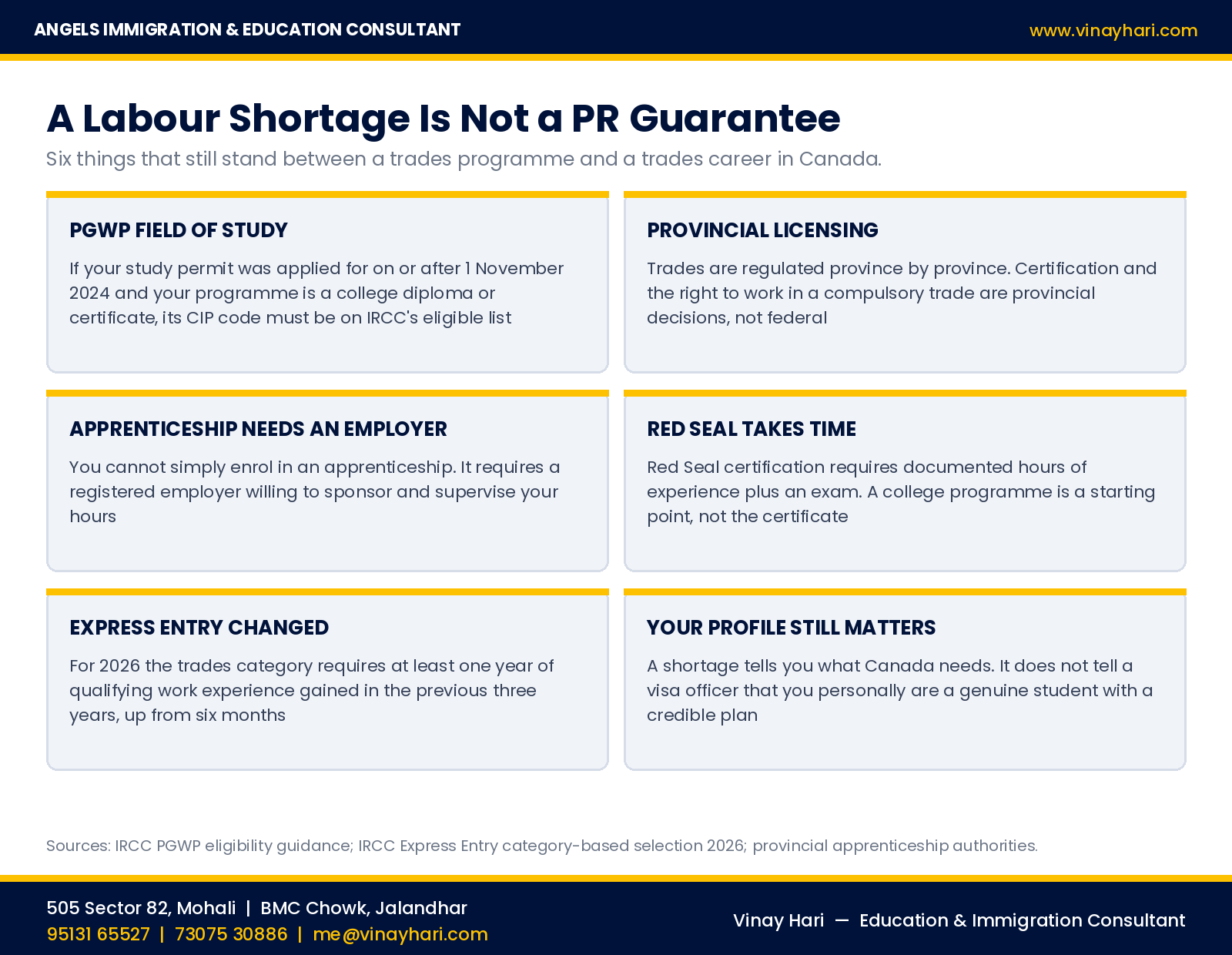
Six things still have to line up.
Your programme has to be PGWP-eligible. If you applied for your study permit on or after 1 November 2024 and your programme is a college diploma or certificate rather than a degree, its CIP code must appear on IRCC’s list of eligible fields of study. Trades sit among the priority categories on that list, which is genuinely good news — but “trades-sounding” is not the test. The specific CIP code is. IRCC announced on 15 January 2026 that the list is frozen for all of 2026, so what you check today should hold for this application cycle.
Trades are licensed provincially, not federally. Ontario, Alberta and British Columbia each run their own system. Some trades are compulsory, meaning you cannot legally work in them without certification. A federal shortage headline does not override a provincial licensing requirement.
An apprenticeship needs an employer. You do not enrol in an apprenticeship the way you enrol in a course. You need a registered employer willing to sponsor you, supervise your hours and sign off on your progress. Finding that employer is the real bottleneck, and it is not something a college admission solves for you.
Red Seal takes time. Certification requires thousands of documented hours plus an exam. A one or two-year college programme is a starting point on that road, not the destination. Anyone describing a diploma as “Red Seal” is describing it wrongly.
Express Entry moved the goalposts. For 2026, IRCC’s category-based selection still includes skilled trades, but the minimum qualifying work experience rose from six months to one year, earned within the previous three years. Cooks were removed from the trades category entirely.
Your own profile still has to hold up. A shortage tells a visa officer what Canada needs. It says nothing about whether you are a genuine student with a credible plan and provable funds. If your file is weak, the strength of the labour market will not carry it — and if it has already been refused once, our guide to what to do after a Canada study visa refusal explains how officers actually assess these applications.
“Labour demand is an opportunity, not a guarantee. Nobody — not a college, not a consultant, not a government press release — can promise you a job or permanent residence.”
Vinay Hari · Education & Immigration Consultant
Two numbers circulating online that I could not verify
Two figures appear constantly in trades content aimed at Indian students, and in fairness to you, I could not confirm either against a current Government of Canada source while writing this.
The first is a claimed shortfall of “more than 20,000 skilled trades workers every year”. The second is “700,000 skilled trades workers retiring between 2019 and 2028” — a figure that circulated widely several years ago and is now well past the projection base it came from.
I have left both out and used verified current figures instead: 4.3 million retirements economy-wide from 2024 to 2033, and 189,000 construction trades retirements by 2033. Those are on canada.ca today.
If someone quotes you a number, ask which department published it and when. It is a fair question and a good habit.
“Ask which department published the number and in which year. A figure without a source is an advertisement.”
Vinay Hari · Education & Immigration Consultant
Why this matters specifically for Indian students
Most Indian families still treat trades as what you do when you cannot do anything else. That assumption is costing students money.
Consider what a lot of Punjab and Haryana students already hold when they walk into my office:
An ITI in electrician trade with two years of site experience. An ITI welder who has actually welded. A diesel mechanic who has rebuilt engines. A fitter. A carpenter. Someone who has spent three years on construction sites and knows how a building goes up.
These students routinely abandon all of it to apply for a business management diploma, because business sounds respectable and the admission is easy.
Look at what that decision does to the application. The student now has to explain to a visa officer why a person with six years of hands-on electrical work is going to Canada to study retail management. There is often no good answer, because there is no good reason.
Whereas a relevant technical or trades programme lets the same student say something simple and true: this is what I already do, this is the certification level Canada uses, this is why I want to do it there.

“Your existing skill is not a limitation. For many students it is the strongest part of the application, and they throw it away because someone told them a diploma in business looks better.”
Vinay Hari · Education & Immigration Consultant
That is not a promise that a trades programme will be approved. Programme choice is one element of a study permit application among many — funds, ties, documentation and credibility all still apply. But a course that follows logically from what you have already done is a considerably easier thing to defend than one that does not.
Check these four things before you pay a fee
The same trade course at two different colleges can produce two completely different outcomes. This is where students lose money.
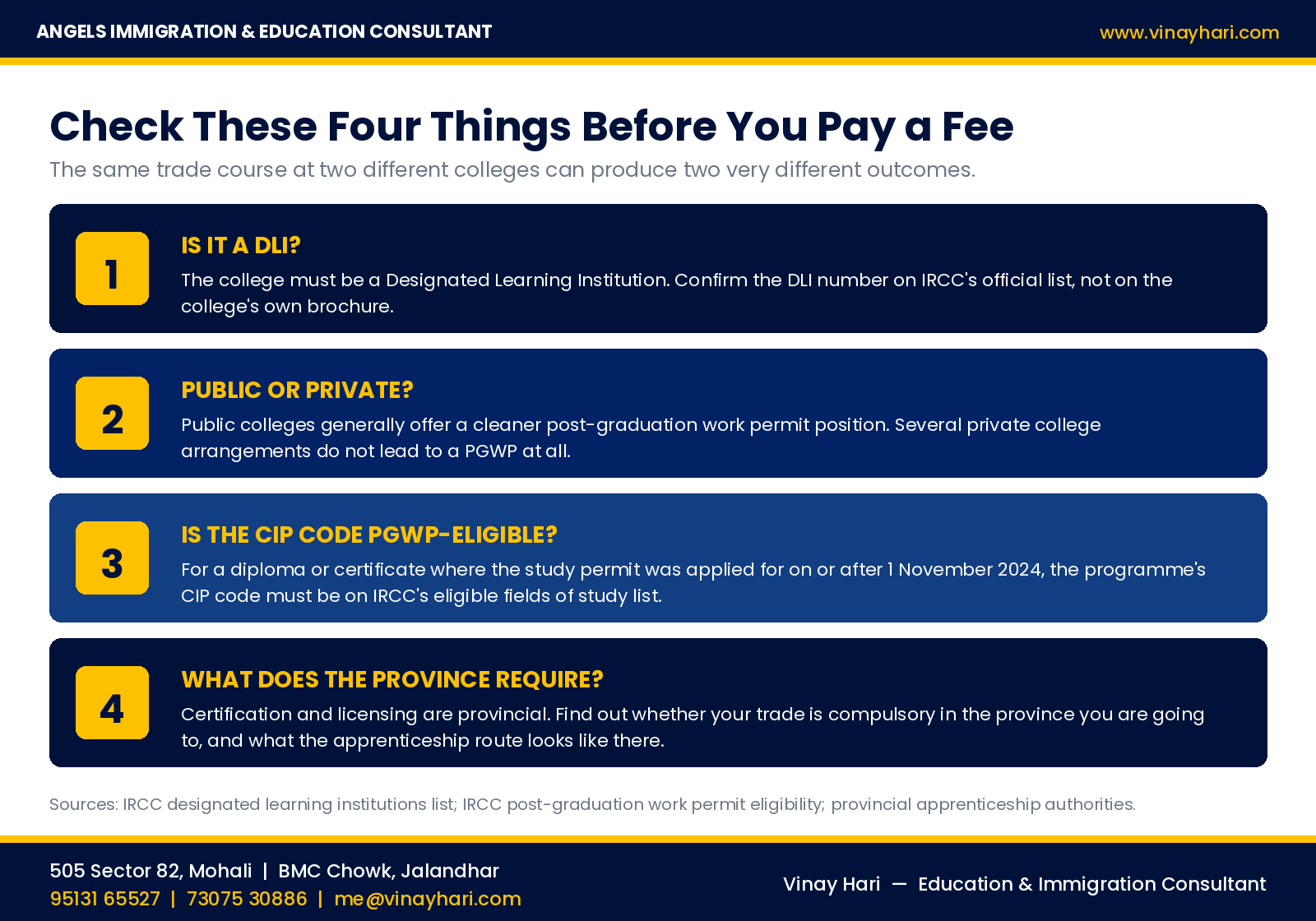
Is it a DLI? The college must be a Designated Learning Institution. Confirm the DLI number against IRCC’s official list — not against the college’s own brochure or an agent’s screenshot.
Public or private? Public colleges generally offer a cleaner post-graduation work permit position. Several private college arrangements do not lead to a PGWP at all, and students find this out after they have paid.
Is the CIP code PGWP-eligible? For a diploma or certificate where the study permit was applied for on or after 1 November 2024, the programme’s CIP code must appear on IRCC’s eligible fields of study list. Ask for the CIP code in writing.
What does the province require? Certification and licensing are provincial. Find out whether your trade is compulsory in the province you are heading to, and what the apprenticeship route actually looks like there.
Fees for these programmes vary widely by college and province, and colleges normally require a substantial payment before issuing the documents you need. Get the full figure — tuition, living costs, and the amount payable up front — in writing before you commit to anything.
“The college name matters less than three letters: DLI. Check it yourself, on the government list.”
Vinay Hari · Education & Immigration Consultant
Questions worth answering before you enrol
- Does this trade connect to something I have already studied or done?
- Is this specific programme, by CIP code, on IRCC’s PGWP-eligible list?
- Which province am I going to, and is this trade compulsory or voluntary there?
- What does the apprenticeship route look like in that province, and who employs apprentices in it?
- Can my family fund the full budget, not just the tuition?
- Do I actually want to do this work? A trade is physical, technical and demanding. It rewards people who like it and punishes people who chose it as a visa strategy.
If those answers hold up, skilled trades deserve a place on your shortlist alongside anything a university offers. If they do not, no shortage statistic will fix it.
“If you would not do this work in India for a good wage, do not do it in Canada for a visa.”
Vinay Hari · Education & Immigration Consultant
Frequently asked questions
Does Canada really need skilled trades workers?
Yes. The Government of Canada published a projected need for more than 1.4 million new trades workers by 2033, and Employment and Social Development Canada projects more than 410,000 construction trades openings by 2033, including 189,000 from retirements.
Which trades are projected to be in shortage in Canada?
The 2024–2033 COPS projections list welders, electricians, industrial electricians, plumbers, gas fitters, carpenters, bricklayers, sheet metal workers, machinists, heavy-duty equipment mechanics, HVAC mechanics, construction millwrights, automotive service technicians, concrete finishers, roofers and transport truck drivers, among others.
Can an ITI holder from India study a trade in Canada?
Often yes, subject to the institution’s admission requirements and the usual study permit assessment. Prior ITI training and work experience can strengthen the logic of the application, but each case is assessed on its full profile.
Will a trades diploma give me PR in Canada?
No programme gives PR. Express Entry’s category-based selection includes skilled trades for 2026, but it now requires at least one year of qualifying work experience earned in the previous three years, and selection remains at IRCC’s discretion.
Are trades programmes PGWP-eligible?
Trades is one of the priority fields on IRCC’s PGWP eligible fields of study list, which applies to non-degree programmes where the study permit was applied for on or after 1 November 2024. Eligibility depends on the specific CIP code of the programme, so verify the exact programme before paying anything.
Can international students do an apprenticeship in Canada?
Apprenticeship is provincially regulated and requires a registered sponsoring employer. It is not automatically available on the basis of a study permit. Check the rules of the specific province and trade.
What is Red Seal certification?
Red Seal is the interprovincial standard for designated trades in Canada. It requires documented hours of experience and a certification exam, and it allows a certified tradesperson to work in that trade across participating provinces.
Is Team Canada Strong open to international students?
The federal announcement describes it as a plan for young Canadians. Treat it as evidence of how seriously Canada takes the shortage, not as a programme you can apply to.
The honest summary
The Government of Canada’s own data says the country needs a new generation of people who can build, install, repair and maintain things. More than 1.4 million of them by 2033. More than 410,000 in construction alone. Retirements driving 68% of all job openings across the economy.
That is a real and durable signal about where Canada’s labour market is heading.
What it is not is a shortcut. The visa still has to be approved, the programme still has to be eligible, the province still has to license you, and the employer still has to hire you.
A trade is not a second-class education. It is a professional skill with a certification ladder, a licensing regime and real earning potential. For a student who genuinely enjoys practical, technical work — and especially for one who already has an ITI or site experience behind them — it may be one of the most sensible things to examine properly rather than dismiss.
“Skill has dignity. The tools change country. The respect for skill does not.”
Vinay Hari · Education & Immigration Consultant
“Don’t choose a course only because everyone else is choosing it. Choose a skill the country actually needs — then check, carefully, whether the pathway is open to you.”
Vinay Hari · Education & Immigration Consultant
Official sources
- Prime Minister of Canada — Team Canada Strong news release (29 April 2026)
- Spring Economic Update 2026
- ESDC — Improving access to training for skilled trades apprentices (6 February 2026)
- ESDC — Canadian Occupational Projection System, summary of results 2024–2033
- ESDC — Discover careers in the skilled trades
- ESDC — Canadian Apprenticeship Strategy
- IRCC — Post-graduation work permit eligibility
- IRCC — Express Entry category-based selection
If you want your profile assessed
If you hold an ITI certificate, a polytechnic diploma or real trade experience and you are not sure how it maps onto a Canadian programme, bring the documents in. We will look at what you already have, check whether a relevant programme is PGWP-eligible, and tell you honestly if we think the pathway does not work for your profile.
Vinay Hari — Angels Immigration & Education Consultant
505, Sector 82, Mohali | BMC Chowk, Jalandhar
95131 65527 | 73075 30886
me@vinayhari.com
Immigration decisions are made solely by IRCC and provincial authorities. We do not guarantee jobs, visas or permanent residence. Labour market projections change — verify on canada.ca before making a financial commitment.